



👋 Hey friend,
Today’s letter is a bit different.
It’s an aggregation of some ideas (non-obvious and not mainstream) on the topic of intelligence, in the words of influential founders/thinkers.
My inspiration for making this letter? I think there’s a common (yet mistaken) belief that intelligence can be measured in academic performance or “IQ tests”, but in this letter you’ll discover that this couldn’t be further from the truth. And, while intelligence matters, other traits matter even more.
If you’re in a hurry, here’s the quick version:
IQ tests don’t tell you anything about intelligence. It only works at low levels because any test would work there (you don’t need an IQ test for that).
Intelligence is multi-dimensional. There are a thousand ways to be smart!
Intelligence matters, but independent thinking, agency, and determination matters even more.
Now let’s get into the letter! I divided it into three parts:
(1) The IQ Test
(2) Intelligence in Real Life
(3) Intelligence for Entrepreneurship.

📊 The IQ Test
If you think the IQ test tells you anything about intelligence, think again!
The IQ Test is BS…
🟠 Nassim Nicholas Taleb (Writer, Co-founder of Universa Investments):
IQ doesn't measure “intelligence” because the test is made by idiots who don't know how intelligence works, & limit it to a narrow class of mental operations…
It works for low levels because ANY test would work there.Source: Tweet by Nassim Taleb
As Taleb says, the IQ Test limits intelligence to a narrow class of mental operations, but there are a thousand ways to be smart!
🟠 Jeff Bezos (Founder of Amazon):
There are a thousand ways to be smart, by the way. And when I go around and I meet people I'm always looking for the way that they're smart. And that's one of the things that makes the world so interesting and fun is that it is not like IQ is a single dimension. There are people who are smart in such unique ways.
Source: Jeff Bezos - Amazon and Blue Origin | Lex Fridman Podcast #405
And when Taleb says “the test is made by idiots who don’t know how intelligence works”, he’s talking about the academic psychologists who made the test…
🟠 Nassim Nicholas Taleb:
The “intelligence” in IQ is determined by academic psychologists (no geniuses)…
…
Psychometrics peddlers looking for suckers (military, large corporations) buying the “this is the best measure in psychology” argument when it is not even technically a measure — it explains at best between 2 and 13% of the performance in some tasks (those tasks that are similar to the test itself), minus the data massaging and statistical cherrypicking by psychologists; it doesn’t satisfy the monotonicity and transitivity required to have a measure (at best it is a concave measure). No measure that fails 80–95% of the time should be part of “science” (nor should psychology — owing to its sinister track record — be part of science (rather scientism), but that’s another discussion).
Source: IQ is largely a pseudoscientific swindle (Argument Closed)
There’s also a moral implication to these tests…
🟠 Nassim Nicholas Taleb:
[The IQ test] is at the bottom an immoral measure that, while not working, can put people (and, worse, groups) in boxes for the rest of their lives.
Source: IQ is largely a pseudoscientific swindle (Argument Closed)
🧠 Intelligence in Real Life
In the book The Black Swan, Nassim Taleb makes an excellent (and quite funny) comparison between two types of persons to illustrate how intelligence in real life actually looks like…
🟠 Nassim Nicholas Taleb:
I found the perfect non-Brooklyn in someone I will call Dr. John. He is a former engineer currently working as an actuary for an insurance company. He is thin, wiry, and wears glasses and a dark suit. He lives in New Jersey not far from Fat Tony but certainly they rarely run into each other. Tony never takes the train, and, actually, never commutes (he drives a Cadillac, and sometimes his wife’s Italian convertible, and jokes that he is more visible than the rest of the car).
Dr. John is a master of the schedule; he is as predictable as a clock. He quietly and efficiently reads the newspaper on the train to Manhattan, then neatly folds it for the lunchtime continuation. While Tony makes restaurant owners rich (they beam when they see him coming and exchange noisy hugs with him), John meticulously packs his sandwich every morning, fruit salad in a plastic container. As for his clothing, he also wears a suit that looks like it came from a Web catalog, except that it is quite likely that it actually did. Dr. John is a painstaking, reasoned, and gentle fellow. He takes his work seriously, so seriously that, unlike Tony, you can see a line in the sand between his working time and his leisure activities. He has a PhD in electrical engineering from the University of Texas at Austin. Since he knows both computers and statistics, he was hired by an insurance company to do computer simulations; he enjoys the business. Much of what he does consists of running computer programs for “risk management.”
I know that it is rare for Fat Tony and Dr. John to breathe the same air, let alone find themselves at the same bar, so consider this a pure thought exercise. I will ask each of them a question and compare their answers.
NNT (that is, me): Assume that a coin is fair, i.e., has an equal probability of coming up heads or tails when flipped. I flip it ninety-nine times and get heads each time. What are the odds of my getting tails on my next throw?
Dr. John: Trivial question. One half, of course, since you are assuming 50 percent odds for each and independence between draws.
NNT: What do you say, Tony?
Fat Tony: I’d say no more than 1 percent, of course.
NNT: Why so? I gave you the initial assumption of a fair coin, meaning that it was 50 percent either way.
Fat Tony: You are either full of crap or a pure sucker to buy that “50 pehcent” business. The coin gotta be loaded. It can’t be a fair game. (Translation: It is far more likely that your assumptions about the fairness are wrong than the coin delivering ninety-nine heads in ninety-nine throws.)
NNT: But Dr. John said 50 percent.
Fat Tony (whispering in my ear): I know these guys with the nerd examples from the bank days. They think way too slow. And they are too commoditized. You can take them for a ride.
Now, of the two of them, which would you favor for the position of mayor of New York City (or Ulan Bator, Mongolia)? Dr. John thinks entirely within the box, the box that was given to him; Fat Tony, almost entirely outside the box.
To set the terminology straight, what I call “a nerd” here doesn’t have to look sloppy, unaesthetic, and sallow, and wear glasses and a portable computer on his belt as if it were an ostensible weapon. A nerd is simply someone who thinks exceedingly inside the box.
Have you ever wondered why so many of these straight-A students end up going nowhere in life while someone who lagged behind is now getting the shekels, buying the diamonds, and getting his phone calls returned? Or even getting the Nobel Prize in a real discipline (say, medicine)? Some of this may have something to do with luck in outcomes, but there is this sterile and obscurantist quality that is often associated with classroom knowledge that may get in the way of understanding what’s going on in real life. In an IQ test, as well as in any academic setting (including sports), Dr. John would vastly outperform Fat Tony. But Fat Tony would outperform Dr. John in any other possible ecological, real-life situation. In fact, Tony, in spite of his lack of culture, has an enormous curiosity about the texture of reality, and his own erudition—to me, he is more scientific in the literal, though not in the social, sense than Dr. John.
Book: The Black Swan, by Nassim Nicholas Taleb.
And from Taleb’s Bed of Proscrustes:
“I suspect that IQ, SAT, and school grades are tests designed by nerds so they can get high scores in order to call each other intelligent.”
“Never hire an A student unless it is to take exams.”
You might wonder now: what’s the source of thinking outside the box? And the answer is: independent thinking…
🟠 Tim Urban (Creator of the blog Wait but Why):
People believe thinking outside the box takes intelligence and creativity, but it’s mostly about independence. When you simply ignore the box and build your reasoning from scratch, whether you’re brilliant or not, you end up with a unique conclusion—one that may or may not fall within the box. When you’re in a foreign country and you decide to ditch the guidebook and start wandering aimlessly and talking to people, unique things always end up happening.
When people hear about those things, they think of you as a pro traveler and a bold adventurer—when all you really did is ditch the guidebook. Likewise, when an artist or scientist or businessperson “chef” reasons independently instead of by analogy, and their puzzling happens to both A) turn out well and B) end up outside the box, people call it innovation and marvel at the chef’s ingenuity. When it turns out really well, all the “cooks” do what they do best—copy—and now it’s called a revolution.
Simply by refraining from reasoning by analogy, the chef opens up the possibility of making a huge splash with every project. When Steve Jobs and Apple turned their attention to phones, they didn’t start by saying, “Okay well people seem to like this kind of keyboard more than that kind, and everyone seems unhappy with the difficulty of hitting the numbers on their keyboards—so let’s get creative and make the best phone keyboard yet!” They simply asked, “What should a mobile device be?” and in their from-scratch reasoning, a physical keyboard didn’t end up as part of the plan at all. It didn’t take genius to come up with the design of the iPhone—it’s actually pretty logical—it just took the ability to not copy.
Book: The Elon Musk Blog Series: Wait But Why, by Tim Urban.
Let’s recap with a list of 6 points for why IQ tests are useless in real life…
🟠 Nassim Nicholas Taleb:
Real Life: In academia there is no difference between academia and the real world; in the real world there is.
1) When someone asks you a question in the real world, you focus first on “why is he/she asking me that?”, which shifts you to the environment (see Fat Tony vs Dr John in The Black Swan) and detracts you from the problem at hand. Philosophers have known about that problem forever. Only suckers don’t have that instinct. Further, take the sequence {1,2,3,4,x}. What should x be? Only someone who is clueless about induction would answer 5 as if it were the only answer (see Goodman’s problem in a philosophy textbook or ask your closest Fat Tony) [Note: We can also apply here Wittgenstein’s rule-following problem, which states that any of an infinite number of functions is compatible with any finite sequence. Source: Paul Bogossian]. Not only clueless, but obedient enough to want to think in a certain way.
2) Real life never never offers crisp questions with crisp answers (most questions don’t have answers; perhaps the worst problem with IQ is that it seem to select for people who don’t like to say “there is no answer, don’t waste time, find something else”.)
3) It takes a certain type of person to waste intelligent concentration on classroom/academic problems. These are lifeless bureaucrats who can muster sterile motivation. Some people can only focus on problems that are real, not fictional textbook ones (see the note below where I explain that I can only concentrate with real not fictional problems).
4) IQ doesn’t detect convexity of mistakes (by an argument similar to bias-variance you need to make a lot of small inconsequential mistake in order to avoid a large consequential one. See Antifragile and how any measure of “intelligence” w/o convexity is sterile edge.org/conversation/n…). To do well you must survive; survival requires some mental biases directing to some errors.
5) Fooled by Randomness: seeing shallow patterns in not a virtue — it leads to naive interventionism. Some psychologist wrote back to me: “IQ selects for pattern recognition, essential for functioning in modern society”. No. Not seeing patterns except when they are significant is a virtue in real life.
6) To do well in life you need depth and ability to select your own problems and to think independently. And one has to be a lunatic (or a psychologist) to believe that a standardized test will reveal independent thinking.
Source: IQ is largely a pseudoscientific swindle (Argument Closed)
🚀 Intelligence for Entrepreneurship
Beyond independent thinking… agency and determination are also traits that beat intelligence…
🟠 Andrej Karpathy (Co-founder of OpenAI):
Agency > Intelligence
I had this intuitively wrong for decades, I think due to a pervasive cultural veneration of intelligence, various entertainment/media, obsession with IQ etc.
Agency is significantly more powerful and significantly more scarce.
Are you hiring for agency?
Are we educating for agency?
Are you acting as if you had 10X agency?
Grok explanation is ~close:
“Agency, as a personality trait, refers to an individual’s capacity to take initiative, make decisions, and exert control over their actions and environment. It’s about being proactive rather than reactive—someone with high agency doesn’t just let life happen to them; they shape it. Think of it as a blend of self-efficacy, determination, and a sense of ownership over one’s path.
People with strong agency tend to set goals and pursue them with confidence, even in the face of obstacles. They’re the type to say, “I’ll figure it out,” and then actually do it. On the flip side, someone low in agency might feel more like a passenger in their own life, waiting for external forces—like luck, other people, or circumstances—to dictate what happens next.
It’s not quite the same as assertiveness or ambition, though it can overlap. Agency is quieter, more internal—it’s the belief that you *can* act, paired with the will to follow through. Psychologists often tie it to concepts like locus of control: high-agency folks lean toward an internal locus, feeling they steer their fate, while low-agency folks might lean external, seeing life as something that happens *to* them.”
Source: Tweet by Andrej Karpathy
🟠 Paul Graham (founder of YC):
It turns out is not that important to be smart. Is much much more important to be determined.
If you imagine this hypothetical person who’s like a hundred out of a hundred for smart, and a hundred out of a hundred for determination. And then you start taking away determination, it doesn’t take very long before you have this sort of ineffectual but brilliant person.
Whereas if you take someone who’s like super, super determined, and you start taking away smartness bit by bit, eventually you get to some guy who owns a lot of taxi medallions. But he’s still rich, right? Or like a trash hauling business or something like that.
[So] you can take away a lot of smart.
🟠 Estée Lauder:
What makes a successful businesswoman? Is it talent? Well, perhaps, although l’ve known many enormously successful people who were not gifted in any outstanding way, not blessed with particular talent. Is it, then, intelligence? Certainly, intelligence helps, but it’s not necessarily education or the kind of intellectual reasoning needed to graduate from the Wharton School of Business that are essential. How many of your grandfathers came here from one or another “old country” and made a mark in America without the language, money, or contacts? What, then, is the mystical ingredient?
It’s persistence. It’s that certain little spirit that compels you to stick it out just when you’re at your most tired. It’s that quality that forces you to persevere, find the route around the stone wall. It’s the immovable stubbornness that will not allow you to cave in when everyone says give up.
Book - Estée: A Success Story, by Estée Lauder.
🟠 Steve Jobs:
I’m convinced that about half of what separates the successful entrepreneurs from the non-successful ones is pure perseverance.
🟠Felix Dennis:
I believe that almost anyone of reasonable intelligence can become rich, given sufficient motivation and application.
Book - How to Get Rich, by Felix Dennis.
🟠 Marc Randolph (Co-founder of Netflix):
Everyone thinks success comes from being smart, but I’m living proof it doesn’t. What matters is being pathologically optimistic and having the guts to test ideas instead of just planning them in your head.
Source: Tweet by Marc Randolph
As Andrej Karpathy pointed out, there’s a “pervasive cultural veneration of intelligence.” And, beyond the fact that Agency is much more important, having this mindset of venerating intelligence is actually dangerous… because if you care about “looking smart” and being smarter than others, you’re not gonna get very far…
🟠 Naval Ravikant (Co-founder of AngelList):
The smartest people aren’t interested in appearing smart and don’t care what you think.
Source: Tweet by Naval Ravikant
🟠 Syed Balkhi:
Common trait I’ve noticed among my smart friends:
They’re not afraid of looking dumb over and over and over again.
Source: Tweet by Syed Balkhi

All the nuggets I’ve picked for the past 5 years are saved and classified in a searchable database, which (as of February 2026) contains over 5,000 timeless ideas (sourced directly from the most influential doers and entrepreneurs — captured on books, interviews/podcasts, tweets, and articles).
I call this database Doers Notebook.
🤔 Why did I build this?
Well, as the Latin motto goes, “A chief part of learning is simply knowing where you can find a thing.” And since it’s all 🔎 searchable, we only need to type a keyword to immediately get a list of insights related to it!
For instance, if I’m unsure about how to get more sales in my business, I can simply type the word “sales” and immediately get 126 insights relevant to sales! In this case from Jim Edwards, Peter Thiel, Naval Ravikant, Paul Graham, Sam Altman, Balaji Srinivasan, Nassim Taleb, and many other remarkable individuals.
It’s like having a second brain 🧠 from which we can pull wisdom on demand, to help us significantly decrease the error rate in our judgment and also get new perspectives on how to solve problems.
In an age of infinite leverage [code and media], judgment is the most important skill.
- Naval Ravikant
A change of perspective is worth 80 IQ points.
- Alan Kay
Plus, I built a feed (similar to X / Twitter) where you can read these nuggets whenever you have some time to kill (instead of scrolling Social Media).
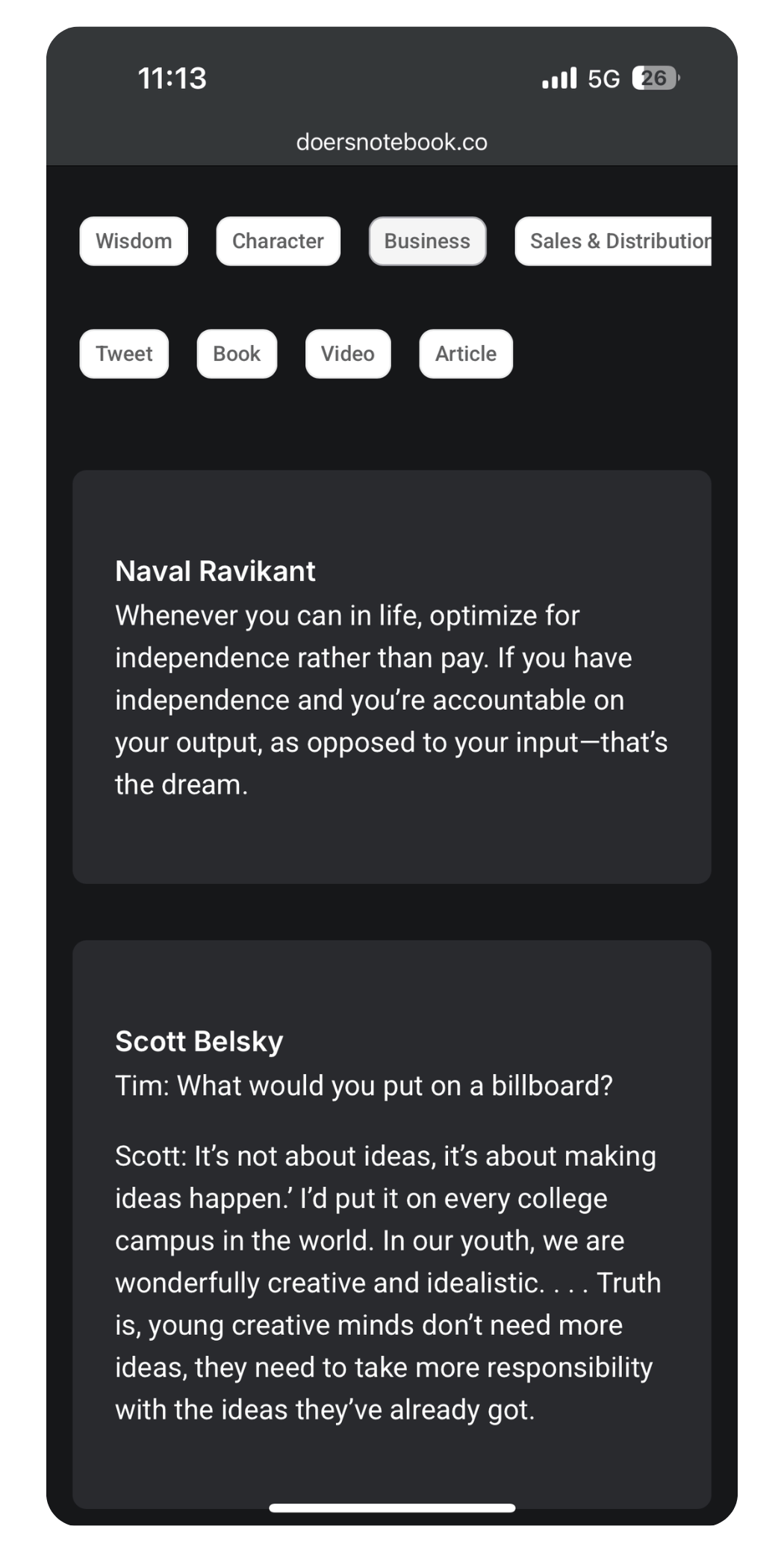
If you want to see Doers Notebook in action, I made a screen record!
You can also go directly to DoersNotebook.com
✍️ New Essay
I recently wrote an essay (with my friend Brian David Crane) exploring the topic of Perfection vs. Excellence.
It’s grounded in the ideas of Brian Chesky (co-founder of Airbnb), Matthew McConaughey, Brad Jacobs, John D. Rockefeller, and Isadore Sharp (founder of Four Seasons).
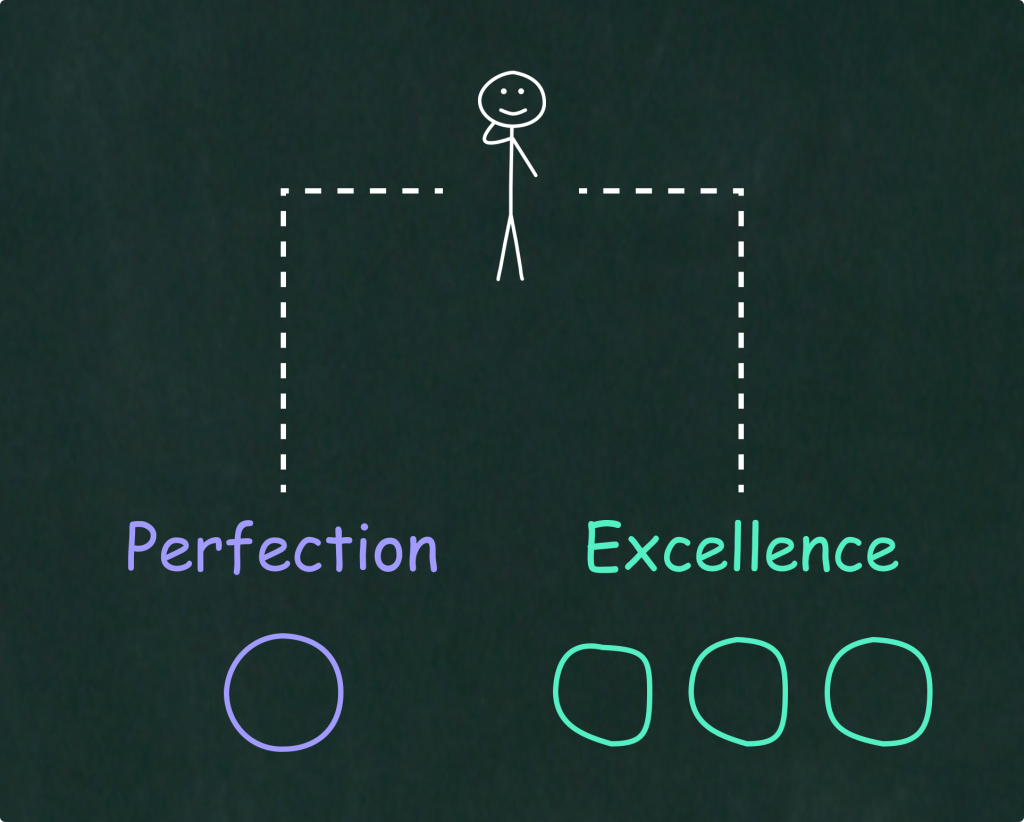
👉 If you are curious, click here to read the full piece (for free)
💥 Stuff I Loved


👉 Highlight resurfaced using Readwise


I hope you enjoyed today’s letter!
Talk you soon,
Your nuggets friend Julio :)