



👋 Hey friend,
Today’s letter is a bit different.
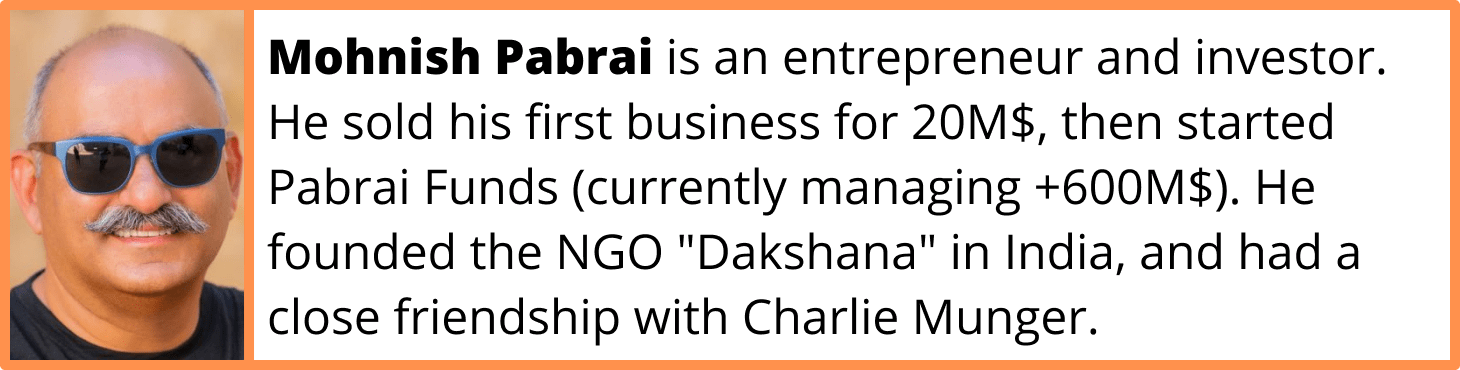
As you might know, I’m a fan of the renowned investor and entrepreneur Mohnish Pabrai. On a few recent speeches, he shared his favorite mental models for investing and starting a business. So I saved the list of mental models in a personal file, but it then occurred to me to share it with you!
And for each mental model, I made a short description using Chat-GPT and Gemini — they mostly nailed it (especially Gemini), and I made edits where it needed.
So here’s the full list of Mohnish’s mental models! (one for investing, and the other for starting a business).
PS: Next week, I’ll send out his list of mental models for life in general.
👤 Doers
💡Nugget
30 Mental Models for Investing
(There are two videos where he explains his mental models for investing: The talk at Heilbrunn Center for Graham and Dodd Investing, and The talk at The UNO).
The Bedrock
Take a simple idea and take it seriously. Mental models only work if you truly absorb them, not if you half-believe them. The edge comes when you see a truth most people casually ignore — and then build your investing behavior around it with full conviction.Ben Graham Fundamentals
(1) Mr. Market is there to serve you, not advise you; (2) always demand a margin of safety; and (3) buy stocks as if you were buying the whole business.Do Not Overdose on Ben Graham
Take the three Ben Graham fundamentals, but that’s it. Don’t take anything else from him. Instead, overdose on Philip Fisher and Charlie Munger to capture high-quality compounders.Buffett’s Lifetime 20-Punch Card
Imagine you only had 20 investment decisions for your entire life. You would become extremely selective, patient, and serious. This model reminds you that great ideas are rare, so don’t waste capital or attention on average opportunities.Stay in the Epicenter of Your Circle of Competence
Size does not matter; depth does. Like billionaire John Arrillaga, who only bought real estate within a one-mile radius of Stanford, you must remain an inch wide and a mile deep to maintain your edge.A High Error Rate is Guaranteed
Investing is an imperfect science. Even Buffett admits that only 12 great decisions drove 60 years of Berkshire’s success—a roughly 4% hit rate. Accept that you will frequently be wrong and size your bets accordingly.Circle the Wagons: The 4% Rule
Because of that 4% hit rate, you must ruthlessly protect your crown jewels. When you finally capture an exceptional business, put it in the center of the wagons and fiercely defend it against the urge to sell.Do Not Cut the Flowers and Water the Weeds
Never sell a compounding machine. Pabrai admits selling Ferrari and Goldman Sachs were massive errors. Great companies can compound for decades. Let your winners ride. Pulak Prasad’s mindset of being a “permanent owner” helps here.
Be a Shameless Cloner
There are no points for originality. Sift through 13F filings, Dataroma, or the Value Investors Club. If a brilliant capital allocator finds an exceptional business you understand, proudly copy their homework.History Does Not Repeat Itself, But It Does Rhyme
Markets change, but human behavior repeats: fear, bubbles, forced selling, and mispricing keep appearing in new places. Studying history helps you recognize when an unloved market today (e.g./ Turkey) resembles a past opportunity before others notice.Explain Your Thesis to a 10-Year-Old
If you cannot explain the investment in 3–4 simple sentences, you probably do not understand it well enough. A great thesis should be so simple that a 10-year old can understand it.You Always Need a Rope to Get Out of the Deepest Well
Every investor will face moments of despair when the portfolio collapses or the future looks dark. In those moments, you need a “rope”: an anchor that helps you hold on. For Pabrai, that rope was estimating the intrinsic value of his investments, and focusing on that instead of the market value of his investments at that time.Pursue Quality Intensely
Inspired by Nick Sleep and the book Zen and the Art of Motorcycle Maintenance, this rule demands concentrating capital into exceptionally high-quality compounders. When you find apex businesses like Costco or Amazon, buy them and let them run to escape velocity.Thou Shall Not Use Excel
If an investment requires a complex, multi-tab spreadsheet to justify the valuation, pass immediately. True value should be so obvious that you can do the simple math in your head.Develop and Use a Pre-Investment Checklist
A checklist protects you from repeating known mistakes. Before investing, review the common causes of failure: leverage, weak moats, bad management, poor incentives, and hidden risks. The checklist slows you down before emotion or excitement takes over.Be Singularly Focused Like Arjuna
Like the mythical archer who saw only the exact center of the bird’s eye, you must shut out all macroeconomic noise and market chatter. Focus entirely on the specific microeconomics of the business: read every footnote, turn every page, and ignore the rest.Enjoy Hunting for Needles in Haystacks
Warren Buffett spent his youth sifting through discarded racetrack tickets and thousands of pages of Moody's manuals. Finding rare, mispriced bets requires relentless labor. If you do not genuinely love the grueling, tedious hunt itself, you will fail.Your Deepest Desire Is Your Destiny
Borrowing from the Upanishads, Pabrai notes that you find exactly what you genuinely seek. If your deepest, singular desire is to find exceptional compounders trading at massive discounts, your mind and actions will naturally align to uncover them.Have Someone to Discuss Your Investment Ideas With
Our brains naturally trick us into falling in love with our own ideas. You must have a trusted, highly intelligent peer to bounce ideas off of—someone perfectly willing to objectively tell you why your "brilliant" new thesis is actually flawed.The Mistress Always Looks Hotter Than the Wife
Your brain will constantly tempt you with new, shiny investment ideas (the mistress) that seem far more exciting than the great compounding businesses you already hold (the wife). Resist this psychological trap; be extremely reluctant to trade what you own.Neither a short-term borrower nor a long-term lender be
Do not put yourself in a fragile financial position. Borrowing short-term can kill you if conditions change suddenly, and lending long-term can trap your capital at poor rates.
Introduce randomness in your life
Leave room for serendipity. Pabrai’s entire investing career started simply because he randomly bought a Peter Lynch book at an airport. Rigidly planning every moment blinds you to unexpected opportunities. Embrace unstructured exploration to let massive luck enter your life.
Be a Swiss Army knife
Be adaptable. Sometimes you’ll have to violate some of these mental models.
Focus on spinoffs
Corporate spin-offs are a fertile hunting ground for severe mispricing. Institutional investors often blindly dump the shares of the newly spun-off entity because it doesn’t fit their mandate, creating forced selling and massive, temporary discounts for observant value investors.
Focus on the uber cannibals
Look for businesses that aggressively and consistently buy back their own stock when it is cheap. By drastically reducing their outstanding share count, these “uber cannibals” mathematically multiply the remaining owners’ stake in the underlying earnings without requiring any operational growth.
Focus on the spawners
Target companies with the unique DNA to incubate and launch entirely new businesses internally. Giants like Alphabet or Amazon use their earnings to continuously fund asymmetrical, adjacent bets. When just one of these internal experiments hits escape velocity, it creates colossal, unexpected wealth for shareholders.
Arbitrage is wonderful
Arbitrage is one of the small blades in the investor’s Swiss Army knife. It lets you make money from clear price gaps — often in mergers or special situations — while waiting for the true no-brainers. It is not the big game, but it is a wonderful little game.
Heads I win, tails I don’t lose much!
Look for asymmetric bets where the upside is large but the downside is limited. The best investments do not require certainty; they require downside protection. If things go right, you can make a lot. If things go wrong, the balance sheet, assets, or cash flows keep you from losing much.
Focus on low-risk, high uncertainty bets
Wall Street hates uncertainty and will aggressively discount stocks facing unpredictable near-term news. If you find a business with fundamentally low economic risk but high optical uncertainty, you can buy it at a steep discount. The market’s confusion creates your margin of safety.
Do not skim off the top
(Applies if you’re a fund manager) Avoid standard Wall Street fee structures (like taking 2% of assets regardless of performance) that guarantee the manager gets rich even if clients lose money. Align your incentives perfectly. By only taking a cut of the profits above a high hurdle, you build absolute, lifelong trust with your partners.
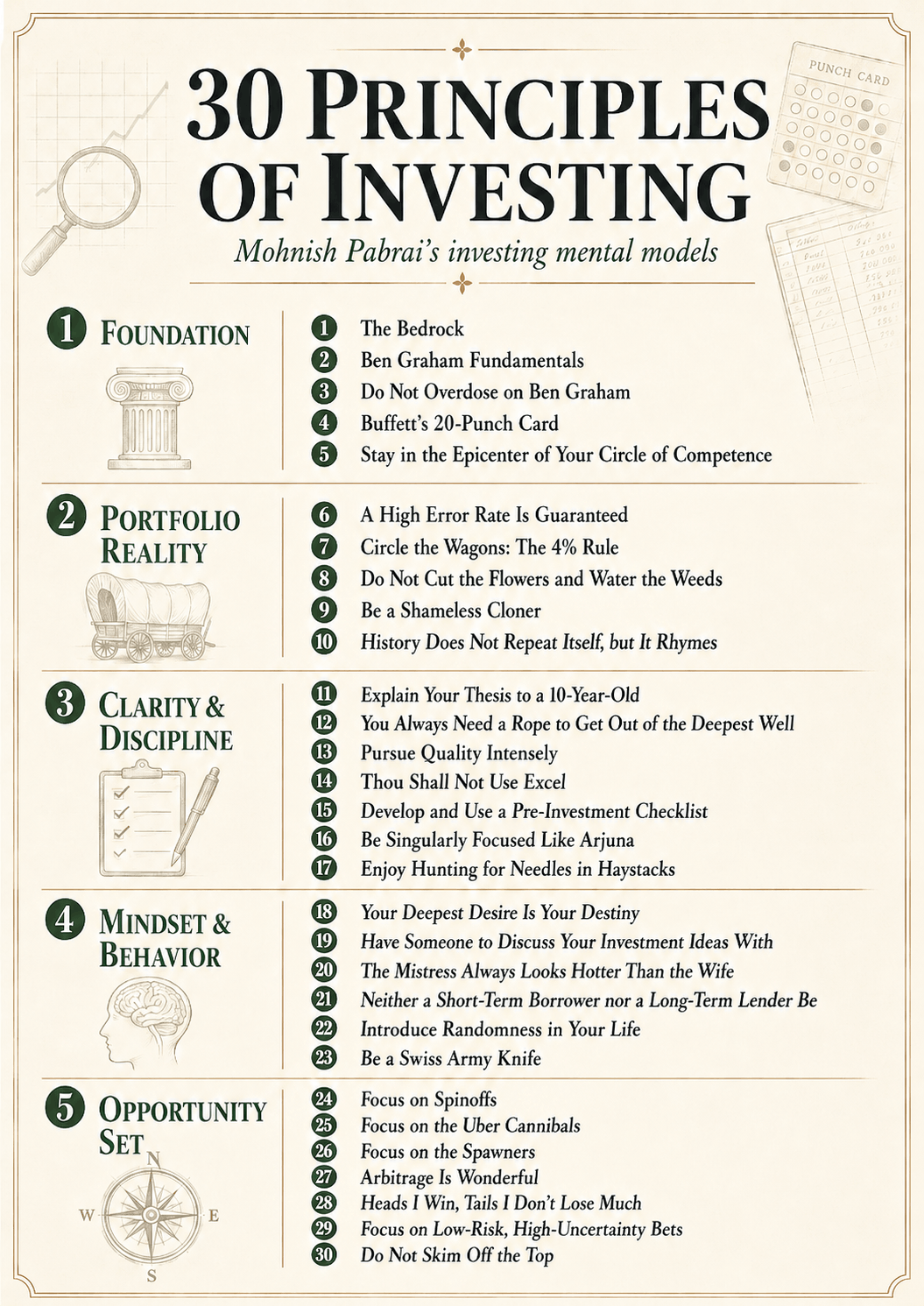
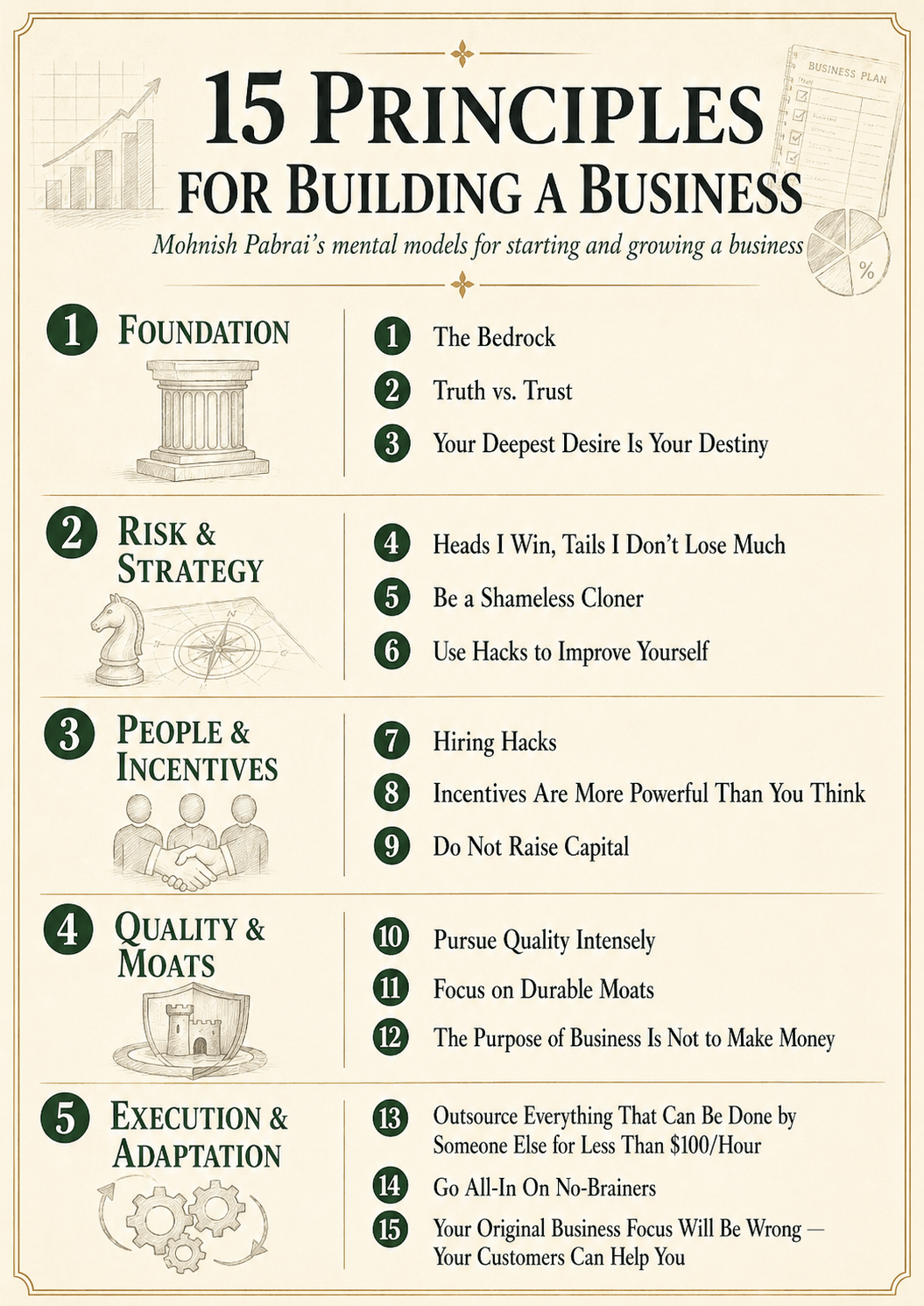
15 Mental models for starting/growing a business:
(Mohnish explains these mental models on his speech at SXSW).
The Bedrock
Take a simple idea and take it seriously. Most people hear great principles, nod, and move on. The entrepreneur’s edge comes from building the whole business on one obvious truth and executing it with unusual intensity.Truth vs. Trust
Truth is the raw material; trust is the compound interest. If customers, employees, and partners learn that you don’t distort reality, even in small things, trust builds over time — and that trust becomes a business advantage.Your Deepest Desire is Your Destiny
The world is a very malleable place. If you know what you want, and you go for it with maximum energy and drive and passion, the world will often reconfigure itself around you much more quickly and easily than you would think.
— Marc Andreessen
Belief comes before ability.
Heads I win; Tails I don’t lose much
Look for asymmetric bets: situations where the upside is large but the downside is survivable. In business, that means testing ideas cheaply, avoiding fatal risks. As Elon Musk said “Failure is irrelevant unless is catastrophic.”Be a Shameless Cloner
Don’t worship originality. Study what already works, and adapt it to your context.Use Hacks to Improve Yourself
Don’t rely only on willpower. Design your environment, habits, relationships, and incentives so they pull you upward.Hiring Hacks
Incentives are More Powerful than You Think
People respond to incentives more than speeches, values, or intentions. If the rewards are wrong, behavior will drift in the wrong direction. Great businesses design incentives so customers, employees, and partners win by doing the right thing.Do Not Raise Capital
Pursue Quality Intensely
Quality is not a detail; it is the business. Better products, better service, better writing, better hiring — all of it compounds. When quality becomes an obsession, customers notice, trust grows, and the company becomes harder to compete with. Mohnish recommends reading Robert Pirsig’s Zen and the Art of Motorcycle Maintenance.Focus on Durable Moats
A moat is a structural competitive advantage that protects your business from rivals over time. Whether it is immense brand loyalty, high customer switching costs, network effects, or an unbeatable low-cost structure, you must build a fortress around your profit margins so competitors cannot easily steal your market share.The Purpose of Business is Not to Make Money
A business fundamentally exists to solve a specific problem or fulfill a societal need. If you start a company solely to get rich, you will likely cut corners. Instead, obsess over delivering massive value. If you solve your customers’ problems exceptionally well, immense financial reward will naturally follow as a byproduct.Outsource Everything that Can Be Done by Someone Else for Less than $100/hour
A founder's time is their most constrained asset. If a repetitive or administrative task can be delegated cheaply, do it immediately. This ruthless prioritization frees you to focus exclusively on high-leverage activities, and the things you are uniquely good at.Go All-In On No-Brainers
Most opportunities are not worth much attention. But occasionally, you find a bet with huge upside, low downside, and obvious logic — something you can explain to an 8 year old. When a true no-brainer appears, don’t dabble. Concentrate your time, money, and energy behind it.Your Original Business Focus Will Be Wrong — Your Customers Can Help You
Your initial business plan will rarely survive its first contact with the real market. Instead of stubbornly sticking to your original idea, listen intensely to your early users. Pay attention to what they actually use and what they are willing to pay for, then pivot your operations to serve that exact, proven demand.

💥 Stuff I Loved


I hope you enjoyed today’s letter!
Talk you soon,
Your nuggets friend Julio :)
Great read Julio !