



👋 Hey friend,
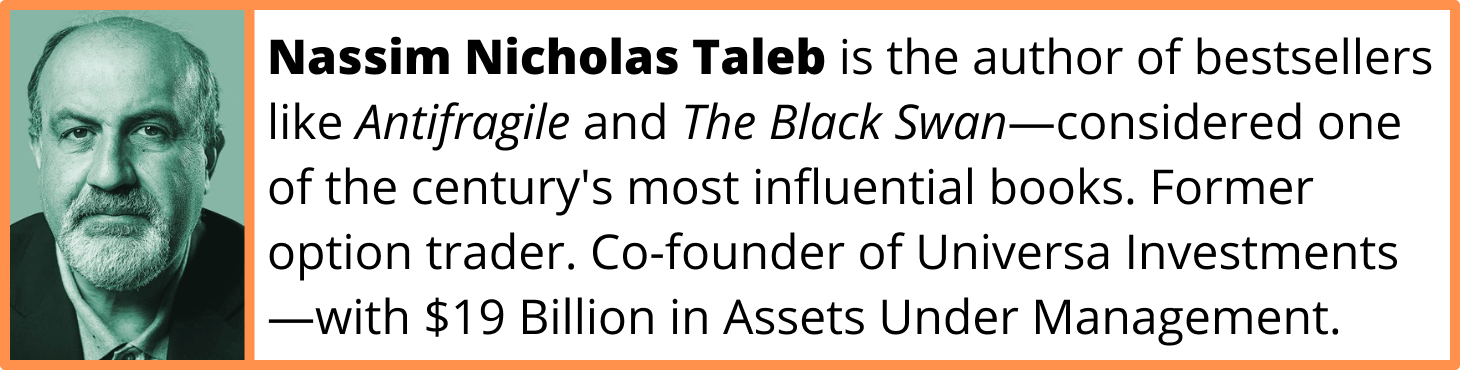
Today’s insight comes from Nassim Nicholas Taleb.
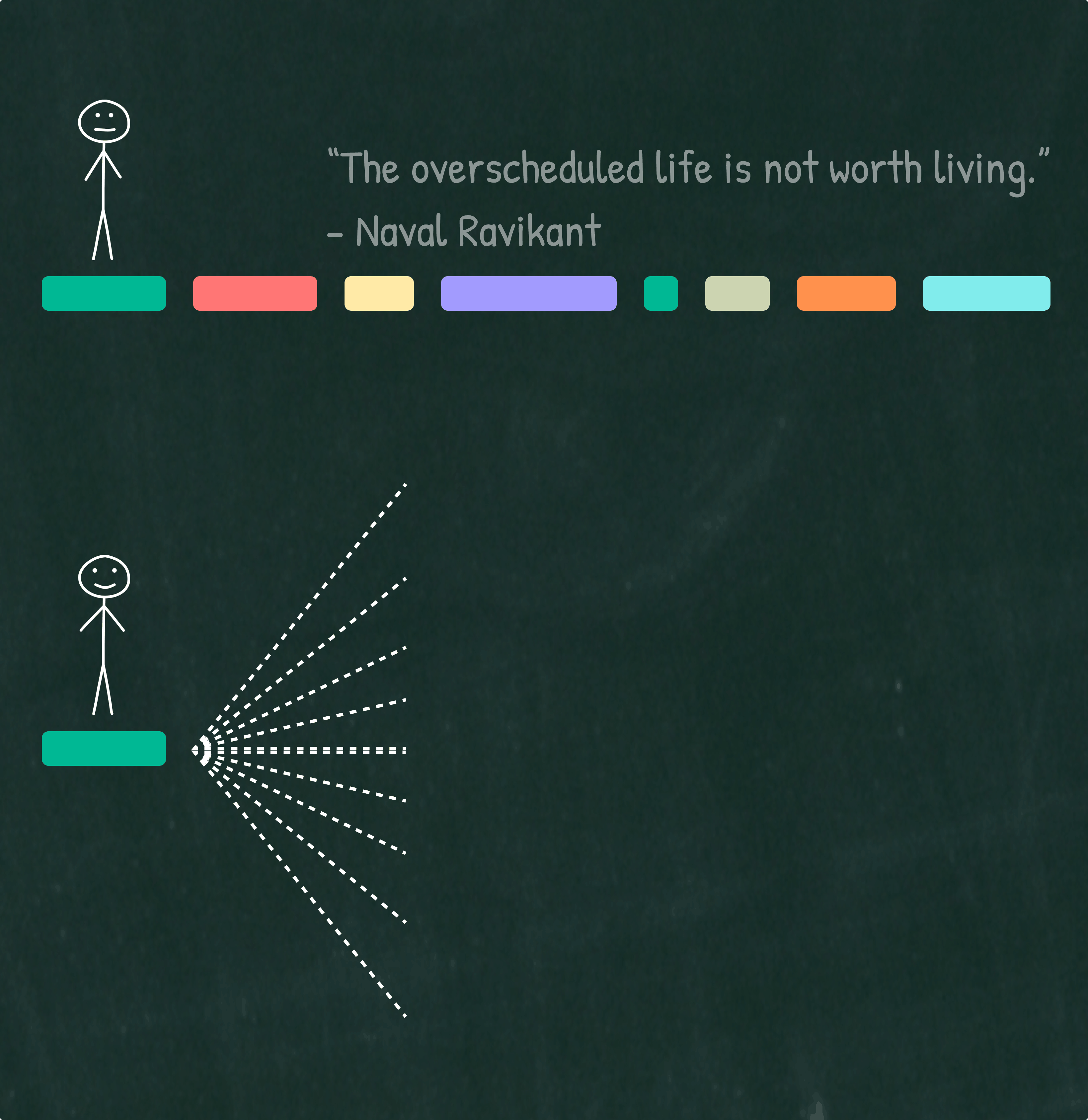
It’s a contrast to the prevailing idea that it’s a good thing to have some grand project or master plan in your life, where you know with precision what you’ll be doing tomorrow or a year from now. But even if this brings you comfort (since it removes uncertainty — which is a source of discomfort), it makes your life tasteless and boring.
Knowing with exact precision what you’ll be doing in the future (what Taleb calls “touristification”, since it resembles the tourist who strictly follows a travel itinerary) kills your soul. And it doesn’t even remove uncertainty in real life, it just gives you the illusion of certainty.
So let’s get into this fascinating perspective from Taleb!
👤 Doers
💡Nugget
🟠 Nassim Nicholas Taleb:
What a tourist is in relation to an adventurer, touristification is to life; it consists in converting activities, and not just travel, into the equivalent of a script like those followed by actors. We will see how touristification castrates systems and organisms that like uncertainty by sucking randomness out of them to the last drop—while providing them with the illusion of benefit. The guilty parties are the education system, planning the funding of teleological scientific research, the French baccalaureate, gym machines, etc. And the electronic calendar. But the worse touristification is the life we moderns have to lead in captivity, during our leisure hours: Friday night opera, scheduled parties, scheduled laughs. Again, golden jail. This “goal-driven” attitude hurts deeply inside my existential self.
Which brings us to the existential aspect of randomness. If you are not a washing machine or a cuckoo clock—in other words, if you are alive—something deep in your soul likes a certain measure of randomness and disorder. There is a titillating feeling associated with randomness.
👉 Book: Antifragile
This is well captured in this aphorism from Taleb’s Bed of Procrustes…
“You have a calibrated life when most of what you fear has the titillating prospect of adventure.”
When I read this idea from Taleb, it immediately came to mind something I heard from the famous novelist Lee Child — which I think is an excellent analogy to this idea of “touristification”…
🟠 Lee Child:
A lot of people assume that a book needs planning. They assume that you write out an outline or at least a hit list of plot points — some kind of a synopsis or outline or plan. And I’ve never ever done that. Because writing per se (making it with words) is not really the issue for me. [The issue] is the story that I want. And if I were to plan a story — and I’ve got friends who do huge outlines, you know, 300-page outlines. Even if I did a two-page outline with two lines per proposed chapter, then I’ve told myself the story, and I’m bored with it at that point. I want the next story. So I can’t afford to tell myself the story ahead of time. I have to just improvise it as I go along. So, it’s about starting somewhere which is defined by location and then see what happens. It really is that simple.
So Lee Child doesn’t plan his writing in advance, instead he picks a location and then the location sets the motion of the story…
🟠 Lee Child:
Do you want it to be the West of Texas where it is baking hot and arid? Do you want it to be on the Atlantic coast of Maine in April, where it’s gray and cold and misty? So, that’s how I start with the sense of place, and then it’s just constructing it around that. In a way, the place and the temperature kind of dictates the story in a way.
This is also very similar to how Stephen King writes his novels. I confess I’ve never read any of his novels, but I read his first and only non-fiction book where he talks about his process of writing…
🟠 Stephen King:
I distrust plot for two reasons: first, because our lives are largely plotless, even when you add in all our reasonable precautions and careful planning; and second, because I believe plotting and the spontaneity of real creation aren’t compatible. It’s best that I be as clear about this as I can – I want you to understand that my basic belief about the making of stories is that they pretty much make themselves. The job of the writer is to give them a place to grow (and to transcribe them, of course). If you can see things this way (or at least try to), we can work together comfortably. If, on the other hand, you decide I’m crazy, that’s fine. You won’t be the first.
…
Plot is, I think, the good writer’s last resort and the dullard’s first choice. The story which results from it is apt to feel artificial and labored.
👉 Book - On Writing: A Memoir of the Craft
So just like Lee Child and Stephen King don’t follow a plot for writing their novels, maybe we should also free ourselves from the slavery of following some grand project or masterplan in our lives. Maybe we should make our lives more open to adventure and randomness, while less predictable and boring.
🟠 Nassim Nicholas Taleb:
If I could predict what my day would exactly look like, I would feel a little bit dead.
…
There exist the kind of people for whom life is some kind of project. After talking to them, you stop feeling good for a few hours; life starts tasting like food cooked without salt. I, a thrill-seeking human, have a b***t detector that seems to match my boredom detector, as if we were equipped with a naturalistic filter, dullness-aversion. Ancestral life had no homework, no boss, no civil servants, no academic grades, no conversation with the dean, no consultant with an MBA, no table of procedure, no application form, no trip to New Jersey, no grammatical stickler, no conversation with someone boring you: all life was random stimuli and nothing, good or bad, ever felt like work. Dangerous, yes, but boring, never.
👉 Book: Antifragile

📝 This is How I Take Notes on Podcasts (from my phone)…
How I take notes on Podcasts using the tool Reader/Readwise — this tool boosted my learning from podcasts/interviews, and it absolutely changed my life! If you watch the video below, you’ll understand why (I show you how I saved the previous insight from Lee Child).
(expand the video to watch at full screen)
I typically listen to podcasts on Spotify, but when I want to take notes I simply search it on YouTube (you can always find it there) and then start the process I show in the video above.
If there’s only one tool I recommend to boost your learning from podcasts/interviews, it’s this one! It’s been my favorite learning tool (by far) over the past three years I’ve been using it.
I also talked to the team at Readwise and they agreed to give a 60-day free trial (double the usual trial length) to readers of Little Almanack…
Just go to 👉 https://readwise.io/pickingnuggets-reader
💥 Stuff I Loved



I hope you enjoyed today’s letter!
Talk you soon,
Your nuggets friend Julio :)
Declining needless, over-structured meetings at work and informing colleagues of my newfound philosophy has had a notable change on the quality of my work and my life.
Yet another banger, Julio. I want to share a moment from my own life where I tried to embody this principle.
Last year I spent the whole month of September in Italy. No plan. Bought the flight a few days before, with no return ticket.
I vividly remember my mother asking me repeatedly, "What's your plan?" Understandably, she wanted to keep an eye on me and have a rough idea of where I was (god bless her).
My answer: "There is no plan. The plan is to show up."
The result: I spent 3 weeks on an island I'd never even heard of. Lived with an Italian family, including an old grandmother, a 10-month-old baby, and 15 cats. I rented a moped, and crashed it. Saw a volcano erupt. Went on a date with an Italian woman who spoke very little English. Got rejected by a few others.
Thank you for spreading Taleb's message. Life is either an incredible adventure or it's nothing at all.