


Many books have been written on the life and investment wisdom of Warren Buffett and Charlie Munger.
So what makes this one, Buffett & Munger Unscripted, so special and worth reading?
Personally, I absolutely loved this book because it’s literally Buffett and Munger’s own words, so nothing gets lost in translation. It feels like they’re talking directly to you, sharing their wisdom on investing (and life too).
The author, Alex W. Morris, kept his job simple: he picked the best insights from three decades of Berkshire Hathaway Annual Meetings and polished the transcripts so they’re easier to read.
And because it all comes from those meetings, it reads like a conversation. It’s natural, and it’s fun to read.
Below you’ll find my favorite highlights from the book, along with cool visuals and my personal notes, where I add my own thoughts and connect ideas from other people I admire.
📖 Investing vs. Speculation
I’ll start with my favorite paragraph from the book — which makes the key distinction between a real investment and a speculative bet.
🖍️ Highlight
2002 Meeting (03:07:04)
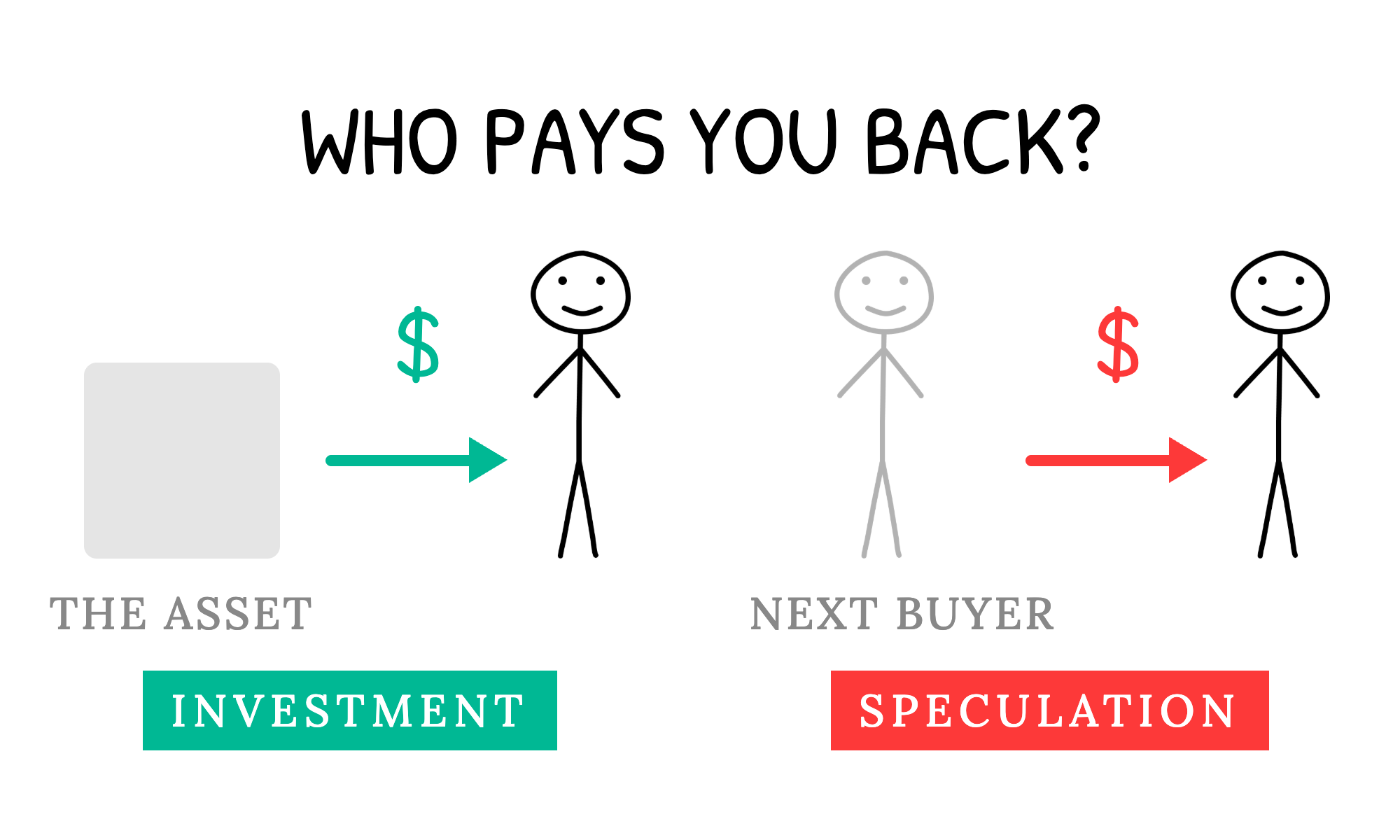
Warren Buffett: “All investment is laying out some money now to get more money back in the future. There are two ways of looking at getting the money back. One is from what the asset itself will produce. That’s investment. The other is from what somebody else will pay you for it later on, irrespective of what the asset produces, and I call that speculation. So, if you are looking to the asset itself, you don’t care about the quote [stock price] because the asset is going to produce the money for you either way…”
PART I: Value Investing
📖 Value Investing
The first highlight addresses a common misconception between value investing and the so called growth investing. Basically, Buffett and Munger don’t see any distinction here, as growth is part of the value equation…
🖍️ Highlight 1
2009 Meeting (02:48:46)
Warren Buffett: “Charlie and I think there is no other kind of investment than a value investment. In other words, we don’t know how anybody would invest in a non-value investment. We’ve always been puzzled by the term ‘value,’ suggesting it contrasts with growth. Value is getting a lot for the expectable future cash flows in terms of what you’re laying out today. Every time somebody characterizes us as value investors, we ask: What other kind could there be?
🖍️ Highlight 2
2012 Meeting (00:47:33)
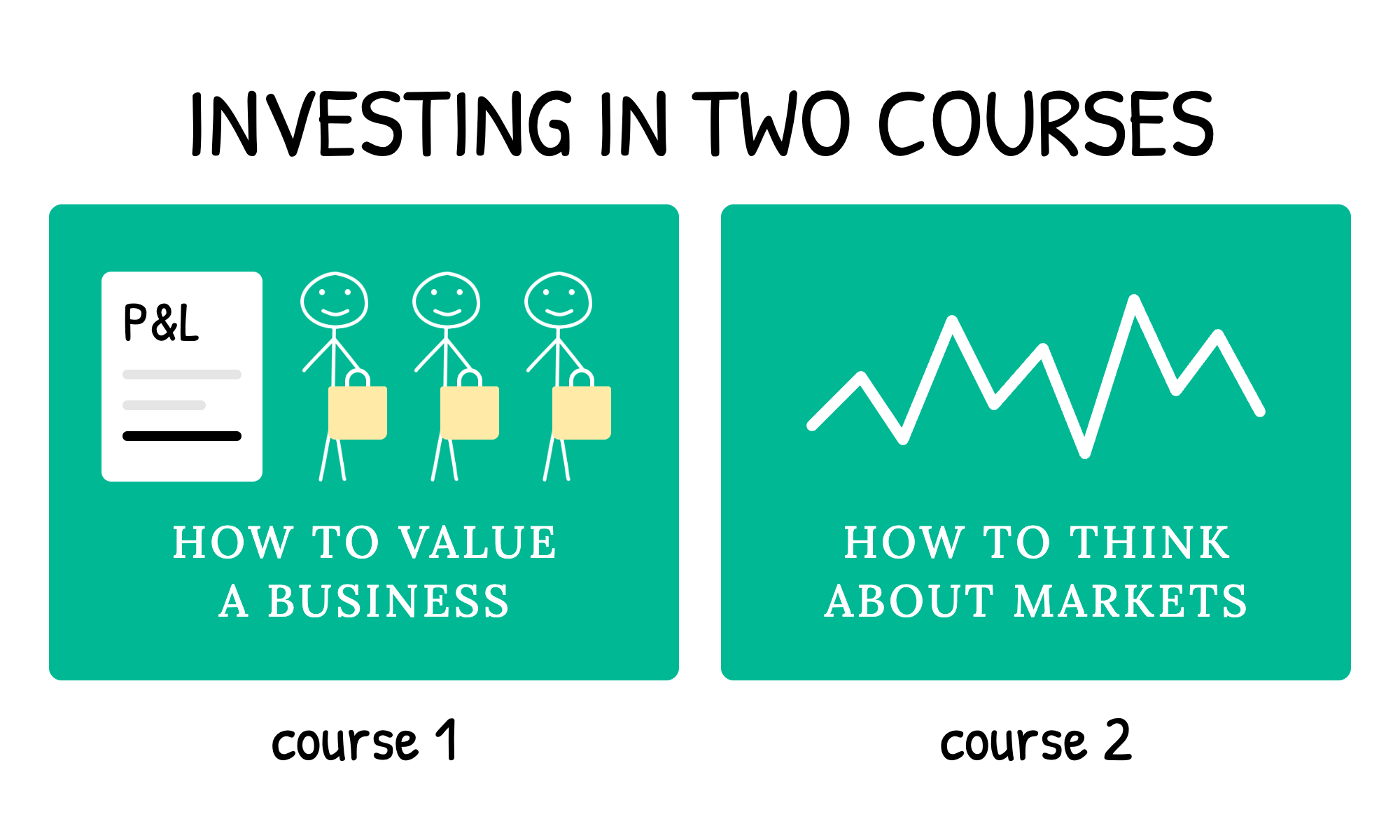
Warren Buffett: “Probably the silliest stuff we’ve seen taught at major business schools has been in the investment area. It is astounding how they’ve focused on one fad after another in finance theory, and it’s usually been very mathematically based … Investing is really not that complicated. I would have two courses: one on how to value a business, and another on how to think about markets. If people grasped the basic principles in those two courses, they would be far better off than if they were exposed to a lot of things like modern portfolio theory or options pricing. Who needs options pricing to be an investor?
“The teaching of investments has totally drifted away. I look at the books that are sometimes used, and there’s really nothing in there about valuing businesses—but that’s what investing is all about. If you buy businesses for less than they’re worth, you’re going to make money. And if you know the difference between the businesses that you can value and the ones you can’t, you’re going to make money. But they’ve tried to make it a lot more difficult. That’s what the high priests in any particular arena do; they have to convince the laity that the priests need to be listened to.”
[📝 Note]
Nassim Nicholas Taleb also explains why this phenomenon of making things more complicated than they should is so common in academia…
For an academic judged by his colleagues … a mountain giving birth to a mouse, after huge labor, is not a very good thing. They prefer the mouse to give birth to a mountain; it is the perception of sophistication that matters. The more complicated, the better; the simple doesn’t get you citations, H-values, or some such metric du jour that brings the respect of the university administrators, as they can understand that stuff but not the substance of the real work. The only academics who escape the burden of complication-for-complication’s sake are the great mathematicians and physicists.
Nassim Nicholas Taleb, foreword to Edward O. Thorp’s A Man for All Markets
🖍️ Highlight 3
2016 Meeting (03:19:48)
Warren Buffett: You don’t need the IQ in the investment business that you need in certain activities in life, but you do have to have emotional control. We see very smart people do very stupid things; it’s fascinating. Just take the people who get very rich and then leverage themselves up in some way that they lose everything. They are risking something important for something that isn’t important. Well, you could figure that out in first grade, but people do it time after time.
📖 A stock is a piece of a business
🖍️ Highlight
1998 Meeting (03:02:34)
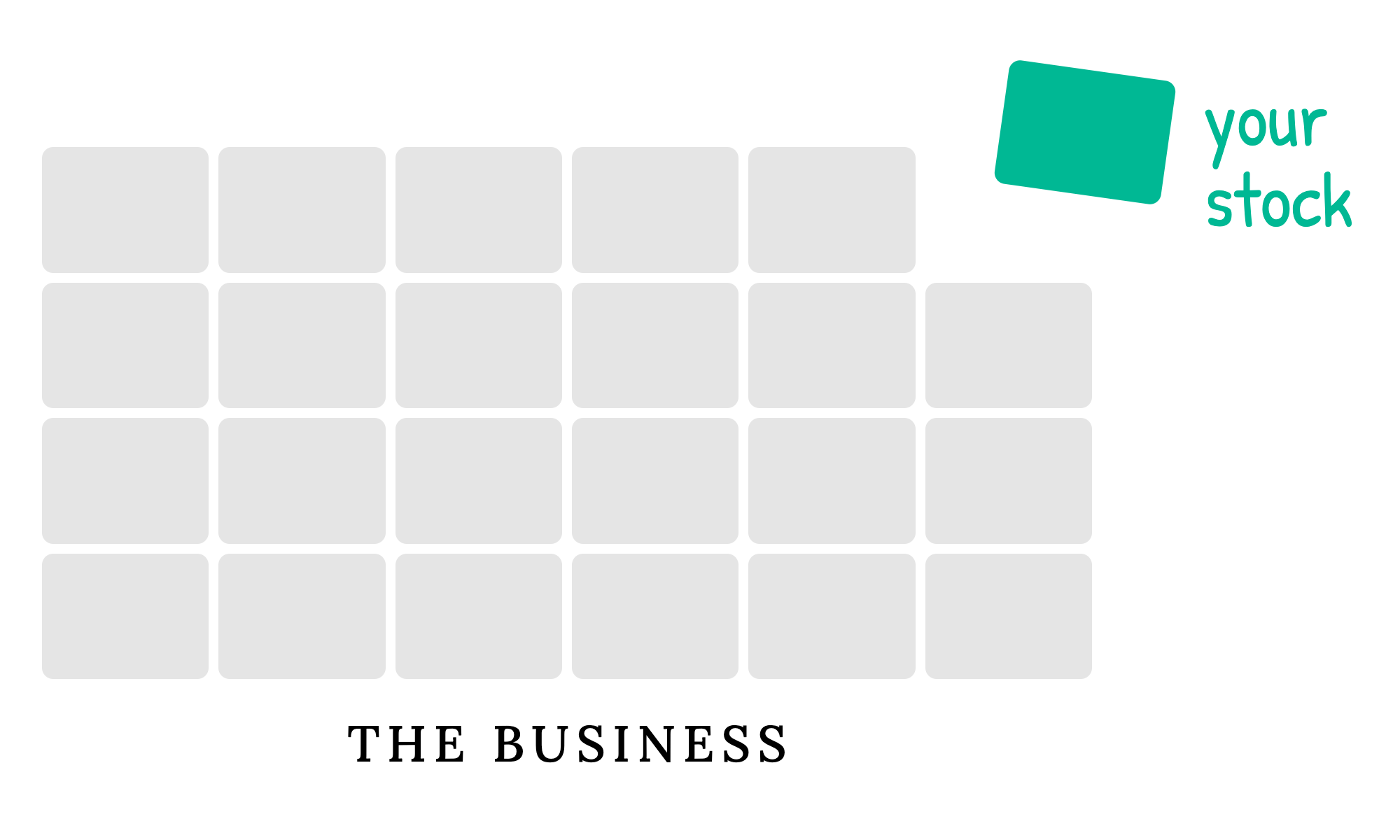
Warren Buffett: If you were thinking of buying a gas station, dry cleaner, or convenience store to invest your life savings in and to run as a business, you’d think about the competitive position and what it would look like five to ten years from now, and how you were going to run it, or who was going to run it for you, and how much you had to pay. That’s what we think of when we look at a stock, because a stock is nothing other than a piece of a business.”
[📝 Note]
On the importance of ownership…
You get truly rich by owning things that increase rapidly in value. This can be a piece of a business, real estate, natural resource, intellectual property, or other similar things. But somehow or other, you need to own equity in something, instead of just selling your time.
— Sam Altman, How to Be Successful (link)
📖 The Compounding Machine
🖍️ Highlight
2003 Meeting (04:10:30)
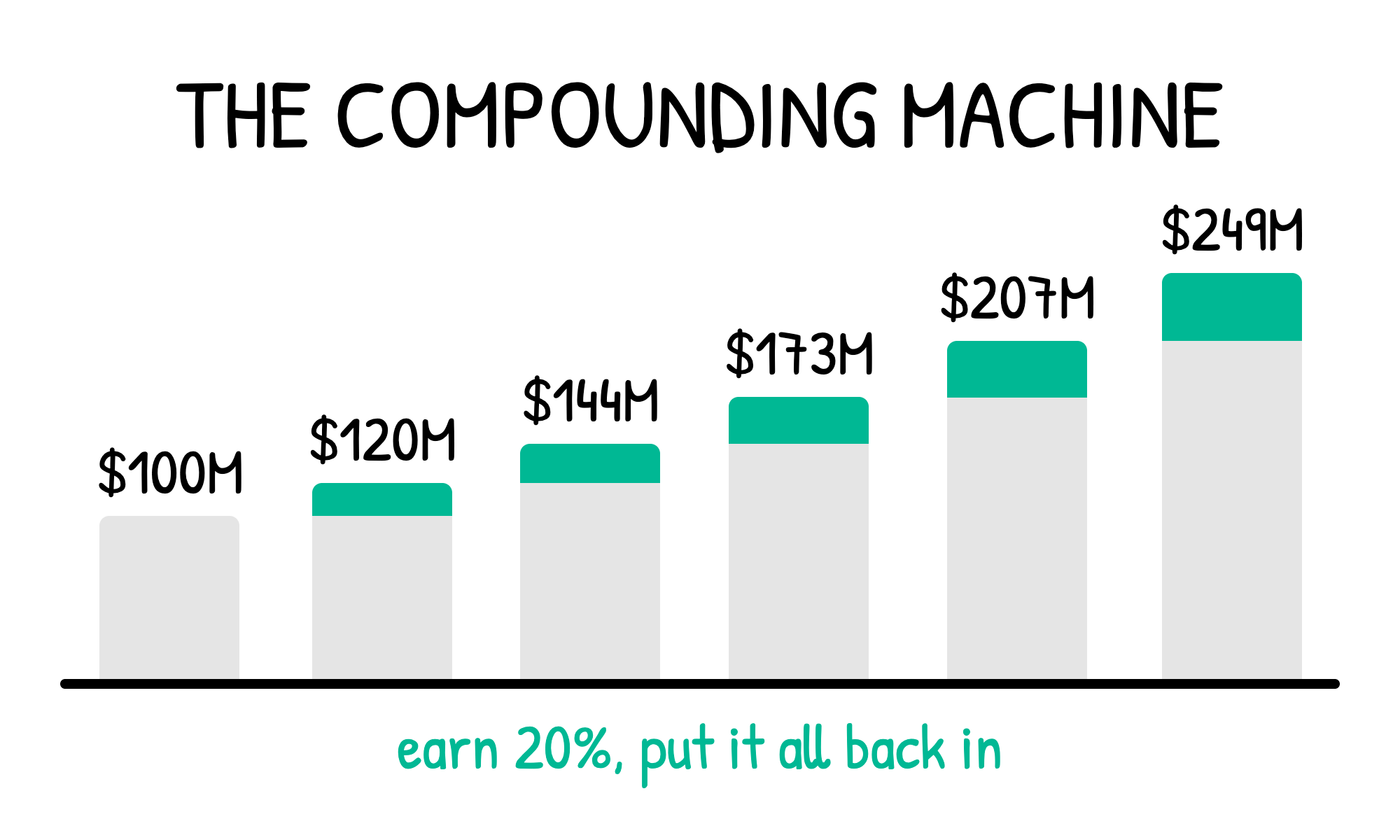
Warren Buffett: “The ideal business is one that earns very high returns on capital and can keep using lots of capital at those high returns. That becomes a compounding machine. If you can put $100 million into a business that earns 20% on capital, ideally it would be able to earn 20% on $120 million the following year, $144 million the following year, and so on. You could keep redeploying capital at these same returns over time. But there are very, very, very few businesses like that.
📖 Success in Business and Investing
🖍️ Highlight 1
1998 Meeting (03:10:53)
Warren Buffett: “If you’re interested in business, you ought to learn all the accounting you can. It is the language of business. That doesn’t mean it’s perfect, so you have to know the limitations.
“I would also advise you to work at a number of businesses. There’s nothing like seeing how business operates to build your future judgment about businesses. When you understand which businesses are very competitive and which are less competitive, and why that works that way, it adds to your knowledge. I would take accounting courses, I would do a lot of reading about investments, and I would get business experience. I would talk with people that are in business to find out what they think makes their operation tick, or to see where they have problems and why. “Sop it up every place you can. And if it turns you on, you’ll do well in it. Certain activities grab different people. If you understand business, you understand investments. Investments are simply business decisions in terms of capital allocation.”
Charlie Munger: “There’s also the little matter of underspending your income year after year after year. That really works if you keep at it.”
Warren Buffett: “Any $1 you save before you get out and start having a family is probably worth $10 later on simply because you can save it and invest it. The time to save is when you’re young; you’ll never have a better time to save, because the expenditures come along whether you like them or not. Work for yourself first, and put the money aside. I was lucky that way, I didn’t have to pay for my own college. I probably wouldn’t have gone to college if I’d had to pay for it. I was able to save everything I made in my teens, and those dollars got magnified quite a bit. Whereas when I started selling securities, the money I made then was taken up by family needs to quite an extent. So start saving early. A lot of that is a habit anyway; it’s a great habit to have.”
🖍️ Highlight 2
2002 Meeting (01:53:48)
Warren Buffett: “I don’t know to what extent it’s innate or to what extent it’s learned, but an ability to detach yourself from the crowd is a quality you need. A great IQ is not needed. You do not have to be terrifically smart to do well as an investor.
“I first learned from Ben Graham in a very big way; I learned something additionally from Phil Fisher; and I learned a lot from Charlie. And the proof is in my record, actually. From eleven to nineteen, I read every book there was on investments, and I didn’t do well at all. I had no real investment philosophy. I tried a lot of things and I was having a lot of fun, but I wasn’t making any money. Then I read Ben Graham’s book in 1949 [The Intelligent Investor], when I was at the University of Nebraska, and it changed my whole view of investing. Basically, it told me to think about a stock as a part of a business. Now, that seems so obvious ... but once you crank into your mental apparatus that you’re not looking at things that wiggle up and down on charts, but instead you’re buying a business, you’ve set a foundation for thinking rationally about investing.
“There’s no reason you need a high IQ ... Temperament, however, is enormously important; it may be innate, it may be learned, it may be intensified by experience or reinforced in various ways. You have to be realistic. You have to define your circle of competence accurately. You have to know what you don’t know, and not get enticed by it. You have to have an interest in money, I think, or you won’t be good at investing. But if you’re very greedy, it’ll be a disaster, because that will overcome rationality.
…
“We’ve seen relatively little correlation between investment results and IQ. Not that there are a whole bunch of people out there with 80 IQs knocking the cover off the ball. But there are all kinds of people with high IQs that get no place. It’s more interesting to look at why people with high IQs don’t succeed, and then see if you can cast those factors out of yourself, and leave a residual that will work.
“It’s like Charlie says: ‘All I want to know is where I’m going to die, so I’ll never go there.’ If you study people who ‘die,’ financially, with high IQs and ask why, you’ll see certain overwhelming characteristics present in most cases. You have to make sure that you don’t possess them, or if you do possess them, that you can get rid of them or control them in some manner.”
[📝 Note]
Nobody is going to teach you to think for yourself. A large fraction of what people around you believe is mistaken. Internalize this and practice coming up with your own worldview. The correlation between it and those around you shouldn’t be too strong unless you think you were especially lucky in your initial conditions.
— Patrick Collison, Patrick Collison’s Advice. (link)
🖍️ Highlight 3
2010 Meeting (03:42:57)
Warren Buffett: “We’ve seen a few periods of great opportunities that scream at us, and we’ve seen a few periods of overvaluation that scream at us. And then 90% of the time we’re somewhere in between. In terms of being scared, I don’t know what you can do about that. If you have a temperament that when others are fearful you’re going to get scared yourself, you are not going to make a lot of money in securities over time, in all probability …
People look at quotations, and more than that, do something based on small changes in quotations. Think how much more rational investing in a farm is than the way many people buy stocks. If you buy a farm, do you get a quote next month? No, you look at the farm and say, ‘I expect it to produce so many bushels of corn, and if it does that, it meets my expectations.’ Many people buy a stock and think that if it goes up it’s wonderful, and if it goes down it’s bad. We think just the opposite. When it goes down we love it, because we’ll buy more. And if it goes up, it kills us to buy more. But if you can’t get yourself into that mental attitude, you’re going to be scared whenever everybody else is scared. If somebody else tells you when to buy, a week later somebody else will tell you the world is coming to an end. You’re a broker’s friend, but you won’t make a lot of money.”
…
“Some people really do not have the temperament, emotional stability, or whatever it may be, to invest in securities. They’d be much better off if there were no quotations at all … In the end, what counts is buying a good business at a decent price, and then forgetting about it for a long, long, long time. Some people can do it and some people can’t.”
[📝 Note]
Andrew Carnegie reached a similar conclusion back in 1920…
Nothing tells in the long run like good judgment, and no sound judgment can remain with the man whose mind is disturbed by the mercurial changes of the Stock Exchange. It places him under an influence akin to intoxication. What is not, he sees, and what he sees, is not. He cannot judge of relative values or get the true perspective of things. The molehill seems to him a mountain and the mountain a molehill, and he jumps at conclusions which he should arrive at by reason. His mind is upon the stock quotations and not upon the points that require calm thought. Speculation is a parasite feeding upon values, creating none.
Andrew Carnegie, The Autobiography of Andrew Carnegie.
📖 When To Sell
🖍️ Highlight
2009 Meeting (01:52:53)
Warren Buffett: “If we lose confidence in management or in the durability of the competitive advantage, or if we recognize that we made a mistake, we sell. On the other hand, if you really get a wonderful business with outstanding management, mostly the wonderful business part, when in doubt, keep holding. But it’s not an inviolable rule.
“On the wholly-owned businesses, we have an attitude that, when we buy, it’s for keeps. We make only two exceptions: when they promise to start losing money indefinitely, or if we have major labor problems. But, otherwise, we are not going to sell something just because we get offered more money for it, even if it’s more than it’s worth.
“That’s a peculiarity we have, and we want our partners to know about that. We do think it helps in terms of buying businesses over time. It’s also the way we want to run our business. With stocks, we sell them, but we’re often more reluctant to sell than most people. If we made the right decision, we like to ride that a very long time. We’ve owned some stocks for decades. But if the competitive advantage disappears, if we really lose faith in the management, or if we were wrong in the original analysis, we sell.”
[📝 Note]
Don’t be lazy—be very lazy. We buy rarely, and we sell even more rarely.
— Pulak Prasad, What I Learned About Investing From Darwin.
📖 Owning Businesses
🖍️ Highlight
1999 Meeting (03:19:43)
Charlie Munger: “Generally speaking, trying to dance in and out of the companies that you really love on a long-term basis has not been a good idea for most investors. We’re quite content to sit with our best holdings.”
Warren Buffett: “People have tried to do that with Berkshire over the years. I’ve had some friends that thought it was getting a little ahead of itself from time to time; they thought they’d sell and buy it back cheaper. It’s pretty tough to do. You have to make two decisions right, you have to sell it right and then you have to buy it right later on, and usually you have to pay some tax in between.
“If you get into a wonderful business, the best thing to do is usually to stick with it. Coca-Cola and Gillette both experienced disappointments, below what they anticipated twelve to eighteen months ago and below what we anticipated. But that will happen. It happens with some of our wholly-owned businesses from time to time. Sometimes they do better than we anticipate, too.
“It’s not the nature of things that everything goes in a nice, straight, smooth line upward ... It’s a competitive world. Your competitor’s correct moves, your own incorrect moves, the world environment, all of those things can interrupt trend lines.”
[📝 Note]
“We want to be permanent owners of high-quality businesses. We don’t invest unless we think we can own a business forever. Don’t be lazy—be very lazy. We buy rarely, and we sell even more rarely.”
— Pulak Prasad, What I Learned About Investing From Darwin
📖 Declining Businesses
🖍️ Highlight
2012 Meeting (02:49:31)
Charlie Munger: “Declining businesses are not worth nearly as much as growing businesses, but they can still be quite valuable if a lot of cash is going to come out of them.”
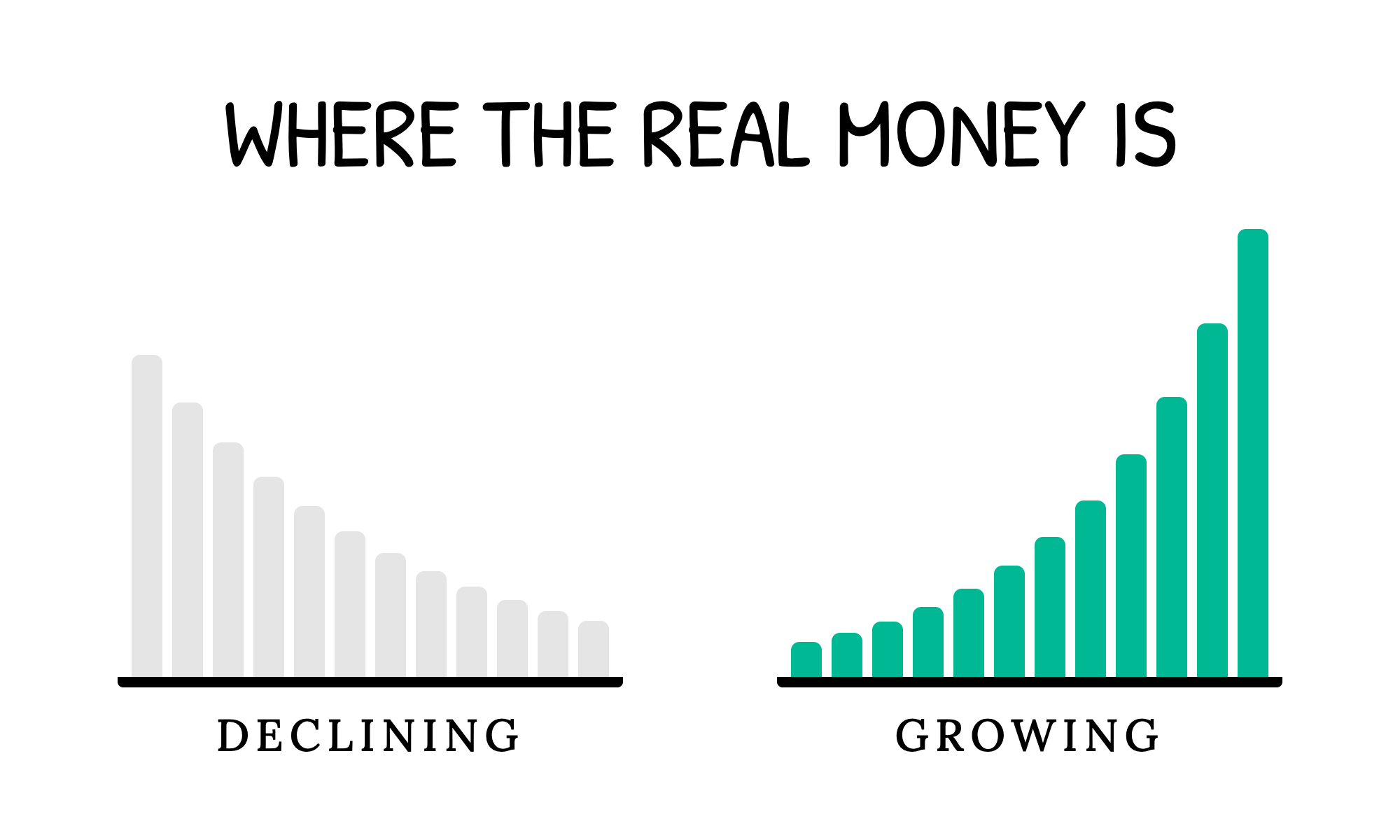
Warren Buffett: “Generally speaking, it pays to stay away from declining businesses. If you really think a business is declining, most of the time you should avoid it. Now, we are in several declining businesses ... but that is not where we’re going to make the real money at Berkshire. The real money is going to be made in the growing businesses, and that’s where the focus should be.
“I would never spend a lot of time trying to value a declining business, what I call the cigar-butt approach, where you get one free puff out of the cigar butt that you find. The same amount of energy and intelligence brought to other types of businesses is just going to work out better. So, our general reaction, unless there’s some special case, is to avoid declining businesses.”
📖 Volatility & Risk
🖍️ Highlight 1
1998 Meeting (04:34:37)
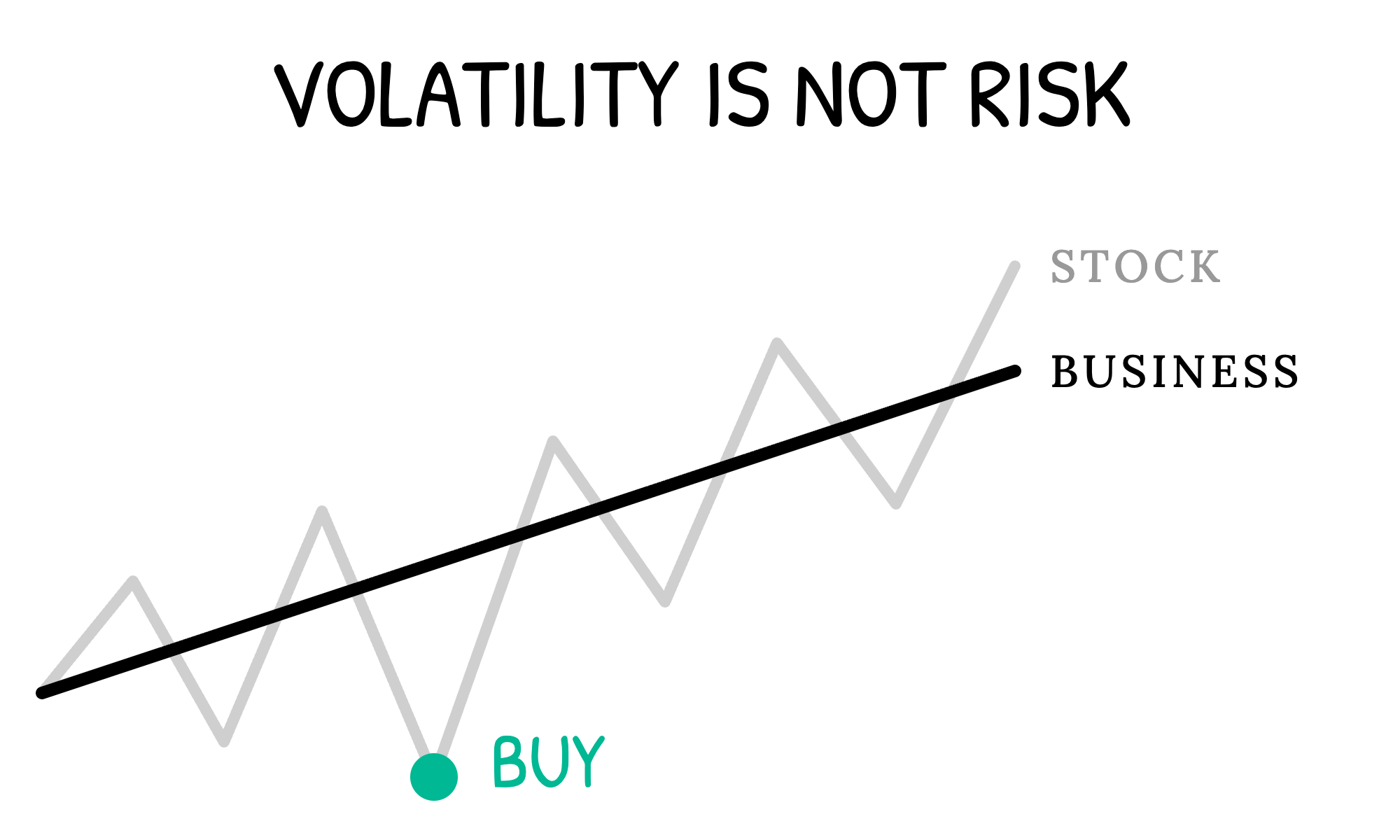
Charlie Munger: “The great emphasis on volatility in corporate finance we just regard as nonsense. Put it this way: As long as the odds are in our favor and we’re not risking the whole company on one throw, or anything close to it, we don’t mind volatility in results. What we want is the favorable odds. We figure the volatility, over time, will take care of itself at Berkshire.”
Warren Buffett: “If we have a business about which we’re extremely confident as to the business results, we would prefer that it had higher volatility rather than lower. We will make more money out of a business where we know where the endgame is going to be if it bounces around a lot ... When we see a business about which we’re very certain, but the world thinks that its fortunes are going up and down, and therefore it behaves with great volatility, we love it. That’s way better than having a lower beta. We actually would prefer what other people would call risk. When we bought The Washington Post it went down 50% in a matter of a few months. That was the best thing that could’ve happened; it doesn’t get any better than that. The business was fundamentally very nonvolatile in nature, TV stations and a strong, dominant newspaper, that’s a nonvolatile business, but it was a volatile stock. That is a great combination from our standpoint.”
[📝 Note]
… As I watched the stock fall from 113 (dollars) to 6 (dollars), I was also watching all of our internal business metrics: number of customers, profit per unit, you know, everything you can imagine, defects, et cetera. Every single thing about the business was getting better and fast.
🖍️ Highlight 2
2001 Meeting (03:43:27)
Warren Buffett: “We regard volatility as a measure of risk to be nuts. The reason it’s used is because the people who are teaching want to talk about risk, and the truth is, they don’t know how to measure it in business. That would be part of our course on how to value a business, understanding the riskiness of the business. Risk with us relates to several possibilities. One is the risk of a permanent capital loss. The other risk is just an inadequate return on the kind of capital we put in. It does not relate to volatility at all ... You can find all kinds of wonderful businesses that have great volatility in their results, but it does not make them bad businesses. And you can find some terrible businesses that are very smooth ... It just doesn’t make any sense to translate volatility into risk ... If somebody starts talking to you about beta, zip up your pocketbook.”
📖 Holding Cash
🖍️ Highlight 1
2004 Meeting (01:43:49)
Warren Buffett: “We think the best way to minimize risk is to think. And the idea that you say, ‘I’ve got 60% in stocks and 40% in bonds,’ and then have a big announcement, ‘Now we’re moving to 65% in stocks and 35% in bonds,’ as some strategists or whatever they call them on Wall Street do, that is pure nonsense. What you ought to do is have your default position be short-term instruments, and whenever you see anything intelligent to do, you should do it ... So much of what you see about asset allocation is just merchandising. It’s a way to make you think that if you don’t know how to determine whether it should be 60%/40% or 65%/35% that you need these people. You don’t need them at all in investing.”
Charlie Munger: “People have always had this craving to know the future. The king used to hire the magician or the forecaster, and he’d look at sheep guts or something for an answer as to how to handle the next war. There’s always been a market for people who purport to know the future based on their expertise, and there’s a lot of that still going on. People have an economic incentive to sell some nostrum. It can be sold over and over and over again ... I think it’s disgusting. It’s much better to make a living by being part of a system that delivers value to the people who are buying the product. But nobody refrains from creating gambling casinos or something on my theory. If it’ll work to make money, we tend to do it in this country.”

📖 Position Sizing and Diversification/Concentration
🖍️ Highlight 1
1996 Meeting (02:43:36)
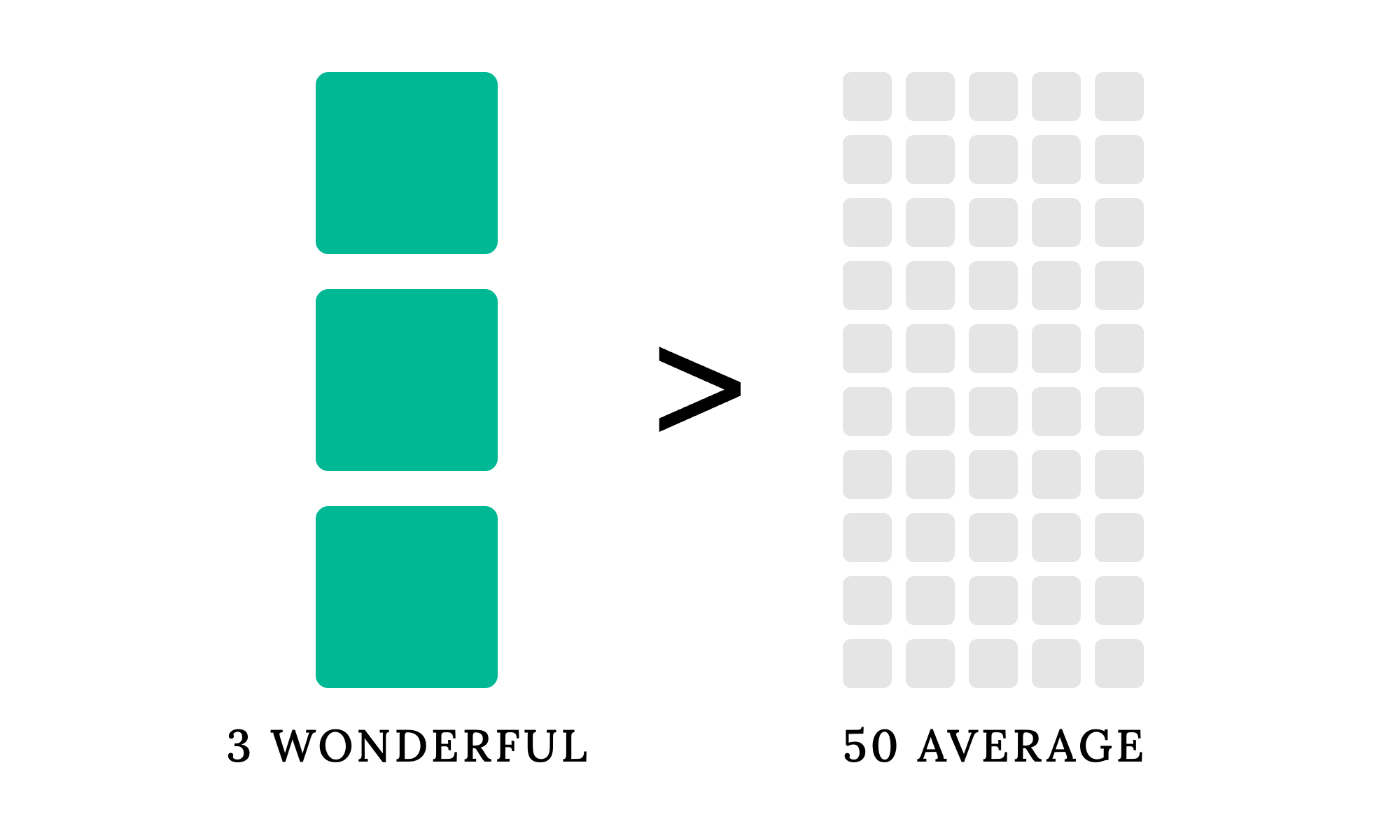
Warren Buffett: “We like to put a lot of money in things we feel strongly about. Diversification, as practiced generally, makes very little sense for anyone that knows what they’re doing. Diversification is protection against ignorance; if you want to make sure that nothing bad happens to you relative to the market, you own everything. There’s nothing wrong with that. That is a perfectly sound approach for somebody who does not feel they know how to analyze businesses. But if you know to analyze and value businesses, it’s crazy to own thirty, forty, or fifty stocks, because there aren’t that many wonderful businesses that are understandable to a single human being in all likelihood. And to have some super-wonderful business, and then put money in number thirty-five on your list of attractiveness and forego putting more money into number one, it just strikes us as madness. It’s conventional practice; if all you have to achieve is the average, it may preserve your job. But it’s a confession, in our view, that you don’t really understand the businesses that you own.
“On a personal portfolio basis, I own one stock [Berkshire]. It’s a business I know and it leaves me very comfortable. Do I need to own twenty-eight stocks to have proper diversification? It’d be nonsense. Within Berkshire, I could pick out three businesses, and I would be very happy if they were the only businesses we owned and I had all my money in Berkshire. Three wonderful businesses is more than you need in this life to do very well ... If you look at how the fortunes were built in this country, they weren’t built out of a portfolio of fifty companies. They were built by someone who identified a wonderful business.
“A really wonderful business is very well protected against the vicissitudes of the economy over time, and competition. We’re talking about businesses that are resistant to effective competition. Three of those will be better than a hundred average businesses. And they’ll be safer, incidentally. There is less risk in owning three easy-to-identify, wonderful businesses than there is in owning fifty well-known, big businesses. It’s amazing what has been taught, over the years, in finance classes about that. If I had to bet the fortunes of my family on the next thirty years, I would rather pick three businesses from those we own than own a diversified group of fifty.”
…
“If you find three wonderful businesses in your life, you’ll get very rich. Bad things aren’t going to happen to those three. I mean, that’s the characteristic of it.”
[📝 Note]
“The more you know, the less you diversify.”
— Naval Ravikant, The Almanack of Naval Ravikant.
📖 Patience (Waiting for the Fat Pitch)
🖍️ Highlight
1995 Meeting (01:45:15)
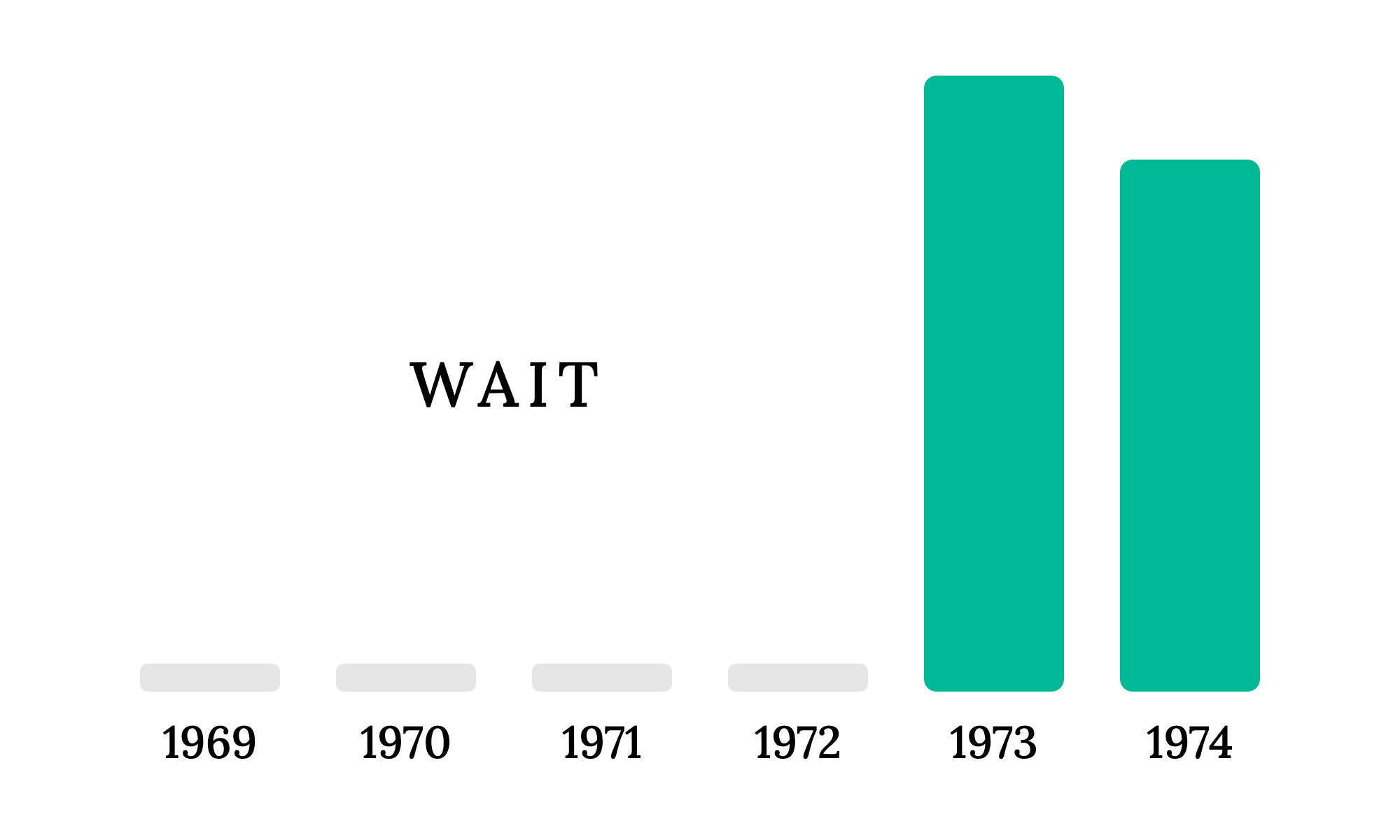
Warren Buffett: “We have sat through some dry spells; that’s true in both the stock market and the acquisition business. I closed up the partnership in 1969 because there was nothing that made sense to do, and I’m glad I did because that situation prevailed in 1971 and 1972, but in 1973 and 1974 there were all kinds of things to do. That will happen from time to time. People will behave, particularly in markets, just as foolishly in the future as they have in the past. It’ll come at unexpected times. But we will get a chance to do something…
📖 First Question on an Investment
🖍️ Highlight
1995 Meeting (02:21:45)
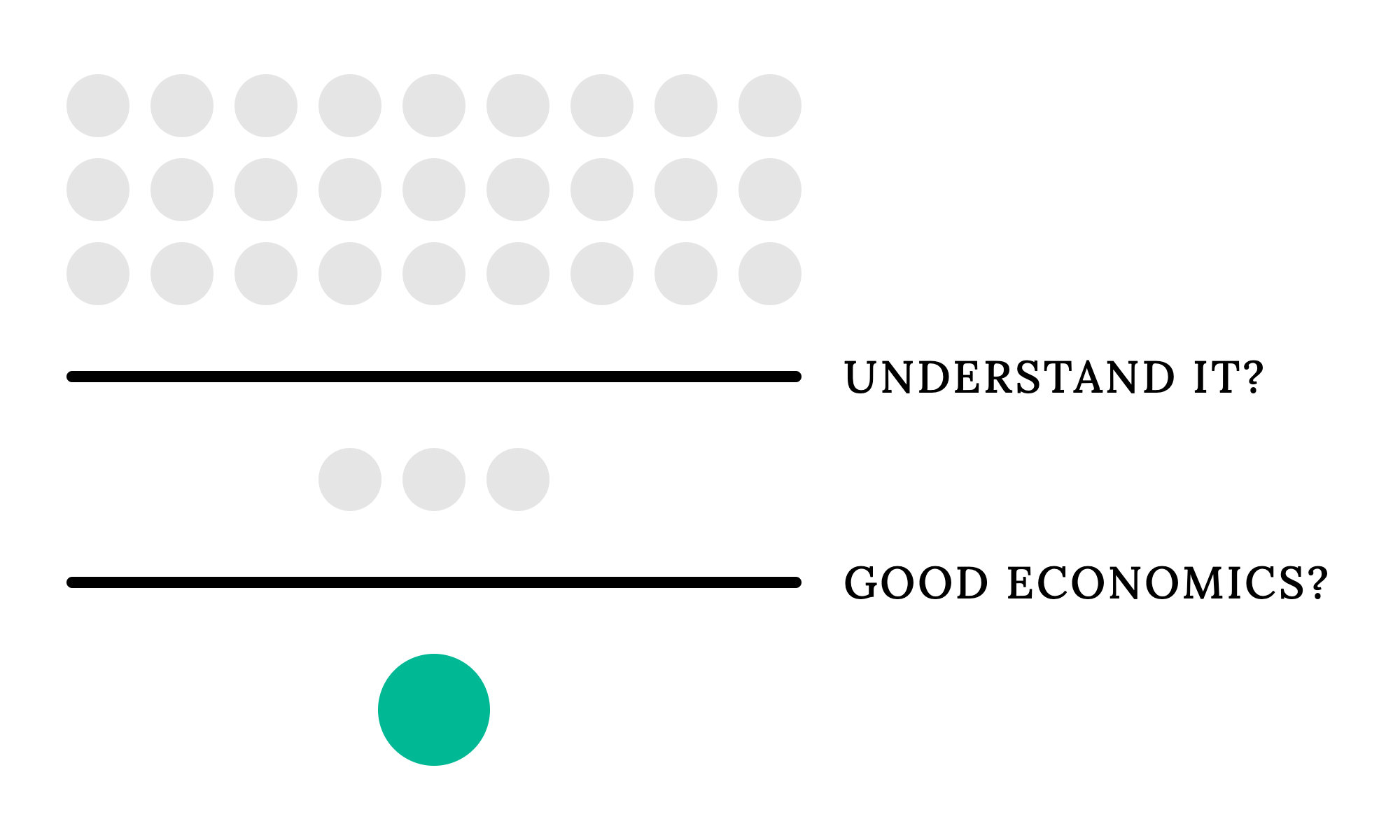
Warren Buffett: “The first question is, ‘Can I understand it?’ Unless I think I can understand it, there’s no sense looking at it. I won’t kid myself into thinking I’m going to understand some software company or some biotech company. What am I going to know about it? So, that’s the first question. The second question is, ‘Does it look like it has good economics?’ Has it earned high returns on capital? Does it strike me as something that’s likely to do that? I go from there.”
Charlie Munger: “We tend to judge by the past record; by and large, if the thing has a lousy past record and a bright future, we’re going to miss that opportunity.”
[📝 Note]
“At Nalanda, here is what we begin with while short-listing businesses: historical return on capital employed. The first word first. Historical. We don’t listen to stories about how ROCE will improve in the future. We want to assess a company purely on its historically delivered ROCE.”
— Pulak Prasad, What I Learned About Investing from Darwin
📖 Owning Great Companies
🖍️ Highlight
1996 Meeting (03:21:17)
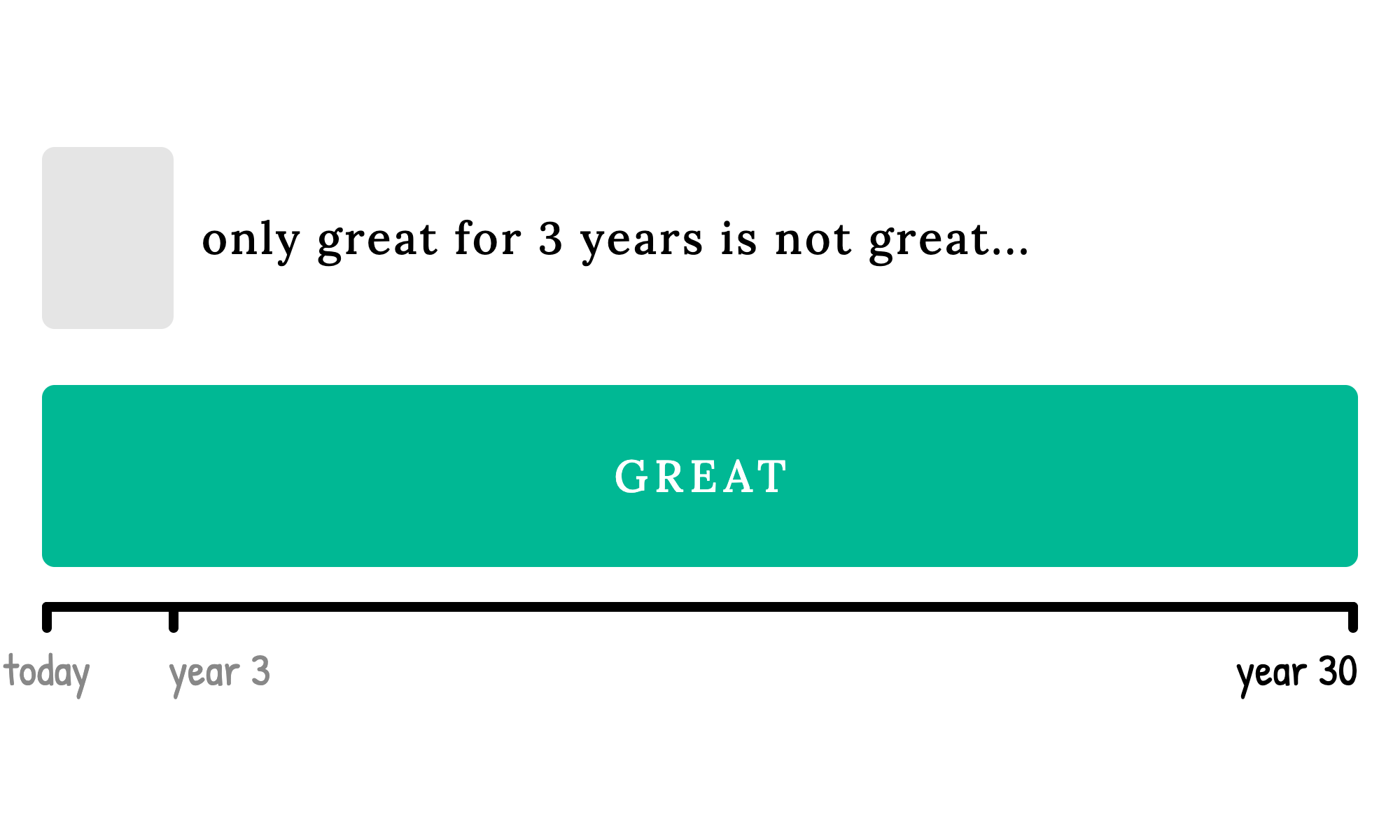
Warren Buffett: “A great company is one that’s going to remain great for thirty years. If it’s only going to be a great company for three years, it isn’t a great company. You really want to go along with the idea that, if you were going to take a trip for twenty years, you wouldn’t feel bad leaving it with no orders at your broker and no power of attorney or anything; when you come back, you know it’s going to be a terribly strong company. I think it’s better just to own them. We could attempt to buy and sell some of the things we own that we think are fine businesses, but they’re too hard to find. We found See’s Candies in 1972; here and there, we get the opportunity to do something. But they’re too hard to find.
“To sit there and hope you buy them in the throes of some panic, you sort of take the attitude of a mortician, waiting for a flu epidemic. I’m not sure that will be a great technique ... I think the main thing to do is find wonderful businesses ... Phil [Carret] has done awfully well by finding businesses he likes, sticking with them, and not worrying too much about what they do day to day ... Say there was no stock market, and the owner of the best business in your hometown came to you and said, ‘My brother died and he owned 20% of the business. I want somebody to go in with me to buy that 20%. And the price looks a little high, maybe, but this is what I think I can get for it. Do you want to buy in?’ If you like the business and you like the person coming to you, and the price sounds reasonable, and you really know the business, I think the thing to do is to take it and don’t worry too much about how it’s quoted. It won’t be quoted tomorrow, next week, or next month. I think people’s investment would be more intelligent if stocks were quoted about once a year ... We did well in 1964 because American Express ran into a crook. We did well in 1976 because GEICO’s managers and auditors didn’t know what their loss reserves should’ve been the previous couple of years. So we’ve had our share of flu epidemics, but you don’t want to spend your life waiting around for them.”
[📝 Note]
“If you focus on near-term growth above all else, you miss the most important question you should be asking: will this business still be around a decade from now? Numbers alone won’t tell you the answer; instead you must think critically about the qualitative characteristics of your business.”
— Peter Thiel, Zero to One
A dreamy business offering has at least four characteristics. Customers love it, it can grow to very large size, it has strong returns on capital, and it’s durable in time—with the potential to endure for decades. When you find one of these get married.
— Jeff Bezos, Invent and Wander.
📖 Margin of Safety
🖍️ Highlight
2007 Meeting (01:09:24)
Warren Buffett: “We favor the businesses where we really think we know the answer. If a business gets to the point where we think the industry in which it operates, or its competitive position or anything, is so chancy that we can’t really come up with a figure, we don’t try to compensate for that by having some extra large margin of safety. We really want to go in on something that we understand better. So if we buy See’s Candies as a business or Coca-Cola as a stock, we don’t think we need a huge margin of safety because we don’t think we’re going to be wrong about our assumptions in any material way.
“What we really want to do is buy a great business, which means it’s going to earn a high return on capital employed for a very long period of time, and where we think the management will treat us right. We don’t have to mark those down a lot when we find those factors ... It’s like if you see somebody walk in the door; you don’t know whether they weigh three hundred pounds or three hundred and twenty-five pounds, but you still know they’re fat, right? And so if we see something we know is fat, financially, we don’t worry about being precise ... You should always feel you’re getting a little more than what it’s worth, and there are times we’ve been able to buy wonderful businesses at 25% of what they’re worth, but you don’t see those sorts of things very often. Does that mean you should sit around and wait ten or fifteen years? That’s not the way we do it. If we can buy good businesses at a reasonable valuation, we’re going to keep doing it.”
📖 Leverage and Options
🖍️ Highlight
2004 Meeting (02:25:01)
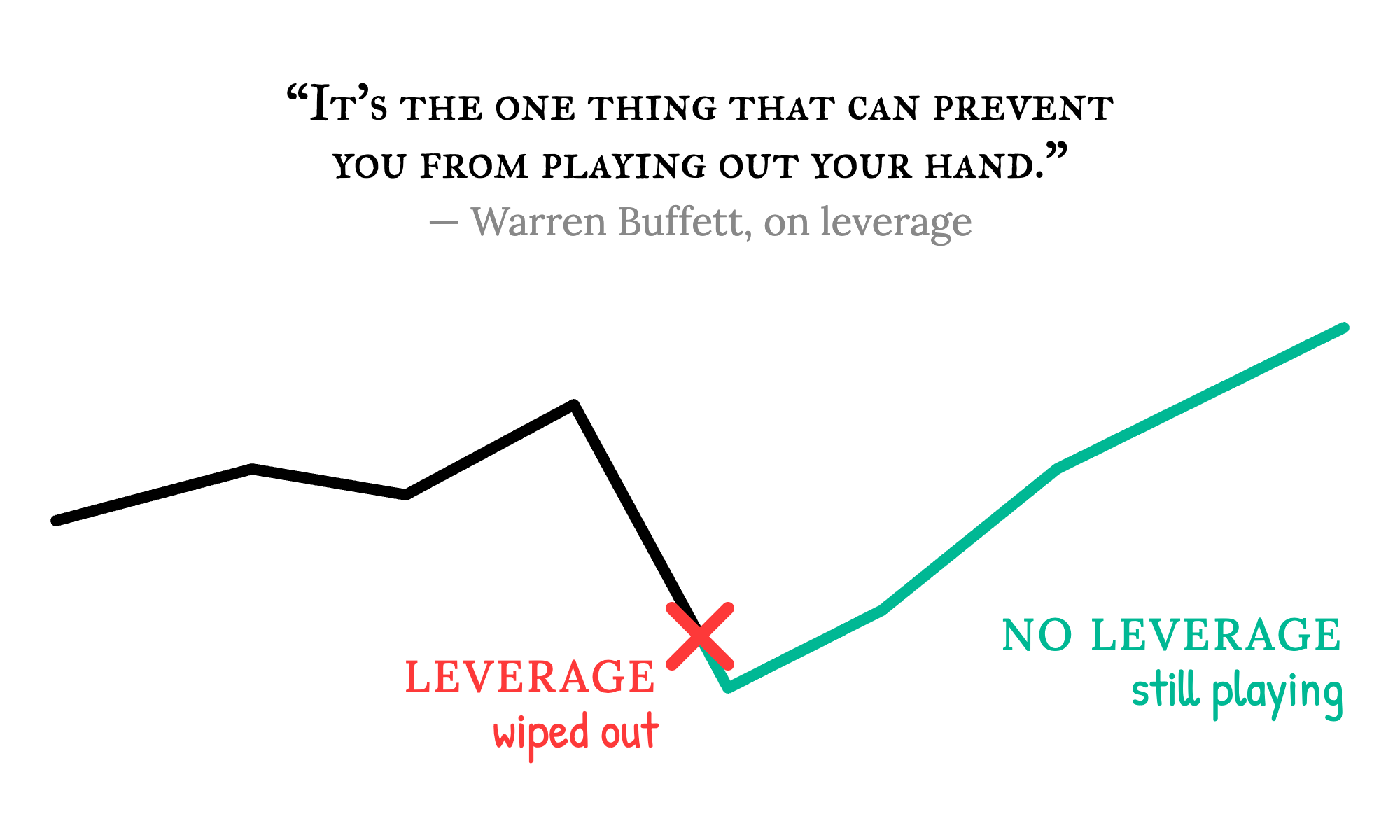
Warren Buffett: “We believe almost anything can happen in financial markets, and the only way smart people can get clobbered, really, is through leverage. If you can hold them, you have no real problems. So, we have a great aversion to leverage, and we would predict that a very high percentage of the smart people operating in Wall Street, at one time or another, are likely to get clobbered through the use of leverage. It’s the one thing that can prevent you from playing out your hand. All of the hands we enter into look pretty good to us, but you do have to be able to play them out ... The big thing you want, at a minimum, is to protect yourself against that insanity in market prices/volatility wiping you out.”
[📝 Note]
“Having an ‘edge’ and surviving are two different things: the first requires the second. You need to avoid ruin. At all costs.
— Nassim Nicholas Taleb
🖍️ Highlight 2
2005 Meeting (03:47:34)
Charlie Munger: “It wasn’t even controversial in this country when we came to introduce single-stock futures and commonly traded puts and calls. Ordinary people got in trouble. If I’d been running the country, I never would have allowed that. I don’t know what good it does for the country to have a lot of trading in puts and calls. One of my children knew a man who had a $2.5 million house and $5 million worth of securities. But he couldn’t live as comfortably as he liked on the income from his securities, so he got in the habit of picking up easy money. He kept selling naked puts secured by his account, including on a whole lot of internet stocks. And, in due time, he didn’t have the $5 million of securities and he didn’t have the house, and he now works in a restaurant. That kind of self-destruction wasn’t possible before we created all these wonderful trading opportunities involving credit. It was not a smart thing for this country to do, to legalize gambling everywhere and to bring it in a more facile form into our investment practices.”
[📝 Note]
Reminds me that great line from Buffett: Do not risk what you have and need for what you don’t have and don’t need.
📖 Cigar Butt Investing
🖍️ Highlight
1998 Meeting (00:16:29)
Warren Buffett: “It’s extremely difficult to get rich by owning a business that earns low returns on equity. We always look at what a business does in terms of what it earns on capital. We want to be in good businesses. Where you really want to be is in businesses that are going to be good and better businesses ten years from now. And we want to buy them at a reasonable price.
“But many years ago, we gave up what I’ve labeled the ‘cigar butt’ approach to investing, which is where you try and find a kind of pathetic company, but it sells so cheap that you think there’s one good free puff left in it. We used to pick up a lot of soggy cigar butts. I had a portfolio full of them, there were free puffs in them, and I made money out of that. But it doesn’t work with big money, and we don’t find many cigar butts around that we would be attracted to.
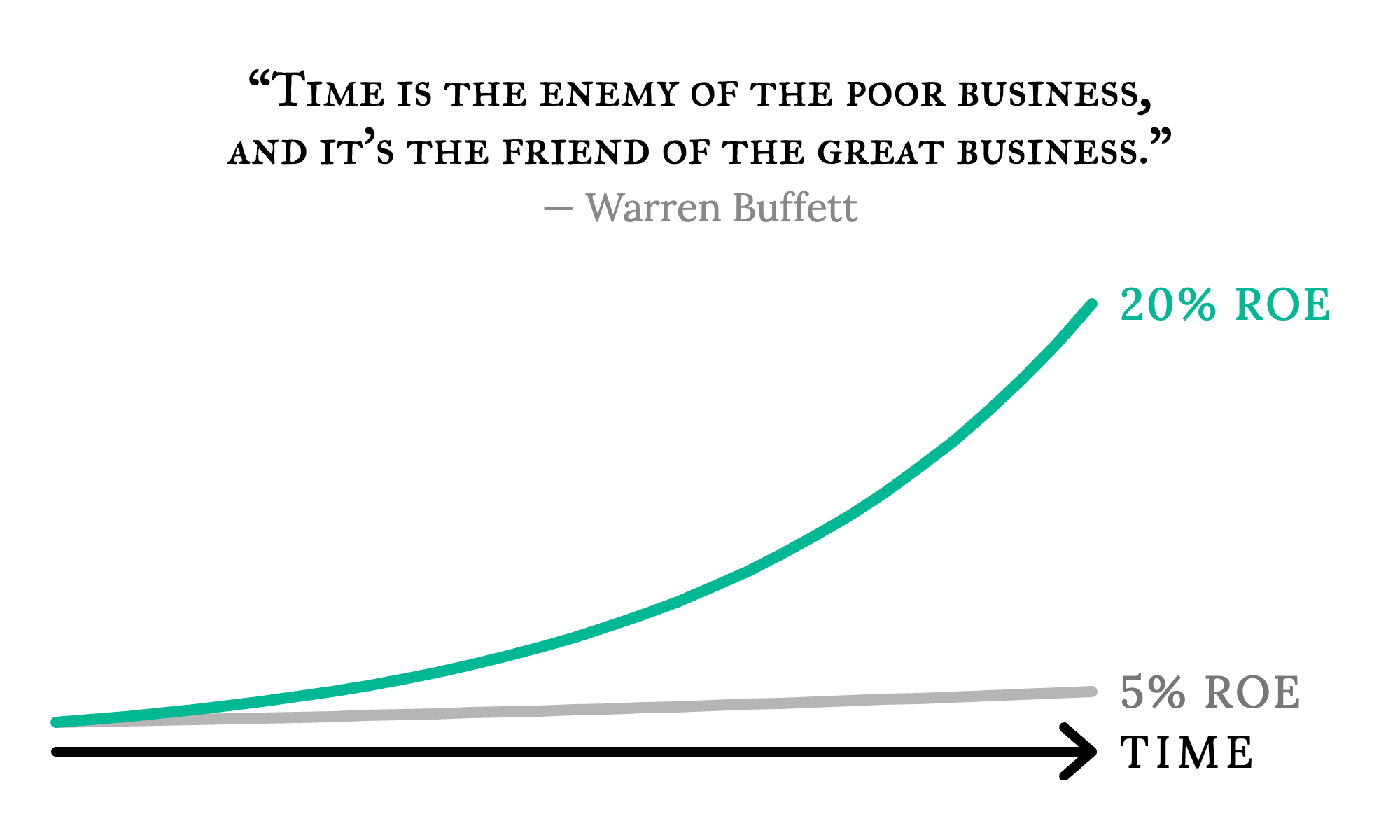
“Those companies had low returns on equity. If you have a business that’s earning 5–6% on equity, and you hold it for a long time, you are not going to do well, even if you buy it cheap to start with.
Time is the enemy of the poor business, and it’s the friend of the great business.
If you have a business earning 20–25% on equity, and it does that for a long time, time is your friend. Time is your enemy in a low-return business. You may be lucky enough to pick the exact moment when it gets taken over by someone else, but we like to think, when we buy a stock, that we’re going to own it for a very long time—and therefore we have to stay away from businesses with low ROEs.”
[📝 Note]
A bad business that is dirt cheap? Pass.
A mediocre business at a low price? Thanks, but no thanks.
A high-quality business at a fair price? Give me more so I can never let go.
— Pulak Prasad, What I Learned About Investing from Darwin
PART II: Valuation and Intrinsic Value
📖 Intrinsic Value
🖍️ Highlight 1
1997 Meeting (02:33:27)
Warren Buffett: “Looking at any business, if we could see its future cash inflows or outflows to or from the owners over the next, call it one hundred years, or until the business is extinct, and then could discount that back at the appropriate interest rate, that would give us a number for intrinsic value. In other words, it would be like looking at a bond that had a whole bunch of coupons on it that was due in a hundred years. If you could see what those coupons are, you could figure out the value of that bond compared to government bonds, if you wanted to stick an appropriate risk rate in. Or you could compare a government bond with 5% coupons to another government bond with 7% coupons. Each one of those bonds has a different value because they have different coupons. Businesses have coupons that are going to develop in the future, too. The only problem is that they aren’t printed on the instrument, it’s up to the investor to try to estimate what those coupons are going to be over time. In high-tech businesses or something like that, we don’t have the faintest idea what the coupons are going to be. When we get into businesses where we think we can understand them reasonably well, we try to print the coupons out. We are trying to figure out what businesses will be worth in ten or twenty years.
“When we bought See’s Candies in 1972, we had to come to a judgment as to whether we could figure out the competitive forces that would operate, the strengths and weaknesses of the company, and how that would look over ten, twenty, or thirty years. And if you attempt to assess intrinsic value, it all relates to cash flows. The only reason for putting cash into any kind of investment now is because you expect to take cash out in the future, not by selling it to somebody else, because that’s just a game of who beats who, but by what the asset produces over time. That’s true if you’re buying a farm, an apartment house, or a business. There are a number of filters which say to us we don’t know what that business is going to be worth in ten or twenty years; we can’t even make an educated guess. Obviously, we don’t think we know to two or three decimal places, anything like that, precisely what’s going to be produced. But we have a high degree of confidence that we’re in the ballpark with certain kinds of businesses. The filters are designed to make sure we’re in those kinds of businesses.
“We basically use long-term, risk-free/government bond-type interest rates to think back in terms of what we should discount future cash flows at. And that’s what the game of investing is all about. Investment is putting out money to get more back later from the asset; not by selling it to somebody else, but by what the asset itself will produce. If you’re an investor, you’re looking at what the asset (business) is going to do. If you’re a speculator, you’re primarily focusing on what the price is going to do independent of the business. That’s not our game. If we’re right about the business, we’re going to make a lot of money. And if we’re wrong about the business, we don’t expect to make money.”
🖍️ Highlight 2
2000 Meeting (00:11:56)
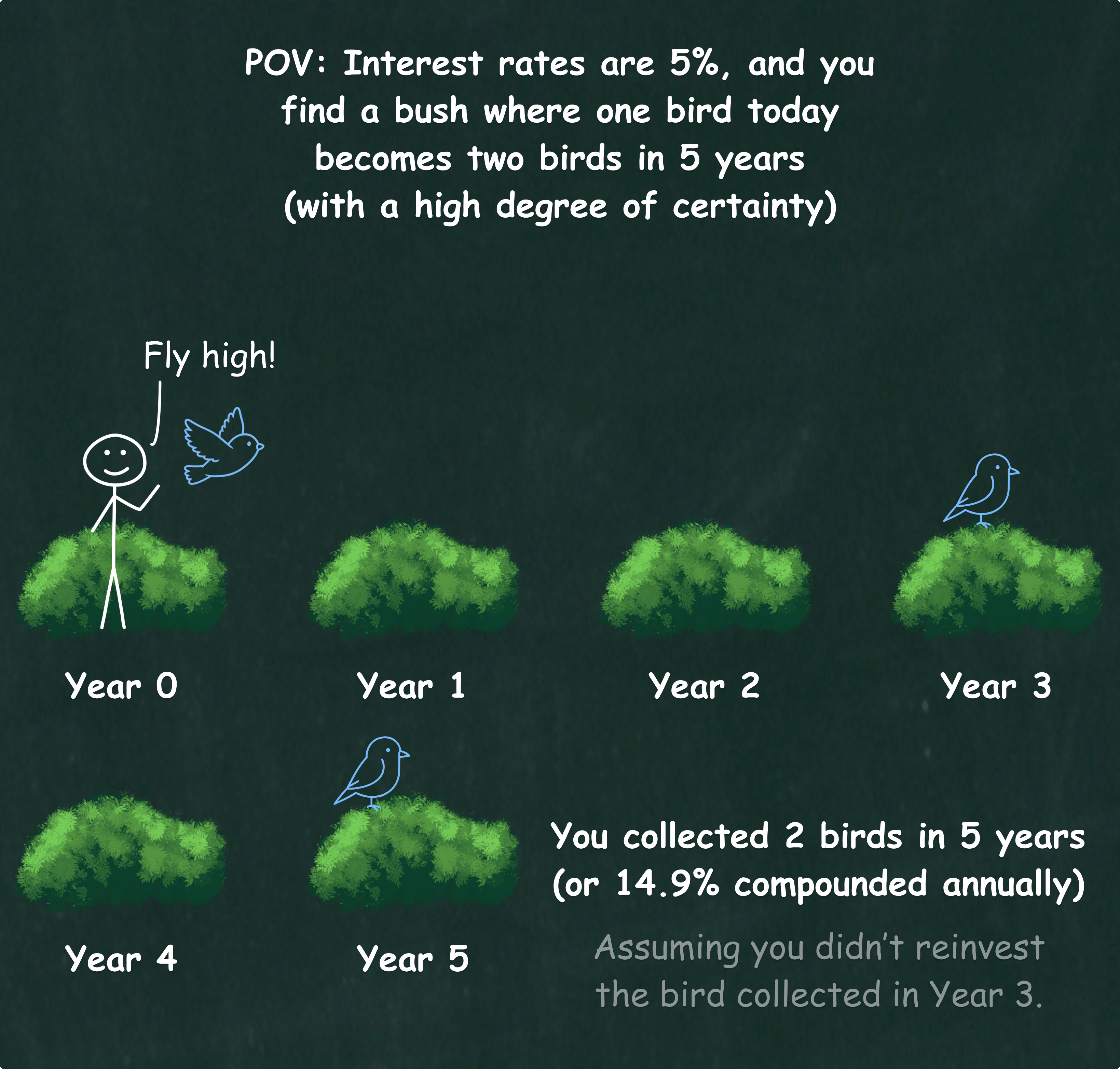
Warren Buffett: The first investment primer that I know of, and it was pretty good advice, was delivered in about 600 B.C. by Aesop: ‘A bird in the hand is worth two in the bush.’ Incidentally, Aesop did not know it was 600 B.C.—he was smart, but not that smart. Aesop was onto something, but he didn’t finish it, because there’s a couple of other questions that go along with it. He forgot to say exactly when you were going to get the two from the bush, and he forgot to say what the interest rates were that you had to measure this against. But if he’d given those two factors, he would have defined investment for the next 2,600 years.
You will trade a bird in the hand, which is investing—you lay out cash today; then … you have to evaluate how many birds are in the bush, and when they’re going to come out. Now, if interest rates are 5%, and you’re going to get two birds from the bush in five years, that’s much better than a bird in the hand now. If you get them in five years, that’s roughly 14% compounded annually and interest rates are only 5%. But if interest rates were 20%, you would decline to take the two birds in the bush five years from now. It’s not good enough, because at 20%, if I just keep this bird in my hand and compound it, I’ll have more birds in five years.
… Usually people associate “growth” with a lot more birds in the bush, but you still have to decide when you’re going to get them, you have to measure that against interest rates, and you have to measure it against other bushes (opportunity costs). And that’s all investing is: It’s a value decision based on what something is worth, how many birds are in the bush, when you’re going to get them, and what interest rates are.
📖 Discounted Cash Flow (DCF) Models
🖍️ Highlight
1996 Meeting (04:18:46)
Charlie Munger: “Warren talks about these discounted cash flows, but I’ve never seen him do one. If it isn’t obvious that it’s going to work well unless you do the calculation, he tends to go on to the next idea.”
Warren Buffett: “It’s true: If you have to actually do it with pencil and paper, it’s too close to think about. It ought to just kind of scream at you that you’ve got this huge margin of safety.”
📖 Interest Rates and Valuation
🖍️ Highlight
1994 Meeting (02:04:19)
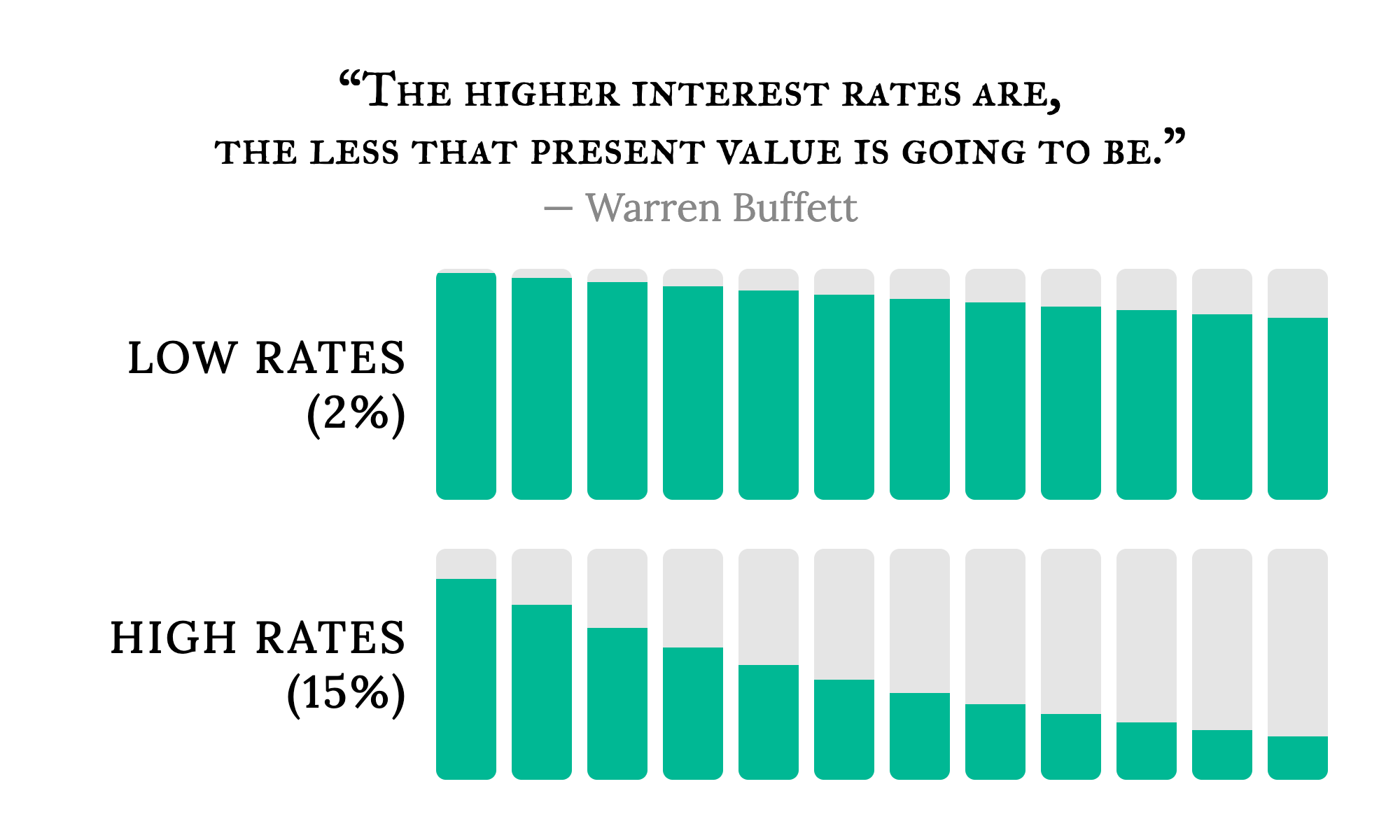
Warren Buffett: “The value of a business, farm, apartment house, or any economic asset, is 100% sensitive to interest rates, because all you are doing in investing is transferring some money to somebody now in exchange for what you expect the stream of money to be over a period of time. The higher interest rates are, the less that present value is going to be. The intrinsic valuation of every business is, by its nature, 100% sensitive to interest rates.”
📖 P/E Ratios
🖍️ Highlight 1
1995 Meeting (04:27:46)
Warren Buffett: “A multiple of today’s earnings is not primarily determinative of things. We bought Coca-Cola, for example, in 1988 and 1989 at $11 a share, as low as $9, as high as $13, but it averaged about $11. Most estimates are for earnings between $2.30 and $2.40 this year. So, that’s under five times this year’s earnings, but it was a pretty good size multiple back when we bought it. It’s the future that counts. It’s like what Wayne Gretzky says, to skate to where the puck is going, not where it is. The current multiple interacts with the reinvestment of capital and the rate at which that capital’s invested, to determine the attractiveness of something now.
🖍️ Highlight 2
2000 Meeting (01:08:09)
Warren Buffett: “One of the best buys we ever made was in 1976 when we bought what became, through repurchases, 50% of GEICO, at a time when the company was losing a lot of money, and was destined to lose a lot of money in the immediate future. The fact they were losing money was not lost on us, but we thought we saw a future there that was significantly different than the current situation. So, it would not bother us in the least to buy into a business that currently was losing money for some reason that we understood, and where we thought that the future was going to be significantly different. There’s no P/E ratio that we have in mind as being a cutoff point at all. You could have some business making a sliver of money on which you would pay a very, very high P/E ratio. We look at all of these as businesses. For example, at [private jet company] NetJets, we’re losing money in Europe. We expect to lose money in Europe getting established. Does that mean it’s a bad thing to buy it? No.
“There are all kinds of decisions that involve the future looking different, in some important way, to the present. Most of our decisions relate to things where we expect the future not to change much. American Express was a good example. When we bought it in 1964, a fellow named Tino De Angelis had caused them incredible trouble; it looked for a time as if it could break the company. If you’d been charging what Tino had stolen from the company against the income account that year, or the legal costs that were going to be attached to it, you were looking at a significant loss. But the question was, what was American Express going to look like ten or twenty years later? We felt very good about that.
“So there are no arbitrary cutoff points. But there is that focus on, how much cash will this business deliver, between now and Kingdom Come? As a practical matter, if you estimate it for twenty years or so, the terminal values get less important. But you do want to have, in your mind, a stream of cash that will be thrown off over, say, a twenty-year period, that makes sense discounted at a proper interest rate, compared to what you’re paying today.”
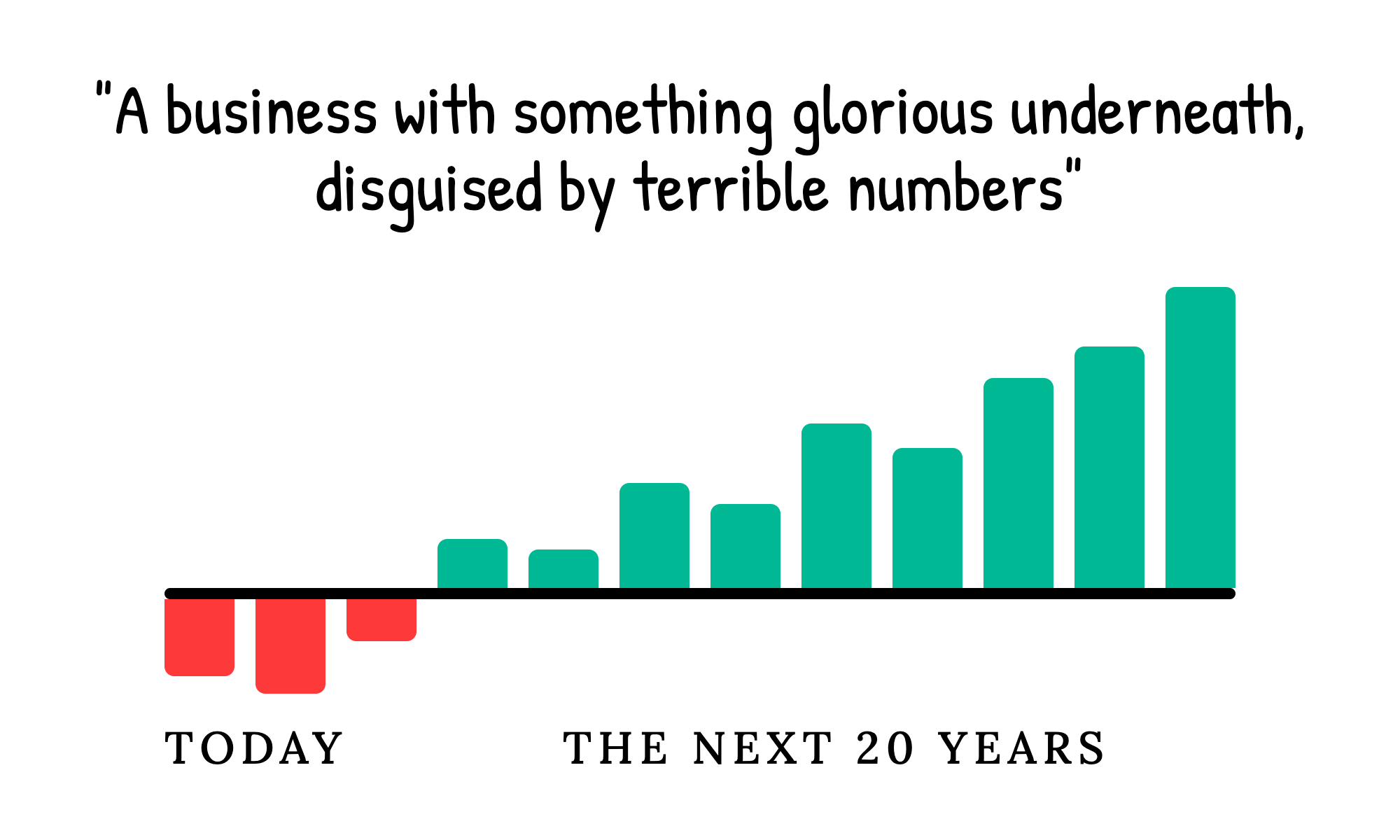
Charlie Munger: “The answer is almost the exact reverse of what you were pointing toward. A business with something glorious underneath, disguised by terrible numbers that cause cutoff points in other people’s minds, is ideal for us, if we can figure it out.”
Warren Buffett: “And we’ve had a couple of those in our history that have made us a lot of money.”
[📝 Note]
“A business with something glorious underneath, disguised by terrible numbers.”
I think a great example of that is Amazon…
We will make bold rather than timid investment decisions where we see a sufficient probability of gaining market leadership advantages. Some of these investments will pay off, others will not, and we will have learned another valuable lesson in either case. When forced to choose between optimizing the appearance of our GAAP accounting and maximizing the present value of future cash flows, we’ll take the cash flows.
— Jeff Bezos, Invent and Wander.
Maximizing the present value of future cash flows and making bold investment decisions will obviously make the P/E ratio look quite expensive (if not uncomputable), but if you really understand the business (in this case Amazon) you’d have done quite well buying the stock.
📖 Discount Rates
🖍️ Highlight
2007 Meeting (03:15:14)
Warren Buffett: “We don’t have formal discount rates. Every time I start talking about this stuff, Charlie reminds me that I’ve never prepared a spreadsheet. But, in effect, I do it in my mind. We are going to want to get a significantly higher return, obviously, in terms of cash produced relative to the amount we’re outlaying now for a business, than from a government bond. That has to be the yardstick at a base. How much more do we want? Well, if government bond rates were 2%, we’re not going to buy a business to earn 3.5% expectancy over the years. We just don’t want to commit our money that way; we’d rather sit around and wait a little while. If they’re 4.75%, what do we hope to get over time? We want to get a fair amount more than that. But I don’t sit down every morning, call Charlie, and say, ‘What’s our hurdle rate today?’ We’ve never used the term. We want enough so we feel very comfortable that if they closed down the stock market for a couple years, or if interest rates go up another hundred or two hundred basis points, we’re still happy with what we’ve bought. Beyond that, I know it sounds kind of fuzzy, but it is fuzzy.”
Charlie Munger: “The concept of a hurdle rate makes nothing but sense, and yet a lot of terrible errors are made by people talking about hurdle rates. Just because you can measure something and guess at it, doesn’t mean it should be the controlling variable in dealing with a messy world. I don’t think there’s any substitute for thinking about a whole lot of investment options, and thinking about why one is better than another and what the likely returns are from each. The trouble with the hurdle rate concept, not that we don’t have one, in a sense, is that it doesn’t work as well as a system of comparing things. In other words, if I have something available that I think will give me 8% for sure and I can buy all I want of it, and you’ve got a perfectly good investment that I think will earn 7%, I don’t have to waste five minutes with you ... I can go on to some different subject. ... In the real world, opportunity costs are what you want to make decisions based on.”
[📝 Note]
Reasoning over spreadsheets…
Your intuition says something as a starting thesis but then you have to reason through it, and the reasoning of it is much, much more important to me than a spreadsheet. I hate spreadsheets because you can make spreadsheets do whatever you want. You can make any chart you want out of a spreadsheet, you just got to type in some numbers... I love words for that reason. Words are reasoning.
— Jensen Huang, A Conversation With NVIDIA’s Jensen Huang. (link)
📖 Permanent Holdings / Never Sell?
🖍️ Highlight
1998 Meeting (00:25:50)
Warren Buffett: “The best thing to do is buy a stock that you don’t ever want to sell, and that’s what we’re trying to do. That’s true when we buy an entire business like GEICO, See’s Candies, or The Buffalo News. We’re not buying those to resell. What we’re trying to do is buy a business that we will be happy with if we own it the rest of our lives, and we expect to with those.
“The same principle applies to stocks. You get extra options with marketable securities: You can add to holdings. We can never own more than 100% of a business, but if we own 2% of a publicly traded business and we like it at a given price, we can take our ownership interest to 4% or 5%. So that’s an advantage. ... We think they’re wonderful businesses or we wouldn’t own them at all. ... The real thing to do with a great business is to just hang on for dear life.”
[📝 Note]
Listen idiot. You’re going to get some companies in the portfolio that are truly exceptional. You will know that they are exceptional... when you own an exceptional business, a fraction of an exceptional business, do not sell it at 90% of intrinsic value, do not sell it when it’s fully priced. Do not sell it when it’s overpriced. You can possibly think about selling it when it’s egregiously overpriced. And when you figure out the difference between overpriced and egregiously overpriced, call me collect.
— Mohnish Pabrai, Interview at the Investors Podcast. (link)
📖 Paying Up for Quality
🖍️ Highlight
1998 Meeting (04:43:24)
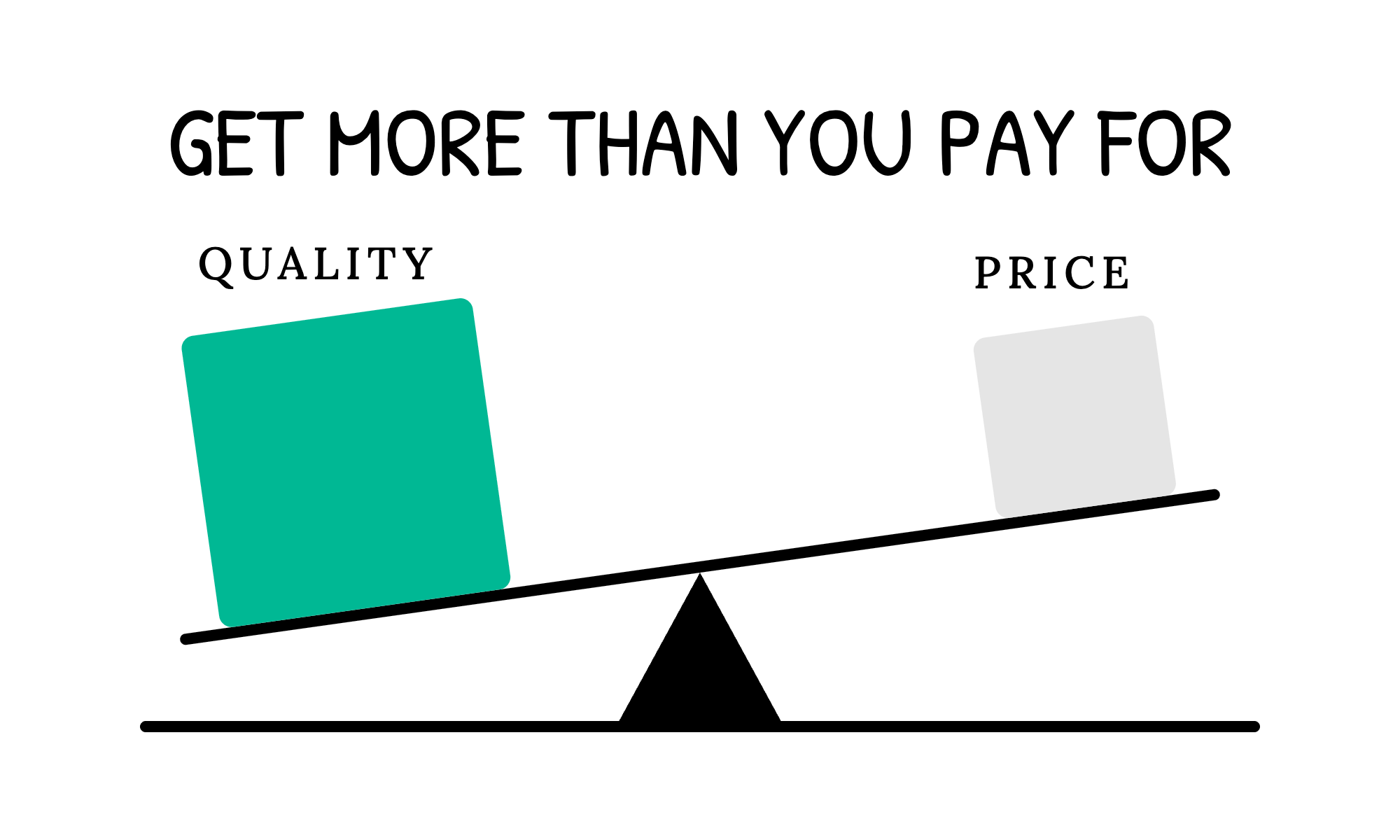
Charlie Munger: “The investment game always involves considering both quality and price. The trick is to get more quality than you’re paying for in the price. It’s just that simple, but it’s not easy.”
Part IV: Management and Board of Directors
📖 Avoiding Bad Actors
🖍️ Highlight 1
1995 Meeting (03:37:50)
Warren Buffett: “We basically have the attitude that you can’t make a good deal with a bad person, so we just forget about it. We don’t try and protect ourselves with contracts or getting into all kinds of due diligence, we just forget about it. We can do fine over time dealing with people we like, admire, and trust. The bad actor will tend to try and tantalize you in one way or another, and you won’t win. It just pays to avoid them. We started out with that attitude, and maybe one or two experiences have convinced us even more so than before that that’s the way to play the game.”
🖍️ Highlight 2
1994 Meeting (00:31:47)
Warren Buffett: “Charlie and I get to work with people we like. It makes life a lot simpler.”
Charlie Munger: “And we tend to like people we admire.”
[📝 Note]
Hire and promote first on the basis of integrity; second, motivation; third, capacity; fourth, understanding; fifth, knowledge; and last and least, experience. Without integrity, motivation is dangerous; without motivation, capacity is impotent; without capacity, understanding is limited; without understanding, knowledge is meaningless; without knowledge, experience is blind. Experience is easy to provide and quickly put to good use by people with all the other qualities.
— Dee Hock, founder of Visa
My most popular tweet of all time is this one... it says if you can’t see yourself working with somebody for life, don’t work with them for a day.
— Naval Ravikant, Happiness Hacks (Tim Ferriss Show)
📖 Addressing Bad News
🖍️ Highlight 1
1995 Meeting (02:01:40)
Warren Buffett: “Charlie and I are always more interested in bad news than good news; we figure the good news will take care of itself. We only give a couple of instructions to people when they go to work for us. One of them is to think like an owner, and the second is to just tell us the bad news immediately; we can take bad news, but we don’t like bad news late.”
[📝 Note]
“I brought him [Jeff Bezos] very bad news about our business, and for some reason, he got excited,” Breier says.
— Brad Stone, The Everything Store (on Bezos).
🖍️ Highlight 2
2018 Meeting (00:49:19)
Warren Buffett: “We’re going to make mistakes. I will guarantee you that we will get some unpleasant news at Berkshire. I don’t know what it will be. The most important thing is that we do something about it. And there have been times when I procrastinated, and Charlie has been the one that jabs me into action. He’s performed a lot of services you don’t know about.”
Part V: Berkshire Hathaway
📖 Berkshire’s Acquisitions
🖍️ Highlight
2002 Meeting (01:29:20)
Charlie Munger: “If you stop to think about it, the ordinary result when a big publicly held corporation buys another corporation is that, maybe two-thirds of the time, it’s a terrible deal for the buying corporation, and yet the people have taken an enormous time doing it. We’ve bought all these businesses taking practically no time doing it, and on average they’ve worked out wonderfully. Why is that? The answer is we wait for the no-brainers. We’re not trying to do the difficult things and we have the patience to wait. And then we’re so peculiar that there actually are a good number of businesses in America who prefer selling to us than to other people. That’s very helpful.”
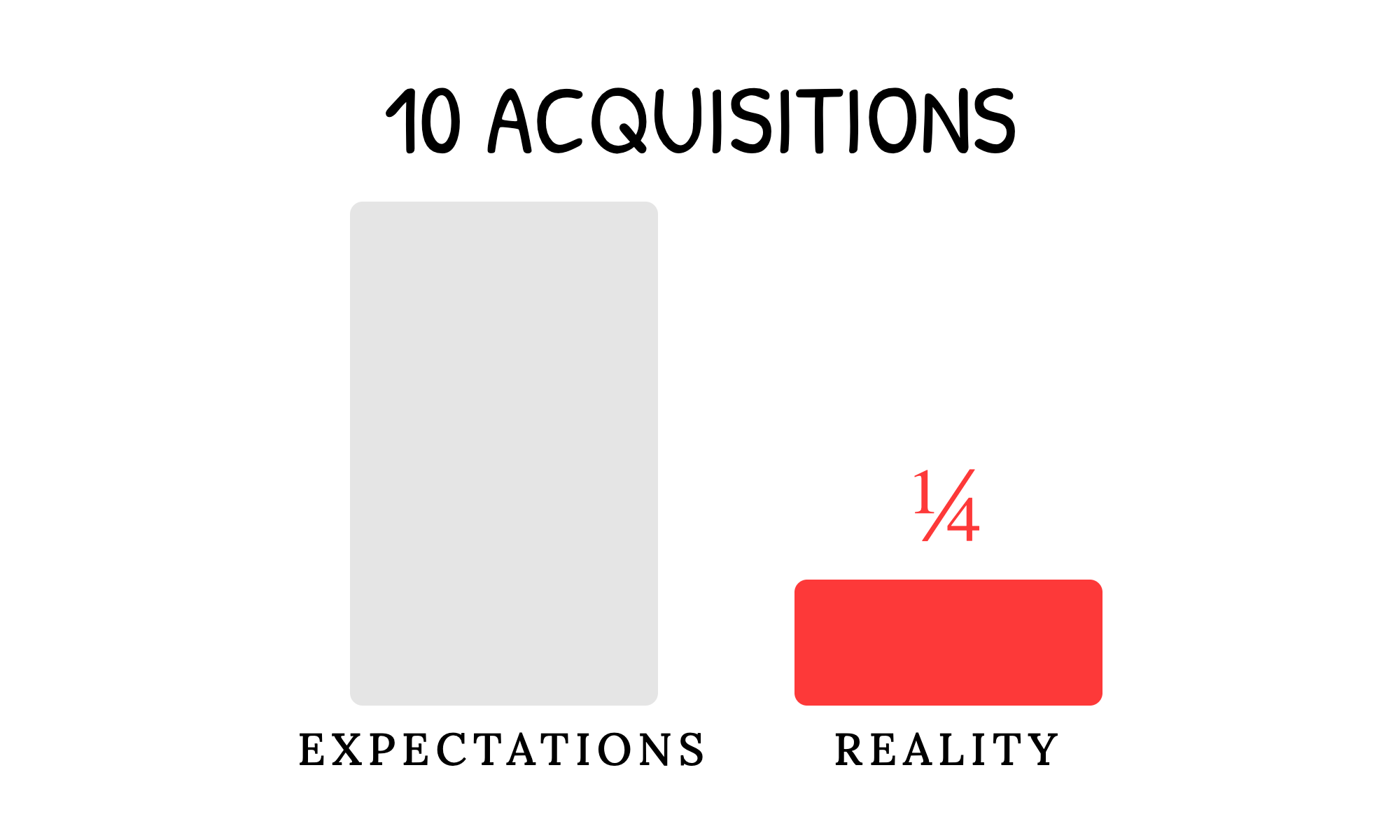
Warren Buffett: “I just saw a review of a major company. It made ten acquisitions in a recent five-year period. Every one of those acquisitions was preceded by due diligence and all the baloney they go through. Not one lived up to, or was even close to, the expectations of the presentation that was made at the time of purchase. In aggregate, the ten earned one-quarter of what they were projected to earn in 2001. In other words, the projections were four times larger than the actual earnings. And this is a company with a strategic acquisition department, loads of people to go over the due diligence, and with investment bankers ‘helping them’ all along the way. And ten out of ten failed miserably. You have to ask yourself, how can you produce that result? Because the world didn’t go to hell during that period, either. They were buying what was getting sold to them, and it was fulfilling some myths that the management had about itself. And managements have many myths about themselves. It isn’t that complicated if you just wait for the fat pitch.”
[📝 Note]
When he had conviction, [Tom Murphy] was prepared to act aggressively. Murphy was willing to wait a long time for an attractive acquisition.
He once said, “I get paid not just to make deals, but to make good deals.”
— William Thorndike, The Outsiders (on Tom Murphy).
📖 Berkshire’s Strategic Vision
🖍️ Highlight 1
1998 Meeting (00:30:02)
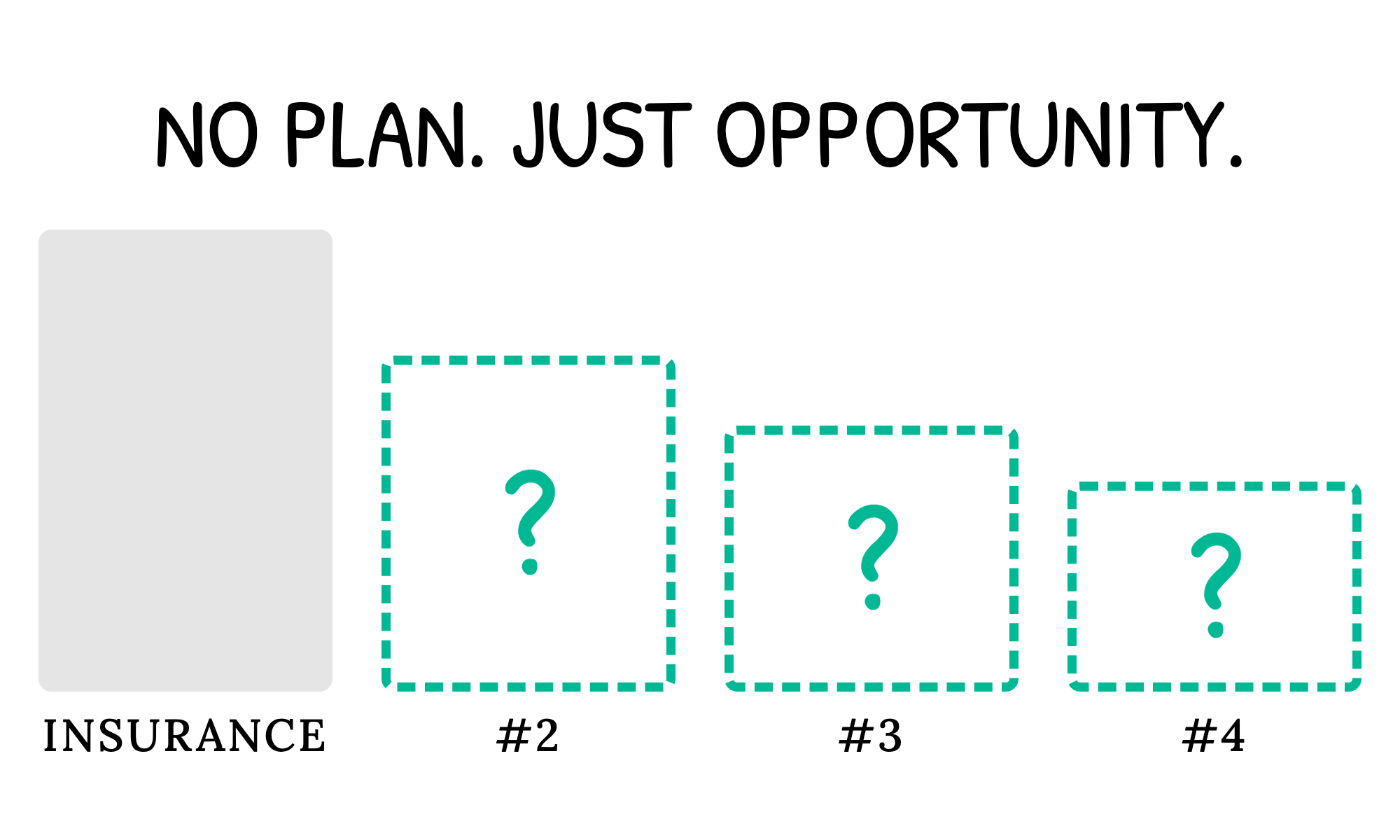
Warren Buffett: “We do know our main business is insurance; it will be accidental, to some extent, over the next ten years, which business ends up being the second or third or fourth largest. That’ll be determined by opportunity ... We have no predetermined course of action whatsoever at Berkshire. We have no strategic planning department. We don’t have any strategic plan. We react to what we think are opportunities. And if it’s a business we can understand, and particularly if it’s big, we would love to make it number two.”
Charlie Munger: “I also want to proudly say that we have no mission statement.”
Warren Buffett: “We’ve never had a consultant. And we try to keep things pretty simple. We still have twelve people at headquarters ... We hope to grow a lot, but we don’t hope to grow at headquarters.”
[📝 Note]
“Strategy is not words. Strategy is action,” Jensen [Huang] said. “We don’t do a periodic planning system. The reason for that is because the world is a living, breathing thing. We just plan continuously. There’s no five-year plan.”
— Tae Kim, The Nvidia Way.
Once criticized for not having a business plan, Henry replied that he knew that a lot of people running companies had very definite plans they followed assiduously. But we’re subject to a great number of outside influences on our businesses, and most of them can’t be predicted. So my plan is to stay flexible... “My only plan is to keep coming to work every day. I like to steer the boat each day rather than plan ahead way into the future.”
— George Roberts, Distant Force (on Henry Singleton).
🖍️ Highlight 2
On holding cash…
2022 Meeting (00:00:37)
Warren Buffett: “Anything could change at Berkshire, but the one thing that won’t change is that we will always have a lot of cash on hand. And when I say cash, I don’t mean commercial paper; in 2008 and 2009, when the financial panic came along, we didn’t own anybody’s commercial paper. We didn’t have money market funds. We had Treasury bills. We believe in having cash. There have been a few times in history, and there will be more times in history, where if you don’t have it, you don’t get to play the next day. It’s like oxygen. It’s there all the time, but if it disappears for a few minutes, it’s all over.”
[📝 Note]
Robustness requires some kind of redundancy—to have inventory… People think it’s silly to have cash in the bank. [But] you are more robust if you have cash in the bank! And actually even antifragile because you can capture opportunities that way.
— Nassim Taleb, The Dark Side of Optimization. (link)
“I like to keep a lot of financial fat under my belt. There is nothing that can ever take the place of cash.”
— J. Paul Getty, As I See It.
📖 Buying Businesses vs Buying Stocks
🖍️ Highlight
1999 Meeting (01:29:06)
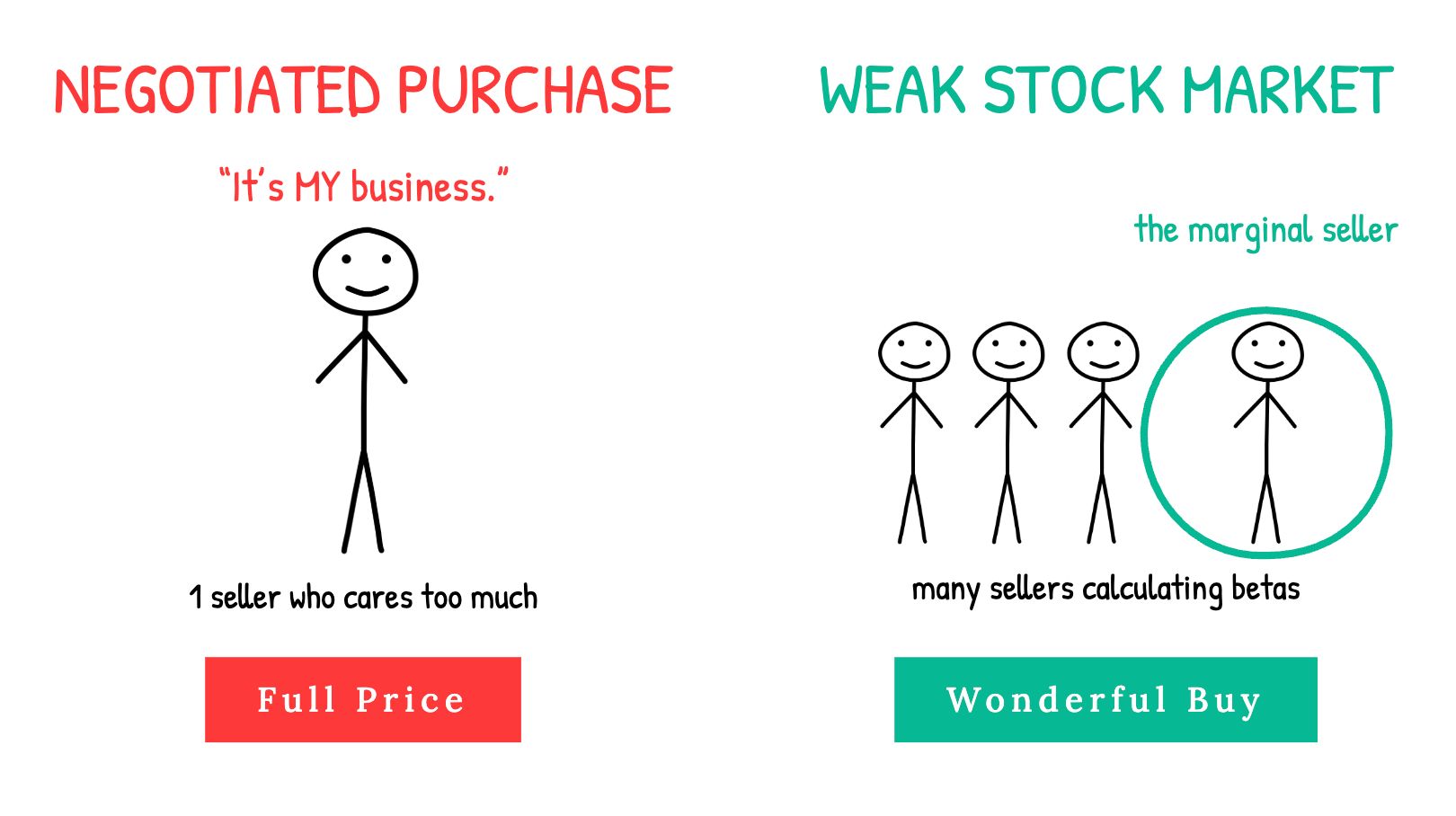
Warren Buffett: “We’ve always wanted to acquire entire businesses. People never seemed to really believe that back when we were buying See’s Candies or The Buffalo News or National Indemnity. But that’s been our number one preference right along. It’s just that we’ve found, much of the time, we could get far more for our money, in terms of wonderful businesses, by buying pieces in the stock market, than we could by negotiated purchase ...
“It’s almost impossible to make a wonderful buy in a negotiated purchase. You will never make the kind of buy in a negotiated purchase that you can in a weak stock market. It just isn’t going to happen. The person on the other side cares too much. Whereas, in the stock market in a 1973 or 1974, you’re dealing with the marginal seller, and whatever price they establish for the business, you could buy it. I couldn’t have bought the entire Washington Post Company for $80 million in 1974, but I could buy 10% of it from a bunch of people who were calculating betas or doing something of the sort. They were in a terrible market. And it was possible to buy a piece of it on that valuation. You never get that kind of buy in a negotiated purchase.”
[📝 Note]
This is from the president of Teledyne George Roberts in 1970:
“We decided there was no point in paying inflated prices for complete ownership of companies when we could buy a substantial interest in them through our insurance companies when the market prices were favorable.”
— George Roberts, Distant Force.
(Teledyne is an industrial conglomerate founded by Henry Singleton — whom Buffett praised to have the best operating and capital deployment record in American business).
📖 Berkshire’s Long-Term Success
🖍️ Highlight 1
1999 Meeting (04:12:34)
Warren Buffett: “The record of Berkshire Hathaway, to the extent it’s been good, has not been because we’ve done brilliant things, but because we’ve done fewer dumb things than most. Why smart people do things that are against their self-interest is really puzzling.”
[📝 Note]
“I don’t believe I have the ability to say what is going to work. Rather, I try to eliminate what’s not going to work. I think being successful is just about not making mistakes. It’s not about having correct judgment. It’s about avoiding incorrect judgments.”
— Naval Ravikant, The Almanack of Naval Ravikant.
🖍️ Highlight 2
2015 Meeting (00:39:39)
Warren Buffett: “I had three extraordinary pieces of luck, in terms of the insurance business. One was, at twenty years old, when I spent a Saturday afternoon in 1951 with a fellow named Lorimer Davidson [CEO at GEICO]. He spent four hours with some twenty-year-old kid he had never heard of before, and he explained the insurance business to me. I received an education at age twenty that I couldn’t have gotten at any business school in the United States. That was just pure luck ...
Then, in 1967, I got lucky again. Jack Ringwalt, for about five minutes every year, wanted to sell his company because he would get mad about something, some claim would come in that he didn’t like. And I told my friend Charlie Heider, ‘Next time Jack is in the mood, be sure to get him to my office.’ Charlie got him up there one day, and we bought National Indemnity ...
And then I really got lucky in the mid-1980s when, on a Saturday, some guy came in the office and he said, ‘I’ve never worked in the insurance business, but maybe I can do you some good.’ And that was Ajit Jain. How lucky can you get?
So, if you ask me whether we can pull off a trifecta like that again in the future, I’d say the odds are very much against it.
“The whole thing in business is being open to ideas as they come along, and insurance happened to be something I could understand. That was in my sweet spot ... There’s an awful lot of accident in life, but if you keep yourself open to having good accidents happen, and get past the bad accidents, some good things will happen.”
[📝 Note]
Leave room in your life for serendipity.
Same idea in relationships:
You need to have space in your life where you’re not booked with the people that you already know, so this way once in a blue moon an invitation will come along and a person will come into your life that’s suddenly really interesting, and now you’ll be able to make the time for them... leaving room in your life for serendipity.
— Naval Ravikant, Happiness Hacks (Tim Ferriss Show).
📖 Berkshire Dividend Policy
🖍️ Highlight
2008 Meeting (04:04:57)
Warren Buffett: “I do believe in dividends in a great many situations, including many of the companies in which we own stock. The test about whether to pay dividends is whether you can continue to create more than $1 of value for every $1 you retain. Take See’s Candies, which we own. See’s has paid virtually everything out to us that they’ve earned because they do not have the ability within to use the large sums they earn intelligently in their business. So it would be an enormous mistake for See’s Candies to retain the money. They distribute to Berkshire, and we hope that we move it in some other area where that $1 becomes worth $1.10 or $1.20, in present-value terms.
“If we do that, the shareholders are better off if we retain the money, because if they were going to get $1 in dividends versus it being worth $1.10 in market value immediately on a present-value basis, they’re better off selling a small percentage of their stock and realizing the required amount that way; they will have more money when they get through doing that than if we paid it in dividends. But if the time comes, and it will someday, when we don’t think we can use the money effectively to create more than $1 of market value per $1 retained, then it should be paid out. And, like I say, we do that individually within Berkshire. But because we have this ability to redistribute money in a tax-efficient way within the company, we have more reason to retain all of our earnings. If See’s were a standalone company, we would pay out practically all of the earnings in dividends, just like we do now, except it goes to Berkshire.
“We like companies in which we have investments to pay to us the money they can’t use efficiently in their own business. In some cases that’s 100% of what they earn; in some cases it’s 0%. We own some stocks that don’t pay any dividends. Did Costco pay any dividend for a while, Charlie?”
Charlie Munger: “While they were growing very rapidly, they paid no dividend. Now they’re paying one. Berkshire’s policy is much the same. Warren has always planned on paying large dividends; he does it in the mode of Saint Augustine when he said, ‘God, give me chastity, but not yet.’”
Warren Buffett: “I’ve always admired that.”
[📝 Note]
In 1987, at a time when both acquisition and stock prices (including his own) were at historic highs, Singleton concluded that he had no better, higher-returning options for deploying the company’s cash flow, and declared the company’s first dividend in twenty-six years as a public company. This was a seismic event for longtime Teledyne observers, signaling the arrival of a new phase in the company’s history.
— William Thorndike, The Outsiders (on Henry Singleton). (Your note: “He was against a dividend until he wasn’t.”)
📖 PETROCHINA
Buffett bought PetroChina in 2002 and 2003.
🖍️ Highlight
2008 Meeting (02:41:38)
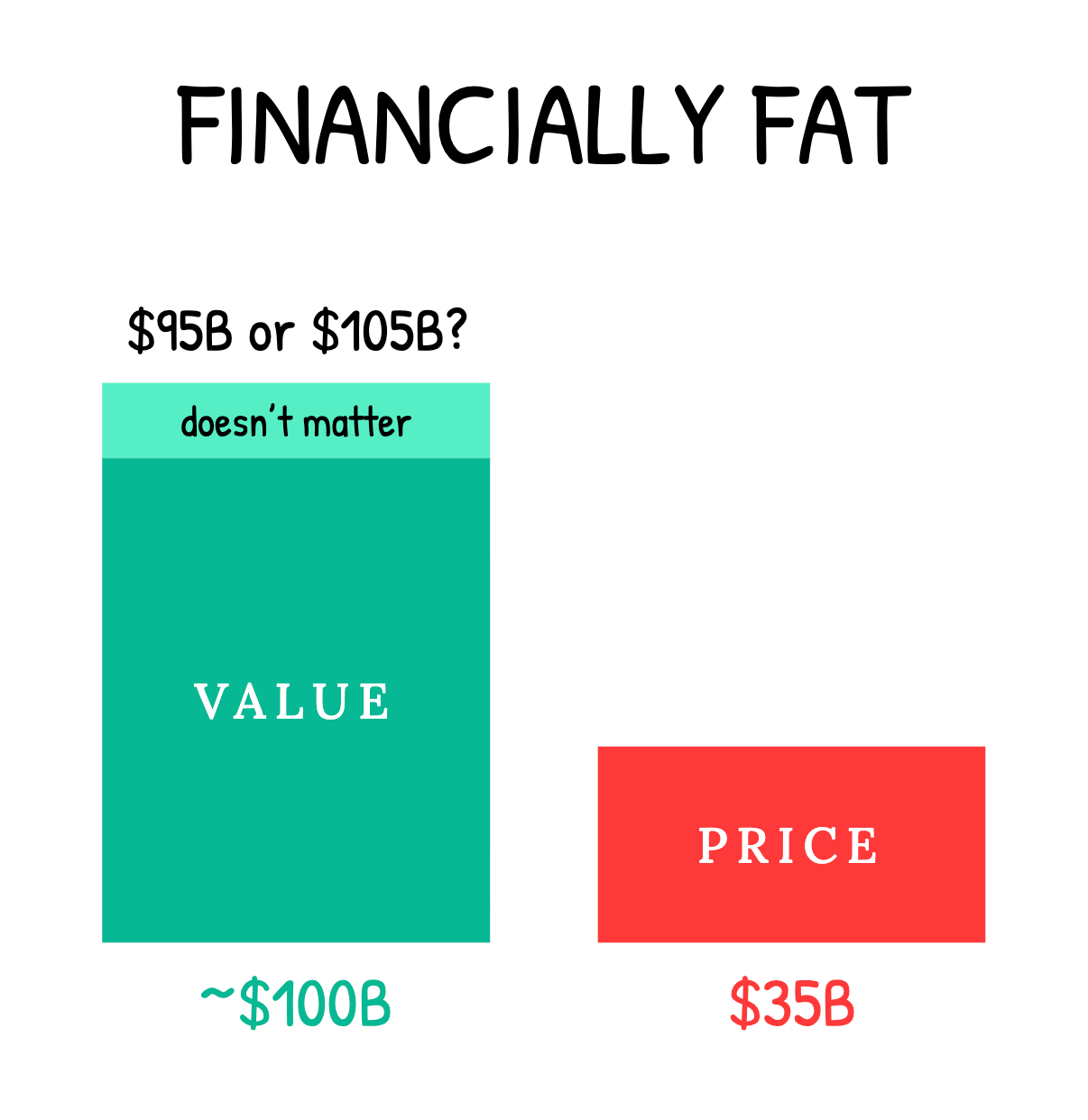
Warren Buffett: “The PetroChina annual report came out and I read it. That’s the only thing I ever did. I never contacted management, read a brokerage report, or asked for anybody’s opinion … I came to the conclusion it was worth $100 billion and it was selling for $35 billion.
“What’s the sense of talking to management? If you talk to management of almost any company, they’ll say they think their stock is a wonderful buy—it doesn’t make any difference. Now, if I thought the company was worth $40 billion, then at that point you have to try to refine your analysis more. But I didn’t need to know whether it was worth $95 billion or $105 billion if I was buying it at $35 billion.
“Any further refining of analysis would be a waste of time when what I should be doing is buying the stock. We really like things that you don’t have to carry out to three decimal places. If you have to carry it out to three decimal places, it’s not a good idea. It’s like if somebody walked in the door and they weighed somewhere between 300 and 350 pounds; I might not know how much they weigh, but I would know they were fat. That’s all I’m looking for, something that’s financially fat. … It should hit you between the eyes.”
Charlie Munger: “I would argue that we have lower due diligence expenses than anybody else in America, and that we have had less trouble because we had less expense … I think our operation is safer because we think like engineers. We want these margins of reliability. Others are trying to do something really difficult, which is to have fine-grain judgments in very complex areas, and rely on other people to do it who are getting paid fees … I think it’s much safer to do it our way.”
Warren Buffett: “If you think the auditors know more about making an acquisition than you do, you ought to take up auditing and let them run the business, as far as we’re concerned. When we get a call on something like [candy and chewing gum company] Mars/Wrigley … if the value of Wrigley depends on a specific lease or a given environmental problem, forget it. There are these overriding considerations that are enormously important, and then there’s a whole lot of trivia that doesn’t mean anything.
“I’ve made plenty of big investment mistakes. I’ve never made one, in my view, that would have been avoided by conventional due diligence. And we would have spent a lot of money, and we would have wasted a lot of time and, in some cases, missed deals, simply because we wouldn’t have committed fast enough.”
📖 Determining Your Circle of Competence
🖍️ Highlight 1
2002 Meeting (03:36:13)
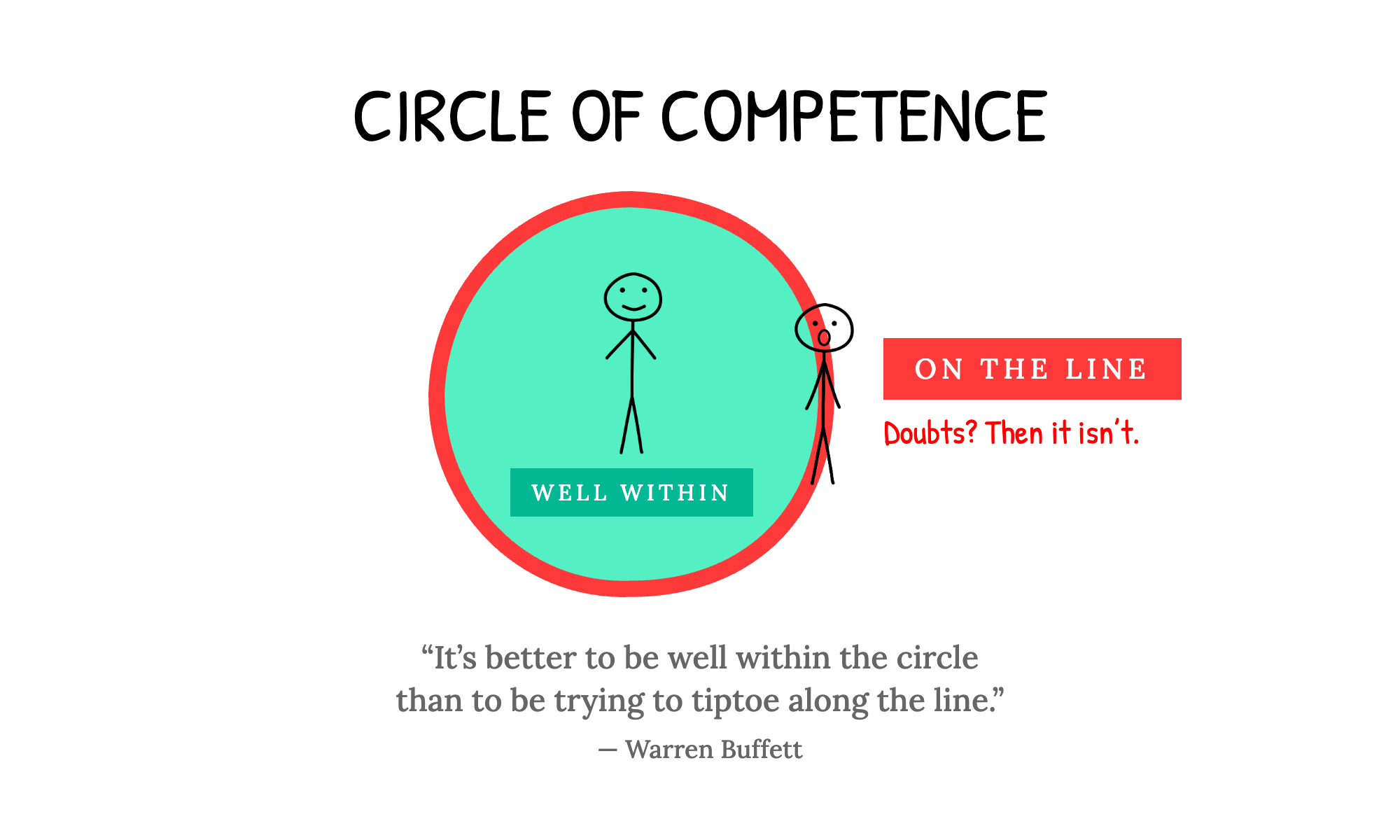
Warren Buffett: “If you have doubts about something being in your circle of competence, it isn’t. I would bet you can understand a Coke bottler, Coca-Cola, McDonald’s, Walmart, and Costco, in a general way, even if you are not able to value them. But there are all kinds of businesses … If you get to something your friend is buying, or that everybody says a lot of money is going to be made in, and you’re not sure whether you understand it or not, you don’t.
“It’s better to be well within the circle than to be trying to tiptoe along the line. And you’ll find plenty of things within the circle. It’s not terrible to have a small circle of competence. I’d say my circle of competence is pretty small, but it’s big enough. I can find a few things.”
[📝 Note]
I also believed then, as I do now after more than fifty years as a money manager, that the surest way to get rich is to play only those gambling games or make those investments where I have an edge.
— Ed Thorp, A Man for All Markets.
🖍️ Highlight 2
2006 Meeting (01:03:38)
Charlie Munger: “One of the foreign correspondents last year, after looking at us carefully, said, in effect, ‘You guys don’t seem smart enough to do so much better than other people as you’re doing. Have you got an explanation?’
“And we said, ‘We know the edge of our competency better than most people do.’ It’s a very useful thing to know the edge of your competency. And I always say it’s not a competency if you don’t know the edge of it.”
📖 Impact of Technological Change
🖍️ Highlight
1999 Meeting (02:44:26)
Warren Buffett: “We think all of that activity [in the technological field] is very beneficial from a societal standpoint. Our own emphasis from an investment perspective is trying to find businesses that are predictable in a general way, as to where they’ll be in ten, fifteen or twenty years.
“That means we’re looking for businesses that, in general, are not going to be susceptible to very much change. We view change as more of a threat in the investment process than an opportunity. That’s quite contrary to the way most people are looking at equities now. But we do not get enthused—with a few exceptions—about change as a way to make a lot of money.
“We’re looking for the absence of change to protect ways that are already making a lot of money and allow them to make even more in the future. So, we look at change as a threat.
“Whenever we look at a business and we see lots of change coming, nine times out of ten, we’re going to pass. And when we see something we think is very likely to look the same ten or twenty years from now, we feel much more confident about predicting it.
“Coca-Cola is still selling a product that is very, very similar to one it sold 110-plus years ago. And the fundamentals of distribution and talking to the consumer, and all of that sort of thing, really haven’t changed at all. Your analysis of Coca-Cola fifty years ago can pretty well serve as an analysis now.
“We’re more comfortable in those kind of business. It means we miss a lot of very big winners, but we would not have picked those out anyway. It does mean also that we have very few big losers and that’s quite helpful over time.”
[📝 Note]
The “Lindy Effect”: the longer something has survived, the longer is going to survive in the future…
How do I write? The common fallacy is that if you want people to read you in the future, you must project something related to the future, focused on the contemporary and be as different from the past as possible –say by populating your work with space machines, high technology, and revolutionary ideas. My U.S. publisher still tries to squeeze modern art on the cover when I am looking elsewhere.
No, no; it’s the exact opposite. I stood the idea on its head. If you want to be read in the future, make sure you would have been read in the past. We have no idea of what’s in the future, but we have some knowledge of what was in the past. So I make sure I would have been read both in the past and in the present time, that is by both the comtemporaries and the dead. So I speculated that books that would have been relevant twenty years in the past (conditional of course of being relevant today) would be interesting twenty years in the future.
— Nassim Taleb, How I Write. (link)
📖 Predictions & Simplicity
🖍️ Highlight
1998 Meeting (00:08:29)
Charlie Munger: “I would say that if our predictions have been a little better than other people’s, it’s because we’ve tried to make fewer of them.”
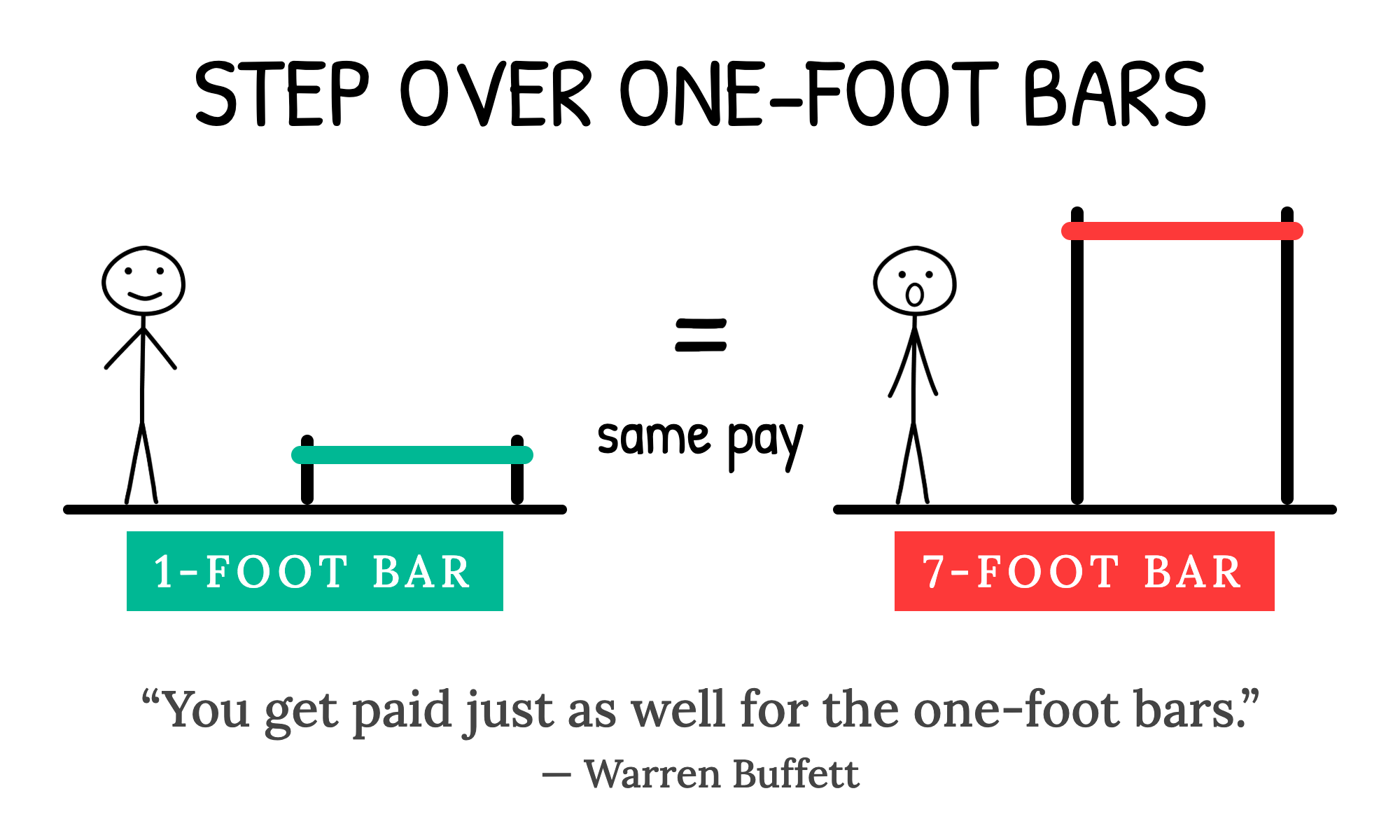
Warren Buffett: “This is not like Olympic diving where they have a degree of difficulty factor, where if you can do some very difficult dive, the payoff is greater than some very simple dive. That’s not true in investments. You get paid just as well for the simplest dive, as long as you execute it all right … We look for one-foot bars to step over rather than seven-foot or eight-foot bars to try and set some record by jumping over. You get paid just as well for the one-foot bars.”
📖 Moats and Sustainable Competitive Advantages
🖍️ Highlight 1
1995 Meeting (01:51:03)
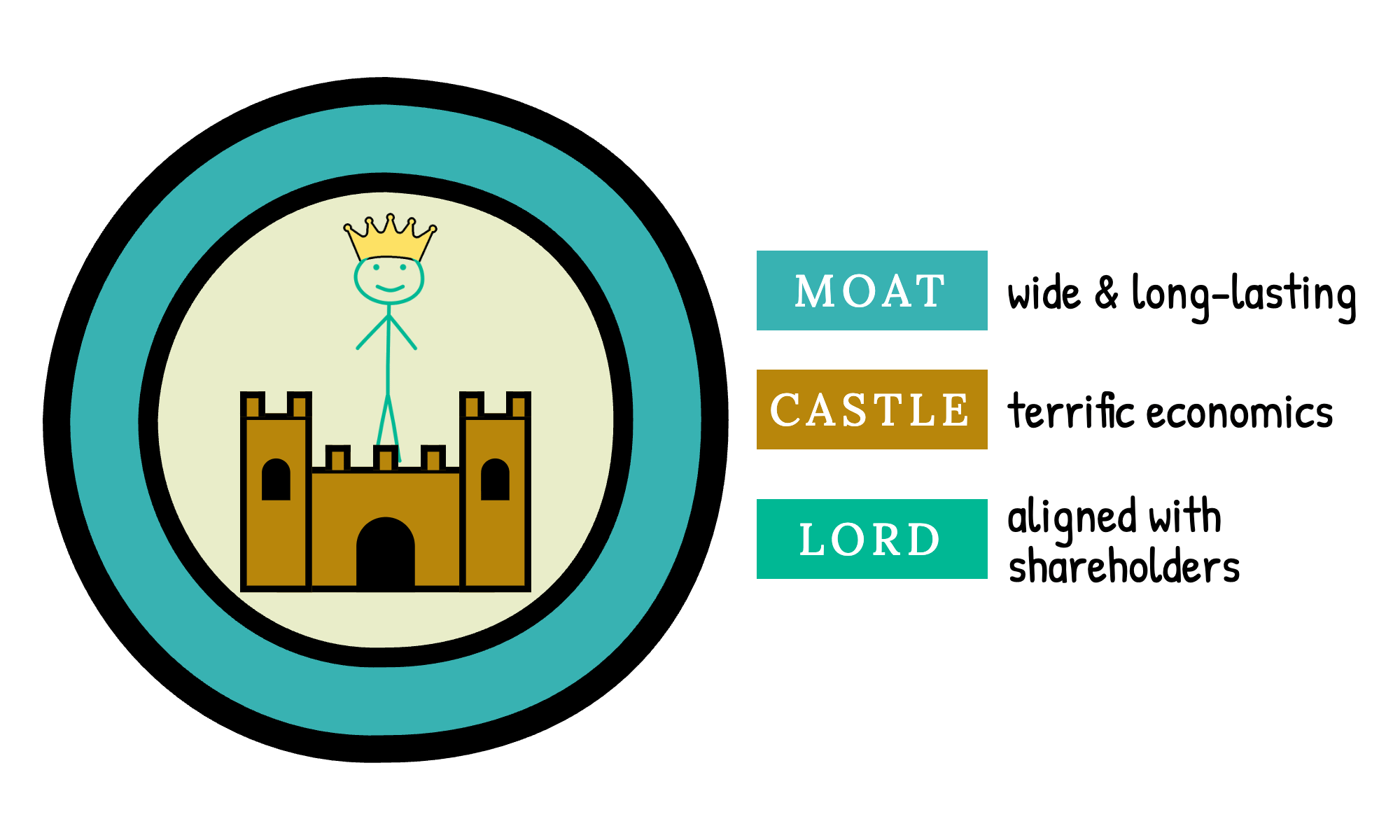
Warren Buffett: “We’re trying to find a business with a wide and long-lasting moat around it, protecting a terrific economic castle with an honest lord in charge of the castle. In essence, that’s what business is all about … We’re trying to find a business that, for one reason or another, has this moat around it—it can be because it’s the low-cost producer in some area, it can be because it has a natural franchise because of surface capabilities, it can be because of its position in the consumers’ mind, it can be because of a technological advantage, or any kind of reason at all.
“All moats are subject to attack in a capitalistic system; if you’ve got a big castle in there, people are going to be trying to figure out how to get to it. And most moats aren’t worth a damn in capitalism, that’s the nature of it, and that’s a constructive thing.
“We are trying to figure out why is that castle still standing, and what’s going to keep it standing or cause it not to be standing five, ten, twenty years from now? What are the key factors? How permanent are they? How much do they depend on the genius of the lord in the castle?
“And then if we feel good about the moat, we try to figure out whether the lord is going to try to take it all for himself, whether he’s likely to do something stupid with the proceeds, and so on. That’s the way we look at businesses.”
[📝 Note]
In the real world outside economic theory, every business is successful exactly to the extent that it does something others cannot. Monopoly is therefore not a pathology or an exception. Monopoly is the condition of every successful business. Tolstoy opens Anna Karenina by observing: “All happy families are alike; each unhappy family is unhappy in its own way.” Business is the opposite. All happy companies are different: each one earns a monopoly by solving a unique problem. All failed companies are the same: they failed to escape competition.
— Peter Thiel, Zero to One
It’s not enough to have a monopoly for just a moment; the critical thing is to have one that lasts over time... these characteristics of monopoly—proprietary technology, network effects, economies of scale—you can think of these as ones that exist at a moment in time where you capture a market and take it over, but you also want to think about: are these things going to last over time? So there’s a time dimension to all these characteristics.
— Peter Thiel, Competition Is for Losers (link)
🖍️ Highlight 2
1995 Meeting (01:51:03)
Warren Buffett: “Charlie and I try to distinguish between businesses where you have to be smart once and businesses where you have to stay smart. Retailing is a business where you have to stay smart. You’re under attack all of the time. If you’re doing something successful, people are in your store the next day trying to figure out what it is about your success that they can transplant and maybe add a little something to in their own situation. You can’t coast in retailing.
“There are other businesses where you only have to be smart once, at least for a very long time. There was once a southern publisher who was doing very well with his newspaper and someone asked him the secret of his success; he said monopoly and nepotism. He wasn’t so dumb, he didn’t have any illusions about himself. If you had a big network of television affiliate stations thirty years ago—although there’s still a major difference between good and bad management—you could’ve been a terrible manager and made a fortune, basically. The one decision, to own the network TV affiliate, overcame almost any deficiency that existed from that point forward. That would not be true if you were the first one to come up with some concept in retailing. You would have to be out there defending it every day.
Ideally, you want terrific management at a terrific business. That’s what we look for. If you have to choose between the two, get the terrific business.”
📖 Betting on Industry Growth
🖍️ Highlight
1999 Meeting (01:12:39)
Warren Buffett: “There’s a lot of difference between making money and spotting a wonderful industry. The two most important industries in the first half of the 20th century in the U.S. and in the world, probably, were the auto industry and the airplane industry. You had these two discoveries essentially in the first decade of the century. And if you’d foreseen, in 1905 or thereabouts, what the auto and the airplane would do to the world, you might have thought that it was a great way to get rich.
“But very, very few people got rich by riding the back of the auto industry. And probably even fewer got rich by participating in the airline industry over that time. Millions of people are flying around every day, but the number of people who’ve made money carrying them around is very limited.
“The capital that has been lost in that business, the bankruptcies—it’s been a terrible business but a marvelous industry. So you do not necessarily want to equate the prospects of growth for an industry with the prospects for growth in your net worth by participating in it.”
[📝 Note]
When an industry grow, the companies in that industry create a lot of value to society, but that doesn’t mean they are going to capture that value for themselves.
Peter Thiel explains this in Zero to One, when he compares Google to the airline industry…
THE BUSINESS VERSION of our contrarian question is: what valuable company is nobody building? This question is harder than it looks, because your company could create a lot of value without becoming very valuable itself. Creating value is not enough—you also need to capture some of the value you create.
This means that even very big businesses can be bad businesses. For example, U.S. airline companies serve millions of passengers and create hundreds of billions of dollars of value each year. But in 2012, when the average airfare each way was $178, the airlines made only 37 cents per passenger trip. Compare them to Google, which creates less value but captures far more. Google brought in $50 billion in 2012 (versus $160 billion for the airlines), but it kept 21% of those revenues as profits—more than 100 times the airline industry’s profit margin that year. Google makes so much money that it’s now worth three times more than every U.S. airline combined.
📖 Mr. Market
🖍️ Highlight
2012 Meeting (01:27:03)
Warren Buffett: “We’ve run Berkshire now for forty-seven years. There have been four or five times when we’ve thought it was significantly undervalued. We saw the price get cut roughly in half at least four times, and in fairly short periods of time. I would say this: If you run any business for a long period of time, there are going to be times when it’s overvalued and times when it’s undervalued.
“Tom Murphy ran one of the most successful companies the world has ever seen in Capital Cities, and in the early 1970s his stock was selling for about a third of what you could have sold the properties for. Berkshire, back in 2000 or 2001—when I wrote in the annual report that we were also going to repurchase shares—was selling at what I thought was a very low price.
“The beauty of stocks is they do sell at silly prices from time to time. That’s how Charlie and I have gotten rich. Ben Graham writes about it in chapter eight of The Intelligent Investor; it says that in the market, you’re going to have a partner named ‘Mr. Market,’ and the beauty of him as your partner is that he’s kind of a psychotic drunk; he will do very weird things over time, and your job is to remember that he’s there to serve you and not to advise you.
“And if you can keep that mental state, then on all those thousands of prices that Mr. Market is offering you every day on every major business in the world practically, he is making lots of mistakes and he makes them for all kinds of weird reasons. All you have to do is occasionally oblige him when he offers to either buy or sell from you at the same price on any given day and on any given security.
“It’s built into the system that stocks get mispriced, and Berkshire has been no exception to that … The important thing is that you make your decisions based on what you think the business is worth. If you make your buy and sell decisions based on what you think a business is worth, and you stick with businesses that you’ve got good reason to think you can value, you simply have to do well in stocks.
“The stock market is the most obliging, money-making place in the world because you don’t have to do anything. You sit there with thousands of businesses being priced at the same price for the buyer and the seller, it changes every day, and you’ve got lots of information about most of those businesses, and you don’t have to do anything.
“Compare that to any other investment alternative. You can’t do that with farms; if you own a farm and the guy has the farm next to you and you’d like to buy it, he’s not going to name a price every day at which he’ll buy your farm or sell you his farm. But you can do that with Berkshire Hathaway or IBM. It’s a marvelous game.
“The rules are stacked in your favor if you don’t turn those rules upside down and start behaving like the drunken psychotic instead of the guy that’s there to take advantage of it.”
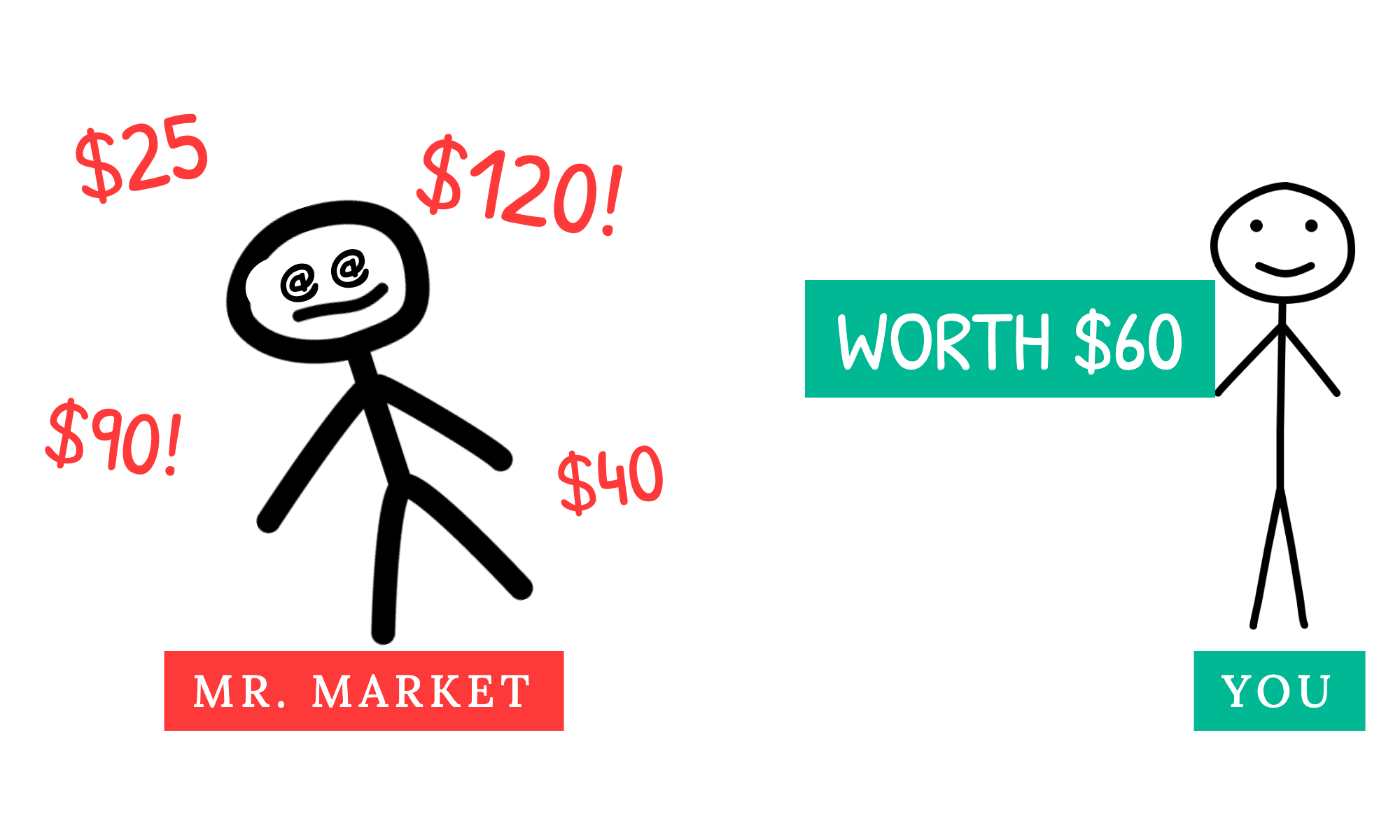
📖 The Psychology of Owning Stocks
🖍️ Highlight
2020 Meeting (02:11:20)
Warren Buffett: “I’m not recommending that people buy stocks today, tomorrow, next week, or next month. It all depends on your circumstances. You shouldn’t buy stocks unless you expect, in my view, to hold them for a very extended period, and you are prepared financially and psychologically to hold them the same way you would hold a farm and never look at a quote—you don’t need to pay attention to it. You’re not going to pick the bottom and nobody else can pick it for you. You’ve got to be prepared when you buy a stock to have it be down 50% or more and be okay with it, as long as you’re comfortable with the business.
“There have been three times in Berkshire’s history when the price of Berkshire stock went down 50%. If you held it on borrowed money, you could have been cleaned out. There wasn’t anything wrong with Berkshire when those three times occurred. But if you’re going to look at the price of the stock and think that you have to act because it’s doing this or that or somebody else asks you, ‘How can you stay with that when something else is going up?’ ... You’ve got to be in the right psychological position. And frankly some people are more subject to fear than others. It’s like the virus [Covid-19]. It strikes some people with much greater ferocity than others.
“Fear is something I really never felt financially, and I don’t think Charlie’s felt it either. Some people can handle it. If you can’t handle it psychologically, then you really shouldn’t own stocks because you’re going to buy and sell at the wrong time. And you should not count on somebody else telling you. You should do something you understand yourself. If you don’t understand it yourself, you’re going to be affected by the next person you talk to. You should be in a position to hold. I don’t know whether today is a great day to buy stocks. I know it will work out over twenty to thirty years. I don’t know if it will work over two years.”
[📝 Note]
Market returns are never free and never will be. They demand you pay a price, like any other product... The volatility fee—the price of returns—is the cost of admission to get returns greater than low-fee parks like cash and bonds. The trick is convincing yourself that the market’s fee is worth it.
— Morgan Housel, The Psychology of Money.
And no one else can summarize this better than Seneca…
“Many are harmed by fear itself, and many may have come to their fate while dreading fate.”
📖 Corporate Finance Theories
🖍️ Highlight
2018 Meeting (04:24:52)
Charlie Munger: “I finally figured out why the teachers of corporate finance often teach a lot of stuff that’s wrong. When I had some eye troubles early in life, I consulted a very famous eye doctor. And I realized his place of business was doing a totally obsolete cataract operation. They were still cutting with a knife after better procedures had been invented.
I said, ‘Why are you in a great medical school performing absolute obsolete operations?’ And he said, ‘Charlie, it’s such a wonderful operation to teach.’
That’s what happens in corporate finance. They get these formulas, and it’s a fine teaching experience. You give them a formula, you present the problem, they use the formula. You get a real feeling of worthwhile activity. There’s only one trouble: It’s all balderdash.”
Warren Buffett: “Whenever you hear a theory described as elegant, watch out.”
[📝 Note]
In Antifragile, Nassim Nicholas Taleb recalls arriving at his first foreign-exchange trading job fresh from an Ivy League education, only to find that the traders making money knew almost nothing of what he had studied. “My intellectual world was shattered,” he wrote, “as if everything I had studied was not just useless but a well-organized scam.”
📖 Market Timing
🖍️ Highlight
1994 Meeting (01:40:20)
Warren Buffett: “You may have trouble believing this, but Charlie and I never have an opinion about the market, because it wouldn’t be any good and it might interfere with the opinions we have that are good. If we’re right about a business, and we think it’s attractive, it would be very foolish for us to not take action because we thought something about what the market was going to do or anything of that sort. Because we just don’t know. And to give up something that you do know and that is profitable for something that you don’t know and won’t know, it just doesn’t make any sense to us. It doesn’t really make any difference to us.
“I bought my first stock in April of 1942 when I was eleven. The prospects for World War II didn’t look so good at that time; the U.S. was not doing well in the Pacific. I’m not sure I calculated that into my purchase of my three shares, but just think of all the things that have happened since then. Atomic weapons, major wars, presidents resigning, massive inflation at certain times, all kinds of things. To give up what you can do well at because of guesses about what’s going to happen in some macro way just doesn’t make any sense to us.
“The best thing that can happen from Berkshire’s standpoint—we don’t wish this on anybody—is, over time, to have markets that go down a tremendous amount. We are going to be buyers of things over time. And if you’re going to be buyers of groceries over time, you like grocery prices to go down. If you’re going to be buying cars over time, you like car prices to go down. We buy businesses. We buy pieces of businesses, stocks. And we’re going to be much better off if we can buy those things at an attractive price than if we can’t. So, we don’t have any fear at all. What we fear is an irrational bull market that’s sustained for some long period of time.
“You, as shareholders of Berkshire, unless you own your shares on borrowed money or are going to sell them in a very short period of time, are better off if stocks get cheaper, because it means that we can do more intelligent things on your behalf than would be the case otherwise. But we wouldn’t care what anybody thought about it, most of all ourselves.”
Charlie Munger: “If you’re agnostic about those macro factors and therefore devote all your time to thinking about the individual businesses and the individual opportunities, it’s just a way more efficient way to behave, at least with our particular talents and lack thereof.”
Warren Buffett: “If you’re right about the businesses, you’ll end up doing fine…”
[📝 Note]
It is easier to macrobullshit than to microbullshit.
— Nassim Taleb, Incerto.
📖 Gold as a Store of Value
🖍️ Highlight
2005 Meeting (03:29:53)
Warren Buffett: “Gold would be way down on my list as a store of value. I would much prefer owning a hundred acres of land here in Nebraska, or an apartment house, or an index fund. If you go back to 1900, you were talking $20 gold; it went from $20 to $400 over 100 years. The Dow went from 66 to 12,000 in that same period, and paid you dividends during the time you owned it … In the meantime, if you owned the gold, you paid insurance and perhaps some storage cost. It really isn’t a store of value.
“I’m not arguing for paper money, but if you’re worried about paper money—and I think it makes a lot of sense to worry about paper money over long periods of time—gold is just about the last thing I’d want to own under those circumstances. A farm has utility, an apartment has utility, a business will produce earnings. Some businesses will produce them in real terms as they go along. I would rather have the ability to sell people a pound of candy twenty years from now. And if they’re dealing in seashells, I’ll get an appropriate number of seashells instead of paper money for it. But I don’t see gold as a store of value. The truth is it hasn’t worked very well; I see no reason why it should work well in the future.”
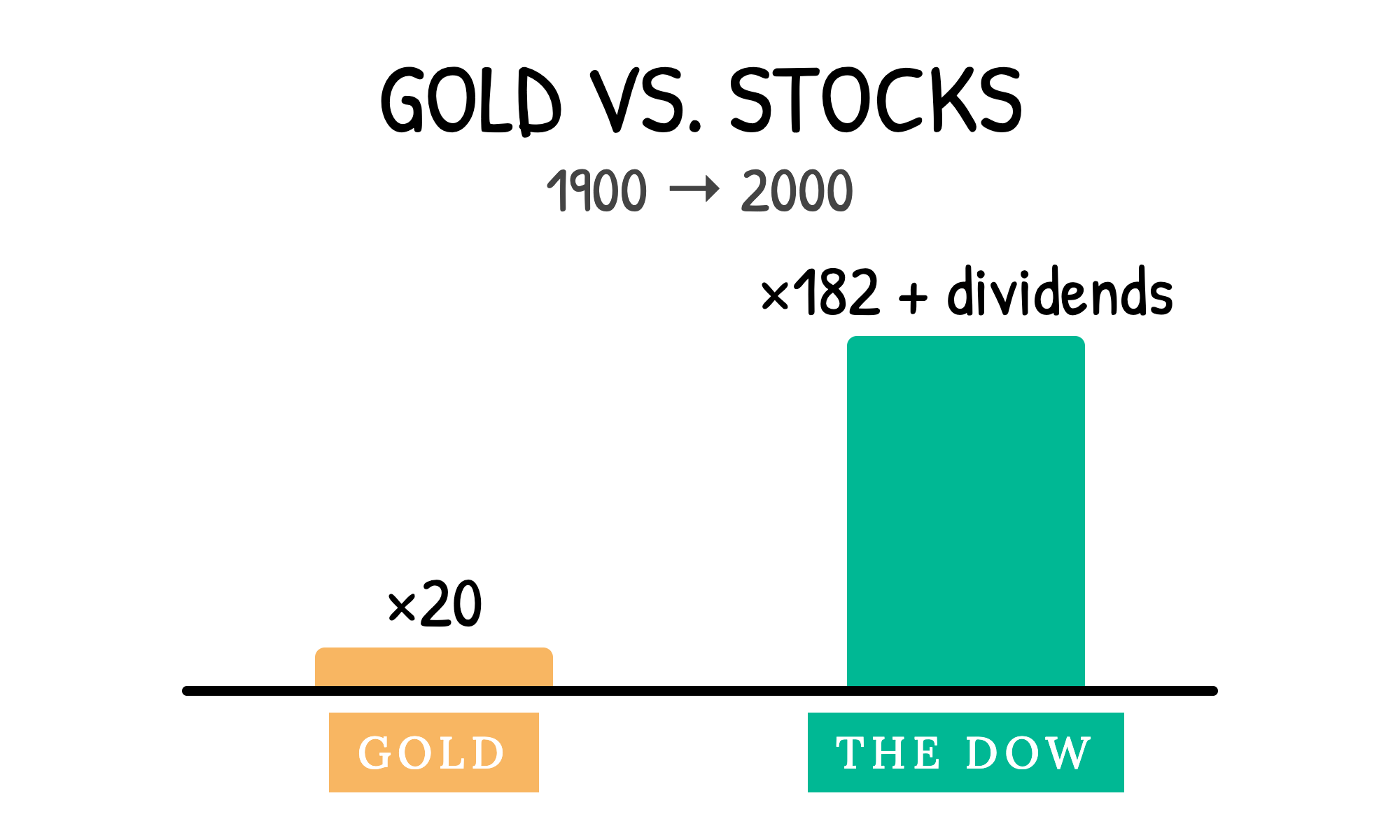
📖 Important and Knowable
🖍️ Highlight 1
1998 Meeting (00:54:40)
Warren Buffett: “We are just looking for decent businesses. We try to think about two things: things that are important and things that are knowable. Now, there are things that are important that are not knowable. In our view, the questions that you raised [about macroeconomic developments] fall in that. There are things that are knowable but not important. We don’t want to clutter our minds up with those. So, we say, ‘What is important and what is knowable? And what among the things that fall within those two categories can we translate into some kind of an action that is useful for Berkshire?’
“We do think we know something about what Coca-Cola, Gillette, Disney, and our operating subsidiaries are going to look like in ten years. We care a lot about that; we think a lot about that and we want to be right about that. If we’re right about that, other things are less important. And if we started focusing on those other things, we would miss a lot of big things.
“Coca-Cola went public in 1919. A share cost $40. And the first year it went down a little over 50%, to $19 per share. There were some problems with bottler contracts, various kinds of problems. If you’d had perfect foresight, you would have seen the world’s greatest depression staring you in the face, when the social order even got questioned. You would have seen World War II, you would have seen atomic bombs and hydrogen bombs. You would have seen all kinds of things. And you could always find a reason to postpone why you should buy that share of Coca-Cola. But the important thing was to see they were going to be selling one billion eight-ounce servings of beverages a day this year, or some large number. And that the person who could make people happy a billion times a day around the globe ought to make a few bucks off doing it. And so that $40, which went down to $19, has to be worth well over $5 million now with dividends reinvested. If you developed a view on other subjects that in any way forestalled you acting on this more important, specific narrow view about the future of the company, you would have missed a great ride. So that’s the kind of thing we focus on.”
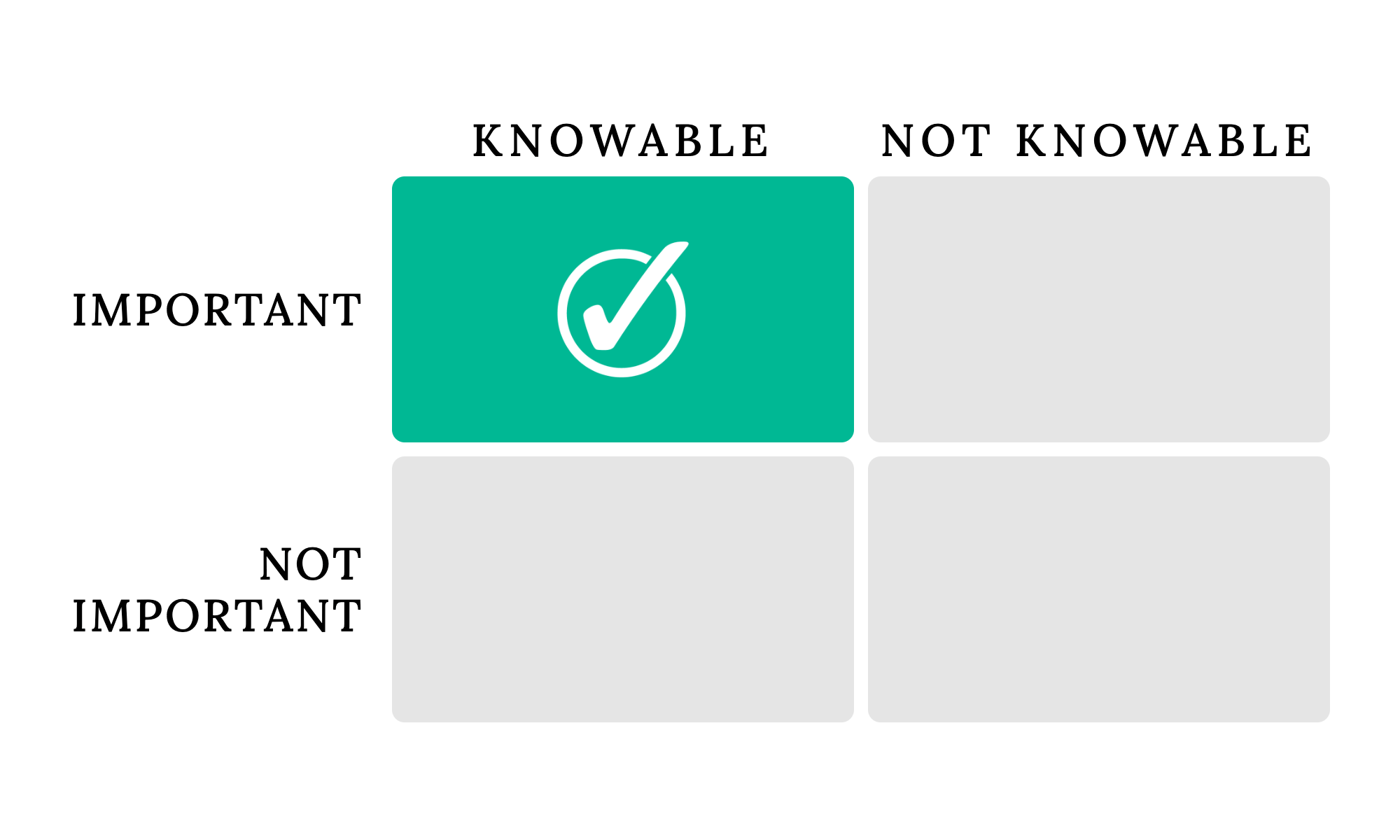
🖍️ Highlight 2
1999 Meeting (02:20:04)
Warren Buffett: “ … If we’re right about the business, the macro factors aren’t going to make any difference. And if we’re wrong about the business, macro factors are not going to bail us out.”
📖 Lesson Learned from See’s Candies
🖍️ Highlight
2003 Meeting (01:46:16)
Charlie Munger: “I think there’s some mythology in this idea that I’ve been this great enlightener of Warren Buffett. He hasn’t needed much enlightenment, but we both kept learning all the time, so that the men we were five years earlier were less sensible than the men who ultimately were there. And See’s Candies did teach us both a wonderful lesson. “If See’s Candies had asked $100,000 more, Warren and I would’ve walked; that’s how dumb we were at that time. And one of the reasons we didn’t walk is that, while we were making this wonderful decision to not pay a dime more than $25 million, [Munger’s friend] Ira Marshall said to us, ‘You guys are crazy. There are some things you should pay up for. You’re underestimating quality.’ And, Warren and I, instead of behaving the way people do in a lot of places, listened to the criticism. We changed our minds. That is a very good lesson: the ability to take criticism constructively. Think of all the money we made from accepting that one criticism. If you count the indirect effects from what we learned from buying See’s, you can say Berkshire’s been built, partly, by learning from criticism. Now, we don’t want any more today.”
[📝 Note]
My characterization of a loser is someone who, after making a mistake, doesn’t introspect, doesn’t exploit it, feels embarrassed and defensive rather than enriched with a new piece of information, and tries to explain why he made the mistake rather than moving on.
— Nassim Nicholas Taleb, Antifragile
📖 Pricing Power and Inflation
🖍️ Highlight 1
2005 Meeting (00:53:44)
Warren Buffett: “We like buying businesses where we feel that there’s some untapped pricing power. Back in 1972, when we bought See’s Candies, I think it was $1.95 a pound. And they were selling 16 million pounds of candy a year, making $4 million pre-tax against our $25 million purchase price, which I very foolishly refused to budge on, and which would have cost us a lot of money.
“But one of the questions we asked ourselves, and we thought the answer was obvious, was if we raised the price $0.10 a pound, would sales fall off a cliff? And the answer, in our view at least, was no, there was some untapped pricing power. It’s not a great business when you have to have a prayer session before you raise your prices a penny; you are in a tough business then. And I would say you can almost measure the strength of a business over time by the agony they go through in determining whether a price increase can be sustained ... You can learn a lot about the durability of the economics of a business by observing the price behavior.”
[📝 Note]
Another example of pricing power from Nvidia…
A lesser-known advantage is pricing power.
Nvidia doesn’t believe in building commodity products, because commodities are subject to downward pricing pressure as competition increases.
Jensen has always said that we should be doing things that other people cannot.
We need to bring unique value to the marketplace. (by doing work that is cutting edge and revolutionary)
We don’t have the culture of just going after market share. We would rather create the market.
— Tae Kim, The Nvidia Way (2024), p. 213. Quoting Nvidia executive Jay Puri.
🖍️ Highlight 2
2011 Meeting (03:09:00)
Warren Buffett: “The businesses that will perform best during inflation are the ones that require little capital investment to facilitate inflationary growth and which have strong positions that allow them to increase prices with inflation. At See’s Candies, the value of the dollar since we bought that business has probably fallen at least 85%.
“That business sells 75% more pounds of candy than it did when we bought it, but it has ten times the revenues and it doesn’t take a lot more capital. Any business that has enough freedom to price to offset inflation without huge investment to support it will do well.”
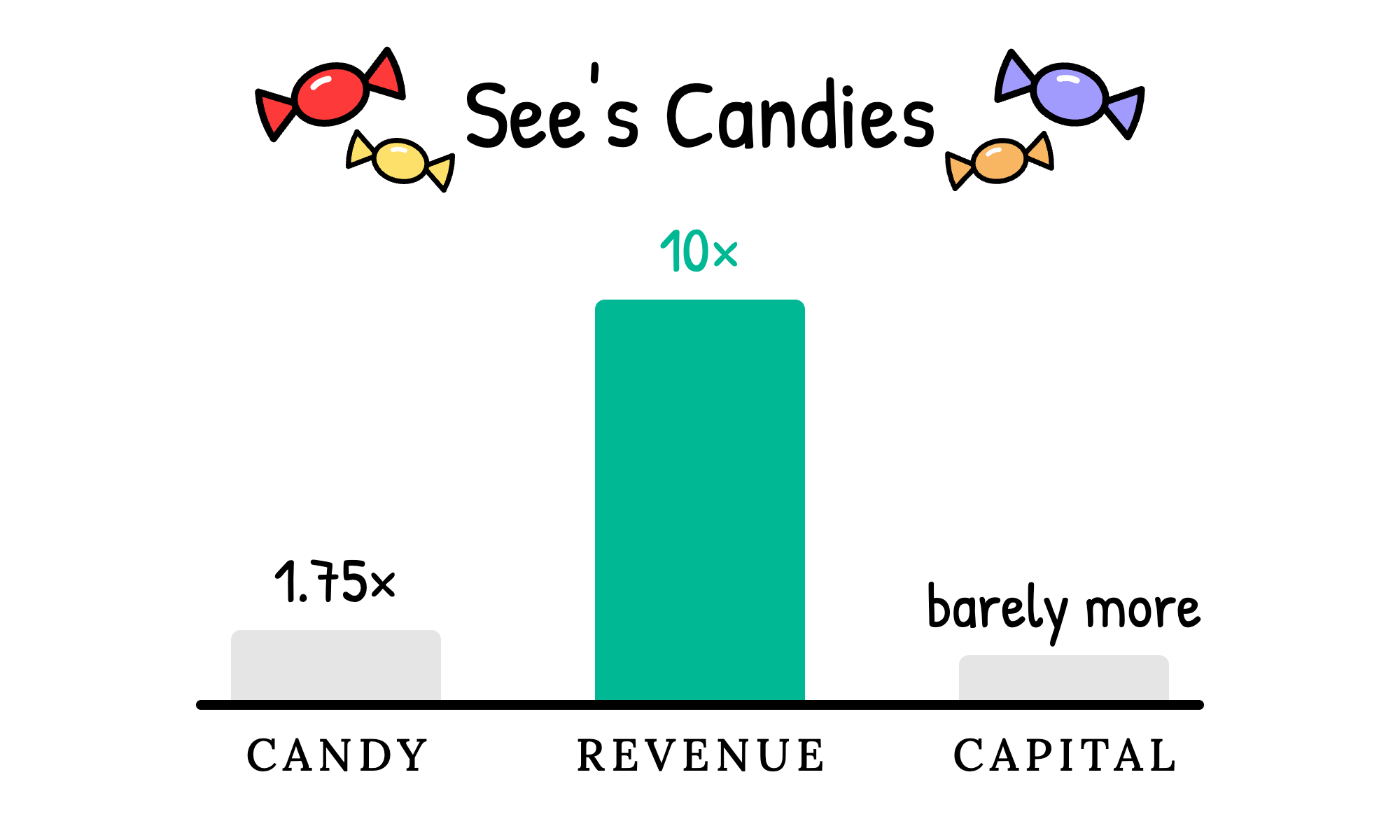
📖 Observing What’s Really Happening
🖍️ Highlight
1997 Meeting (04:23:50)
Charlie Munger: “I love your example of State Farm. Picking some extreme example and asking my favorite question, ‘What in hell is going on here?’ is the way to wisdom in this world. A lot of the mutual companies are now trying to demutualize, helped by a bunch of consultants and so forth. And they are not looking at State Farm, they’re looking at some other model. Everybody can’t be a State Farm. That place got some fundamental values into its operating mechanics, the way it selected personnel, the way it selected agents, the way it discarded agents. It was huge discipline in that operation.”
Warren Buffett: “Yeah, you would say somebody had to do something very right. But I don’t know anybody studying what they did that was right. They don’t want to because it doesn’t fit the pattern. When something like a State Farm or a GEICO happens in this world, you should try to understand it.
“In 1948, I think two-thirds of GEICO was for sale because the fellow who had originally backed these two people from USAA died, and so they had the stock for sale. You couldn’t sell it. That’s how Ben Graham ended up buying it for Graham-Newman, because they [tried to sell it] for six months. They went to all the big insurance companies, and those companies, who could see this company on a very, very tiny scale offering a product for way less money and making lots of money doing it, simply couldn’t shake themselves loose from the myths of the past to buy it.
“They could’ve bought the whole company for $1.2 million, as I remember. Instead, they’ve watched their own distribution system get their heads beaten in over the years. And all the time with these ideas from the past. So, you have to be very careful to look hard at what’s really happening. As Yogi Berra said, ‘You can observe a lot just by looking.’”
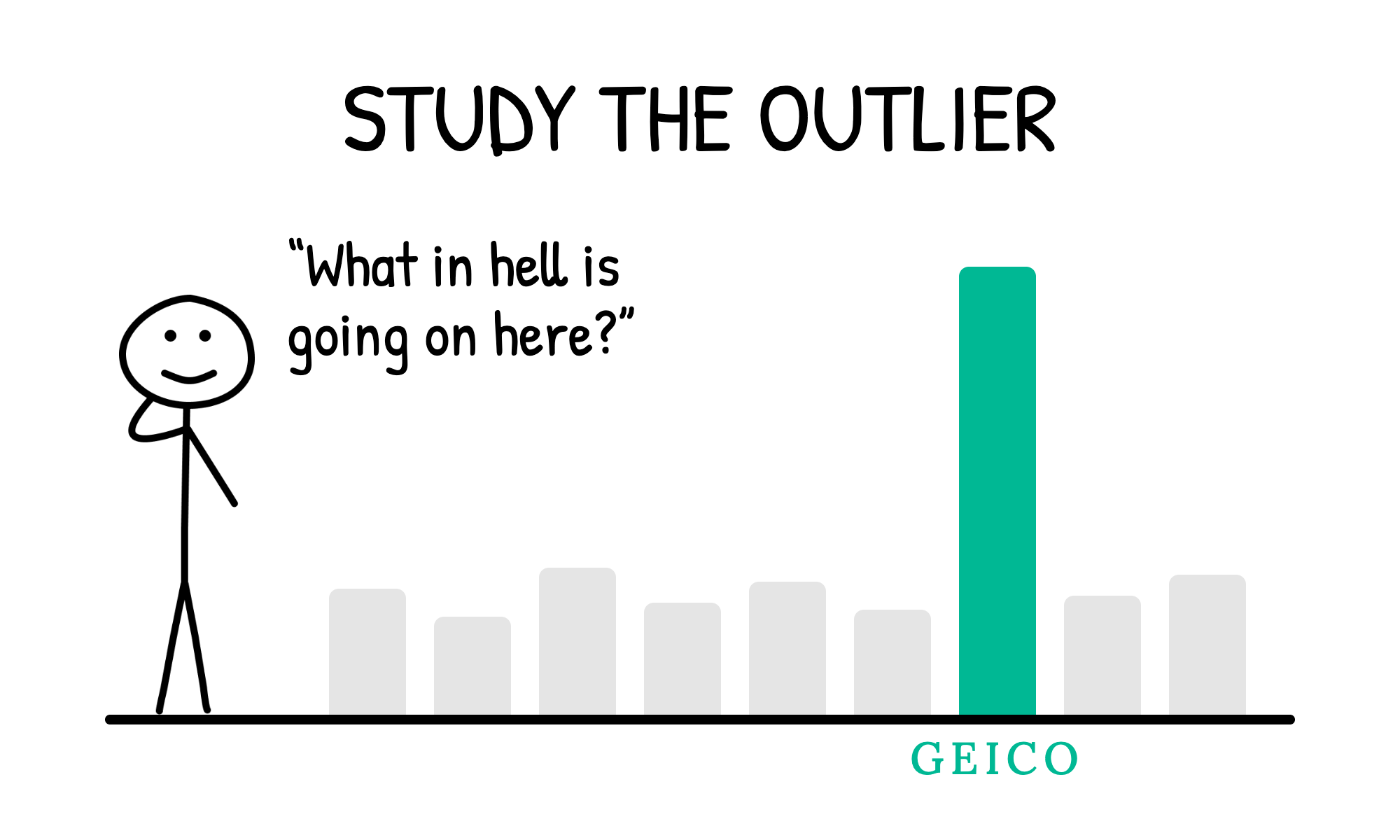
[📝 Note]
The word “anomaly” I have always found interesting—what it means is something that the academicians could not explain.
And rather than re-examine their theories they simply just discarded any evidence of that sort as “anomalous”.
I mean… Columbus was an “anomaly.”
I think when you find information that contradicts previously cherished beliefs… You’ve got a special obligation to look at it and look at it quickly.
I think Charlie [Munger] told me that one of the things [Charles] Darwin did was that whenever he found out anything that contradicted some previous belief, he knew he had to write it down almost immediately because he felt that the human mind was conditioned—so conditioned—to reject contradictory evidence that unless he got it down in black and white very quickly his mind would simply push it out of existence.
— Warren Buffett, 1998 Berkshire Hathaway Annual Meeting.
One of the basic lessons Sam Walton learned at JC Penney was not to be so smug you ignored your competitors, especially their successful policies and practices. “If they had something good, we copied it,” Sam always said with total candor.
— Sam Walton: The Inside Story of America's Richest Man (1990), by Vance H. Trimble.
📖 Ben Graham and GEICO
🖍️ Highlight 1
2023 Meeting (02:18:44)
Charlie Munger: “Ben Graham was a really gifted teacher, a very honorable profession. That is what has lasted. However, an interesting fact that Graham was sheepish about in his old age was that more than half of all the investment return that Ben Graham made in his whole life came from one growth stock, GEICO. At the time that he operated, there were a lot of sort of lousy companies that were too cheap, and you could make a little money floating from one to another, but the big money he made was in one growth stock, GEICO. Buying one undervalued great company is a very good thing, as Berkshire has found out again and again and again.”
Warren Buffett: “And Ben wrote a postscript to the 1949 edition of The Intelligent Investor pointing out exactly that fact, acknowledging it. He took some good lessons from it. That’s the way life is; you prepare and you don’t lose everything along the way, and then something comes along.
“GEICO came along because a banker in Fort Worth had financed Leo Goodwin, and I think the banker got three quarters of it. As I remember, it was for $1.25 million or $1.5 million. It almost fell apart because of a difference of $25,000 in the net worth delivered. This is a business that’s now worth tens of billions. But he pointed out the irony in that, too.
“He was totally intellectually honest about the failings, but also the strengths of his approach. Charlie and I have seen that in our lives. The prepared mind, the willingness to act when you need to act ... It’s one or two things that make the right decision ... The thing to do is just keep trying to think things through and not do too many stupid things. Sooner or later, you have a lollapalooza, as Charlie would say.”