


👋 Hey friend,
In this blog post, I share 12 key ideas — with direct quotes from the book — I learned from reading the book Never Enough: From Barista to Billionaire, by Andrew Wilkinson.
This book is Andrew’s personal journey from growing up in a middle-class family to becoming one of Canada’s richest people in his 30s.
I wasn’t thinking of doing a blog post on this book, but I got sooo many great insights that I thought it would be useful to others if I make it.
The ideas are listed chronologically, following Andrew’s journey as he grows up.
By the way, I also made it into a 🎧 podcast episode (with synced transcription on-screen). So if you prefer to listen, open any of the following links to listen on your favorite podcast app → YouTube / Spotify / Apple Podcasts (alternatively, you can directly search the podcast show “Julio’s Almanack.”) P.S. The podcast has only 11 insights because I accidentally skipped insight #2 😂
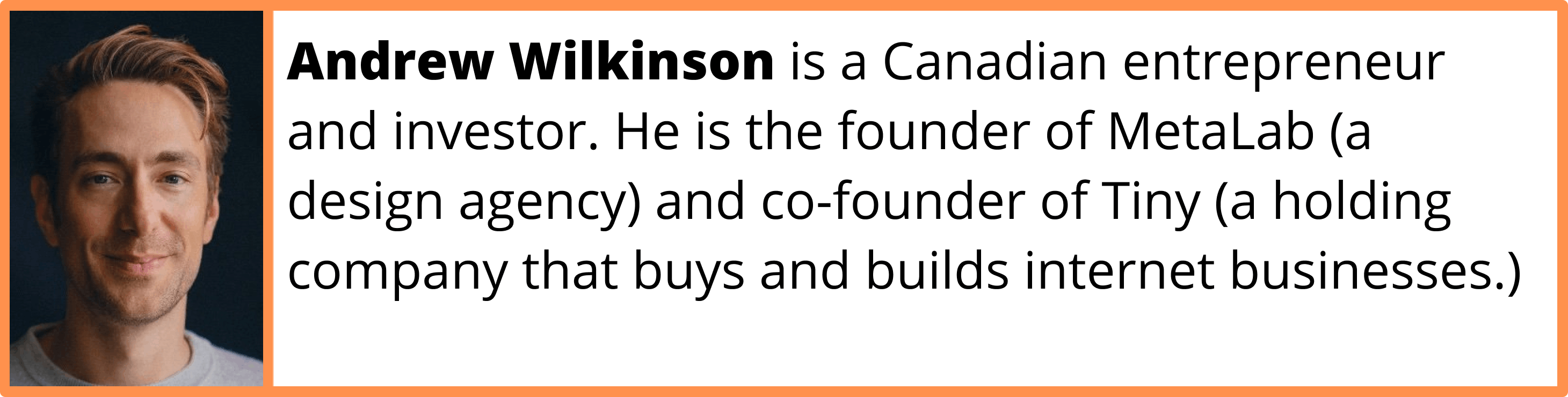
👤 Andrew Wilkinson
💡Idea #1: The Advantage of Being Lazy
In this part of the book, Andrew is a kid living with his two brothers in his parents’ house in Vancouver, Canada.
🟠 Andrew Wilkinson:
We were expected to do some basic chores. Nothing crazy, but I hated chores and I’d do almost anything to avoid them.
My brothers and I would rotate dishwashing duties, having to clear the table and wash the dishes one night each week.
Even as a child, I noticed how much time and work it took for one person to clear the table, scrape the plates, load the dishwasher, and hand-wash the remaining pots and pans.
“What if we all just cleared our own plates then stack them next to the sink?” I proposed during one night of dish duty. “It would be thirty seconds of work for everyone, but it would make this go way faster.”
My parents just laughed and refused, thinking I was trying to weasel out of my responsibilities.
It infuriated me. It made no sense. It would make it go twice as fast. A little assembly line. A massive efficiency gain.
Looking back, I realize that the same qualities that made me a lazy brat as a kid ended up being the ones that made me a successful entrepreneur. As Bill Gates put it: “I choose a lazy person to do a hard job. Because a lazy person will find an easy way to do it.”
For as long as I can remember, I wanted to do things the easy way. To have control. To grab the wheel and make things work better. To this day, if anyone tells me what to do—no matter how reasonable—I will dig my heels in and resist, flashing back to being a kid.
And when I read this passage I remembered a great line from Robert Heinlein where he said: “Progress isn’t made by early risers. It’s made by lazy men trying to find easier ways to do something.”
And actually Bill Gates has publicly credited Robert Heinlein’s novels for influencing his thinking. So I don’t think it’s a coincidence that they share the same idea here.
At its core, I think the benefit of being lazy is that it makes you re-think the problem from scratch, in order to find a more simple and efficient way to solve it. Or you might even conclude that the problem is not even worth solving because is not ultimately adding value to the customer. As Elon Musk says: “The most common error of a smart engineer is to optimize a thing that should not exist.”
💡Idea #2: Don’t Rest in Your Laurels
🟠 Andrew Wilkinson:
Dad was constantly encouraging me to start little businesses. When I started a lemonade stand and told him, proudly, about how I’d raked in $40, he asked me, “What’s next?” I’d looked at him, perplexed. “Okay, think about it, let’s say you make $10 an hour selling lemonade. That means you could pay another kid $5 an hour, have them run the stand, and then use your profits to go start another one. And another. And another.”
His constant questions sparked a habit that would benefit me massively in business. After any win, I’d hear Dad’s voice echoing in my head: “What’s next?” Instead of allowing myself to relax and enjoy what I had—to celebrate an achievement or take a vacation after a long sprint at work—I’d instead wonder how to do it again, but bigger and better and more efficiently.
This workaholic but enjoyable habit made me highly adaptive in business but created an inability to relax or run in place. It created a fortune but pushed me into emotional overdraft.
Naval Ravikant captured this beautifully when he said:
“Happiness is being satisfied with what you have.
Success comes from dissatisfaction.
Choose.”
💡Idea #3: Business is About Solving Problems for Other People
Andrew is a twelve-year-old kid and he is obsessed with Apple products.
He hangs around the electronics store and he is sort of an unofficial employee — helping customers decide which computer to take home.
At some point, an elderly woman asks him to come to her house and help her with her newly-bought Mac computer. And she’s willing to pay him $20 an hour.
Andrew accepts and he quickly starts his first company, where he would offer this technical support service to elderly individuals in the electronics store.
🟠 Andrew Wilkinson:
That first company, with its half-a-dozen elderly customers, taught me one of the most important lessons of my life so far: that a business, even one run by a twelve-year-old, was at its core about solving problems for other people. Until then, I thought that a job, or a business, was something that was dictated to you. There were set paths: as a teenager, you could work at McDonald’s, or babysit, or do a paper route. I slowly came to realize that almost any need, problem, or desire can be turned into a business of its own.
Related to this idea, there’s a passage from Paul Graham which complements it very well.
🟠 Paul Graham:
Someone graduating from college thinks, and is told, that he needs to get a job, as if the important thing were becoming a member of an institution. A more direct way to put it would be: you need to start doing something people want. You don’t need to join a company to do that. All a company is is a group of people working together to do something people want. It’s doing something people want that matters, not joining the group.
For most people the best plan probably is to go to work for some existing company. But it is a good idea to understand what’s happening when you do this. A job means doing something people want, averaged together with everyone else in that company.
👉 Book: Hackers and Painters, by Paul Graham.
Brad Jacobs, who has scaled 8 different businesses to over a billion dollars in market cap, also has an interesting take on how problems are actually opportunities to create value.
He learned this lesson while he was having lunch with his mentor Ludwig Jesselson.
🟠 Brad Jacobs:
At one memorable lunch, I arrived burdened with problems that I began to unload on him. Mr. Jesselson listened carefully—he was good at that—and waited until I had run out my string. Then he put down his fork, turned to me, and in his thick German accent said, “Look, Brad, if you want to make money in the business world, you need to get used to problems, because that’s what business is. It’s actually about finding problems, embracing and even enjoying them—because each problem is an opportunity to remove an obstacle and get closer to success.”
In that moment, I learned something invaluable: Problems are an asset—not something to avoid but something to run toward.
👉 Book: How to Make a Few Billion Dollars, by Brad Jacobs.
By the way, if you want a great way to discover new books and learn their key ideas, I use a book summary app called Shortform, which has a library of over 10,000 books.
I’ve been using Shortform for the past 4 years, and I use it often when I don’t have enough time to properly get into a book — for instance, when I only have 20 minutes while commuting somewhere or I’m sitting in a restaurant waiting for the food.
Plus, it helps me spend less time scrolling X and Instagram reels, and instead use that time for learning!
Their summaries cover the big ideas of a book, connect them with ideas from other books (this is great for discovering new titles and expanding your knowledge on the topic), and include interactive exercises to help you apply what you learn.
You can also listen to the summaries (with the audio version) or download them as PDFs to read offline.
Authors like Mark Manson, James Clear, and Sahil Bloom have also recommended Shortform.
Because I use Shortform and it’s a great fit for readers of my blog, I reached out to them and they agreed to give us a 20% discount on the Annual Subscription by signing up with this link! (You also get a 5-day free trial).
💡Idea #4: There’s No Harm in Asking
In this part of Andrew’s journey, he and three other teenagers are running a website where they write about the latest news on Apple products.
🟠 Andrew Wilkinson:
The next summer, I sent a one-line email that would change my life. I had saved up enough money to travel to Mecca for Apple nerds—the Macworld conference in New York—where Steve Jobs usually launched Apple’s new products.
I sent an email to my contacts on the Apple PR team:
“I’m going to be at Macworld next week and was hoping to interview Steve. Possible?”
I knew this was bold. I was a nobody. Interviews were typically doled out to Newsweek and the Wall Street Journal, not tiny websites run by kids.
A few minutes later, I got a reply:
“Steve’s schedule is too hectic, but I can get you in for a group tour of the new Apple Store in Soho?”
I was shocked. I’d expected to get fully shut down or not even get a reply, and now I was getting a behind-the-scenes tour of their first ever Apple Store, which nobody had seen the inside of yet.
While I was upset that I wouldn’t get to meet Steve Jobs, I realized something important. I had asked for something amazing and gotten something great in exchange. If I’d asked for a tour of the Apple Store, I probably would have gotten a “nice try, kid,” but by shooting for the moon and asking for something that was hard to give, I was met with a compromise that was better than I could have hoped for. It’s a strategy I went on to use throughout my career: there’s no harm in asking.
This idea of asking for the moon reminded me a story about Cristopher Columbus that I read on the book The 48 Laws of Power, written by Robert Greene.
(For context, Columbus had just married into an established Lisbon family that had excellent connections with Portuguese royalty.)
🟠 Robert Greene:
Through his in-laws, Columbus finagled a meeting with the king of Portugal, João II, whom he petitioned to finance a westward voyage aimed at discovering a shorter route to Asia. In return for announcing that any discoveries he achieved would be made in the king’s name, Columbus wanted a series of rights: the title Grand Admiral of the Oceanic Sea; the office of viceroy over any lands he found; and 10 percent of the future commerce with such lands. All of these rights were to be hereditary and for all time.
Columbus made these demands even though he had previously been a mere merchant, he knew almost nothing about navigation, he could not work a quadrant, and he had never led a group of men. In short he had absolutely no qualifications for the journey he proposed. Furthermore, his petition included no details as to how he would accomplish his plans, just vague promises.
When Columbus finished his pitch, João II smiled: He politely declined the offer, but left the door open for the future. Here Columbus must have noticed something he would never forget: Even as the king turned down the sailor’s demands, he treated them as legitimate. He neither laughed at Columbus nor questioned his background and credentials. In fact the king was impressed by the boldness of Columbus’s requests, and clearly felt comfortable in the company of a man who acted so confidently. The meeting must have convinced Columbus that his instincts were correct: By asking for the moon, he had instantly raised his own status, for the king assumed that unless a man who set such a high price on himself were mad, which Columbus did not appear to be, he must somehow be worth it.
👉 Book: The 48 Laws of Power, by Robert Greene.
So this idea of shooting for the moon is highly effective because
(1) it raises your own status
and (2) makes the other person compromise in giving you something in-between what you asked and what you actually expected.
This strategy can also be applied to goals in general. As Mathew McConaughey said in The Diary of a CEO Podcast:
“Shooting for an A and making a C, it’s better than shooting for a C and making an F.
So, go for perfection. Reality always comes in under it.”
Let’s go back to Andrew.
Once he graduates from high school, he goes to University to study Journalism. But after a few months and disappointed with the lectures, he drops out.
So he goes back to his parent’s house and starts working in a coffee shop as a barista. There he met two customers who would come to the coffee shop everyday and work from their laptops. Andrew started asking questions about what they did. They tell him they run a small design agency called The Number building websites for local businesses…
🟠 Andrew Wilkinson:
They were more than happy to share the secret of their success, and as they broke it all down, I couldn’t believe my ears. They told me they were able to do three to four projects at a time, and that they charged five to ten thousand dollars per website. By my almost-failed-junior-year math, that was twenty to forty thousand dollars per month in revenue. A veritable fortune compared to my $1,500 a month barista paycheck.
So this motivated Andrew to learn to code and design websites.
At first, he was doing the coding and design all by himself, but as demand grew he set up an agency called Metalab and hired people to do the coding and design, while Andrew would allocate his energy into finding and signing new customers.
Here, we see again his strategy that there’s no harm in asking…
🟠 Andrew Wilkinson:
I started to cold-email CEOs of startups that had just raised ungodly sums from venture capital.
I had a simple insight: most CEOs checked their own emails, and it was easy to guess their email addresses.
What did I have to lose? Whenever I saw a company announce a big raise on TechCrunch, I’d figure out the CEO’s email and contact them.
With the confidence that only a one-line email can convey, I’d send mysterious messages like,
“Hey, big fan of your business. Would love to work together.”
Believe it or not, these random cold emails—most of which took me less than a minute to send out—ended up winning some of MetaLab’s biggest clients and helped me build friendships with some of the most successful people in business.
💡Idea #5: Most People Hate Risk
While Andrew is running his agency Metalab, he secretly wonders why his employees didn’t go and do this themselves — that is, to start an agency selling other people’s time instead of selling their own time for money. And eventually he realized why this was the case…
🟠 Andrew Wilkinson:
I soon realized that it was often due to their desire for certainty. While I’d wanted to shove aside every boss I’d worked for and grab the wheel, I realized that most people abhorred risk. They wanted safety and security. A steady salary and rails—things I had none of. I was perpetually a month away from going broke and constantly pouring my profits into hiring new people, signing scary-looking contracts full of terms I didn’t understand with companies that could sue me into the Stone Age should they so choose, and guaranteeing credit lines personally. Risk, in this case, equaled reward.
💡Idea #6: Be the Only One in Your Category
🟠 Andrew Wilkinson:
I started to set MetaLab apart from other agencies by focusing exclusively on designing digital products like mobile and web apps.
I started calling us an “interface design firm,” which I thought sounded sophisticated. “We’re the top interface design firm in North America,” I would tell a throng of startup founders in a packed bar at the SXSW conference, as I took a swig from my cheap American beer, not mentioning that I had made up this label and we were likely the only interface design firm in North America because there simply weren’t any others.
I hadn’t realized it, but this ability to sell and market is what started to really set me apart from my competition. I had reasonable taste and design sense, but my time as a barista had taught me how to make friends with just about anyone.
Most of my competitors—folks who ran agencies—were nerdy programmers who looked at their shoes when talking to a potential new client. My sales technique was simple: be fun to drink with and ask a ton of questions about whomever I happened to be talking to. It worked surprisingly well. At conferences, I quickly started to learn that the most important business connections were made in bars, gossiping with drunk executives. Buying a round of drinks often generated a huge return on investment. For instance, there was a big Facebook party in Austin, where I got a crowd of startup founders wasted on my credit card. I must have bought a hundred tequila shots that night. It was a monstrous bar bill, but it more than paid for itself a few months later, when they needed design help and one of them (whom I clearly didn’t get drunk enough) remembered my name and reached out to see if my “interface design firm” was accepting new business.
There are two main ideas I took away:
(1) The first has to do with the label that Andrew created. This made his firm look more unique and special, because there was obviously no other firms competing in this niche category of “interface design firm.” I first learnt this idea of being the only one from Kevin Kelly, which he brilliantly captured in this one-liner: “Don’t be the best. Be the only.”
💡Idea #7: Create Goodwill
(2) The second idea is about creating goodwill. When Andrew was inviting the hundred shots of tequila, he was creating a feeling of indebtedness in all of them, which later paid off many times over whatever those tequila shots cost.
Whether consciously or not, reciprocation is a powerful persuasion technique — and it’s one of the seven principles of persuasion that Robert Cialdini discussed on his bestseller book Influence. And as a fun fact, Charlie Munger liked the book so much that he sent a share of Berkshire Hathaway to Cialdini, which he has kept and today is worth over half a million dollars. (After I became aware of this, I immediately bought the book and read it — highly recommended!)
💡Idea #8: Save and Invest
It’s 2008 and the financial crisis had a massive impact on Andrew’s agency MetaLab. He lost all his clients. And Andrew had overspent his income so he was very close to going bankrupt…
🟠 Andrew Wilkinson:
Then, as quickly as it had all come, it was all gone. Almost overnight I went from making seemingly endless profits to making nothing—literally nothing.
A few days later, I went to the grocery store, and after I filled my cart, I had to put items back on the shelf that I couldn’t afford. I left the store that night with a huge bag of potatoes. If I ate a few per day for the next few weeks, I figured those potatoes could get me through bankruptcy. An absurd thought, to be sure, but that was where my head was at.
It was at this point—wandering the fluorescent aisles of a supermarket at night—that I realized how stupid I’d been. I had gotten incredibly lucky, making more money in the past couple of years than I had ever thought possible in a lifetime. I went from mopping the floors of a coffee shop to working with Silicon Valley’s most cutting-edge companies. And yet, I’d somehow spent every single cent I had earned, blowing it on things I didn’t need. I had closets full of clothes I didn’t wear and electronics that were already obsolete. I had shelves displaying fancy liquor I didn’t even like the taste of.
This was my first real slap in the face, the moment I realized that what goes up can also come down and that I had to start learning how to save and invest. I was reminded of my father telling me about the wonders of compound interest as a kid. That if I had just invested all that money instead of buying frivolous nonsense, I could have been set for life.
While many of his competitors went bust, Andrew was able to weather the storm thanks to two things:
The first is an Apple stock that his uncle gave him as a birthday present when he was a kid. He sold it right at the bottom of the crisis for $20,000. If he would have kept it, it would be worth millions today. But he needed the money to keep MetaLab alive.
The second was a new client — a laser hair removal clinic in Arizona. Far from the fancy Silicon Valley clients, but it paid the bills.
🟠 Andrew Wilkinson:
After that brush with death, I vowed that, going forward, I would never spend more than 10 percent of my profits on my lifestyle. Everything else would be saved, invested, or used to start new businesses. I wasn’t going to let this happen again.
And there’s a great line on this from Naval Ravikant, he said:
“People who are living far below their means enjoy a freedom that people busy upgrading their lifestyles can’t fathom.”
💡Idea #9: Anti-goals
At this point, Andrew is running a few businesses and gets an offer from a private equity firm to buy MetaLab for $50 million.
He agrees to sell, and while he and Chris — his business partner — wait for the deal to close, they started reading about Charlie Munger and discovered his mental model of inversion…
🟠 Andrew Wilkinson:
Chris and I had the time and space to reflect on what we wanted our lives to look like going forward. By this time, we had burrowed our way through every book on Warren Buffett and had moved onto his business partner, Charlie Munger. One of his quotes that stuck with us was the constant refrain to “invert, always invert!” Munger said that “problems are often easiest solved in reverse” and explained that it’s much easier to think about what you don’t want than what you do. To think about what you hate, then work backward to optimize your life to avoid the things you disliked being a part of it.
So, we decided to invert. We began by listing our complaints, writing down all the tasks that made us miserable. Long meetings that dragged on. Late-night emails. People who needed constant input and feedback. Packed calendars. Travel that took us away from our kids. The list went on.
We made a list of what we called our “Anti-Goals.” Once Chris and I had itemized everything we hated about our jobs, we spent the next several weeks thinking about how to delegate and structure things so that we weren’t responsible for any of those tasks. Most of our problems were related to issues within our individual businesses. As soon as we hired Brian, it was his job, as interim CEO, to handle all problems relating to MetaLab, and our lives got infinitely easier. So, we figured, we’d hire leaders for each business, and tell them to only call us if it was absolutely necessary. We’d set up a head office, where we’d focus our time on reading, and they could call us only when needed.
My key insight at this time was one that would become the core of how I run my businesses today: It’s not enough to do what you love. You also have to stop doing what you hate. The goal isn’t—as many people think—to not work at all; it’s to only work on things that you enjoy doing. The stuff that you’d do even if you didn’t get paid for it.
One of my favorite authors is Nassim Nicholas Taleb, and in his book Antifragile he has a whole chapter where he talks about this idea that removing is actually more powerful than adding. He calls it via negativa, and the goal is to identify the negative and then avoid it like the plague. The opposite to this is the via positiva, where the goal is to just add new things. Taleb argues that the pros focus on via negativa — on what to avoid — instead of via positiva…
🟠 Nassim Nicholas Taleb:
I have used all my life a wonderfully simple heuristic: charlatans are recognizable in that they will give you positive advice, and only positive advice, exploiting our gullibility and sucker-proneness for recipes that hit you in a flash as just obvious, then evaporate later as you forget them. Just look at the “how to” books with, in their title, “Ten Steps for—” (fill in: enrichment, weight loss, making friends, innovation, getting elected, building muscles, finding a husband, running an orphanage, etc.). Yet in practice it is the negative that’s used by the pros, those selected by evolution: chess grandmasters usually win by not losing; people become rich by not going bust (particularly when others do); religions are mostly about interdicts; the learning of life is about what to avoid.
👉 Book: Antifragile, written by Nassim Nicholas Taleb.
💡Idea #10: The Best Investors Think in Decades
Going back to Andrew, the 50 million dollar deal ends up not working out, because the private equity firm couldn’t come up with the money.
Meanwhile, he spends his time learning about investing from value-investing icons like Warren Buffett, Charlie Munger, Mohnish Pabrai, Peter Lynch, and Bill Ackman.
He even bid $57,000 to win lunch with Bill Ackman, who had auctioned off a one-hour lunch with all proceeds going to charity…
🟠 Andrew Wilkinson:
Sitting at the restaurant, I recalled a piece of advice that Bill had given us over lunch. He told us that the best investors think not in weeks, months, or even years, but in decades. It was important to focus on the long term, not day-to-day vacillations.
And I think this is a very important insight for investors, specially investors in the stock market, because every day the market fluctuates and media outlets come up with whatever reason for why a stock is going up or down. But the key is to ignore all that noise and focus on the fundamentals of the businesses that you own and think in decades, as Bill Ackman advised Andrew and Chris.
💡Idea #11: Invest in What You Know
Another piece of advice they picked up, this time from Peter Lynch, was to “invest in what you know.”
For example, if you drink Starbucks every day, you might want to consider buying Starbucks stock.
(I personally have this rule for investing too. If you’re a consumer of the product, you’ll know if the product starts to suck at some point and sell the stock, or buy more if the product improves. The first time I did this (and bought) was with Spotify. But of course this is just one of the many things I consider before buying a business!)
Andrew says: “We took this to heart, scanning our lives for things to invest in.”
Given Andrew’s experience as a barista, he discovered AeroPress and immediately fell in love with the product.
And if you haven’t heard of AeroPress, it’s a coffee maker that makes extremely high-quality coffee and is mostly sold through specialty coffee shops.
So Andrew and Chris reached out to the inventor of AeroPress, Alan Adler — a teacher of Engineering at Stanford University and serial inventor.
They ended up buying AeroPress for $70 million.
They were confident they could significantly grow the brand through its online store — which, at the time, was barely being exploited.
💡Idea #12: No One is Impressed with Your Possessions As Much As You Are
At this point, Andrew has hundreds of millions of dollars and he discovers a truth of human nature…
🟠 Andrew Wilkinson:
There was something that surprised me about this big lifestyle upgrade. The thing that nobody tells you is that nobody is impressed when you drive a flashy car or show off your crazy house on Instagram. My friend Morgan Housel put it well: “People aren’t thinking: ‘Wow, I’m impressed by this person!’ They’re thinking, ‘I wish I had that house.’”
Or more likely: “What a prick.”
Getting impressive things didn’t win me more friends. At least not the kind I wanted. In fact, it made me more insular. It made me gravitate increasingly to my old friends. My world began shrinking inward to people who knew me before the money—whose intentions I knew I could trust.
Paragraph from The Psychology of Money, written by Morgan Housel:
“Be nicer and less flashy. No one is impressed with your possessions as much as you are. You might think you want a fancy car or a nice watch. But what you probably want is respect and admiration. And you’re more likely to gain those things through kindness and humility than horsepower and chrome.”
And I personally couldn’t agree more with Andrew and Morgan here, but of course when you look around you mostly see people trying to gain status through luxurious items, and I think a big part of that is that it’s beneficial to companies that we try to gain status by buying stuff. I mean, no company out there is gonna make any money if you try to gain status by being kind and humble. So they bombard us with their persuasive marketing to make us believe (almost at a subconcsious level) that we need their fancy stuff in order to be happy and get the admiration of others. Many people say that they buy a Louis Vuitton bag because of the quality, materials, etc. But I’m certain that if tomorrow everybody took this truth of human nature to heart, the bottom line of all these luxury companies would be significantly compressed.
One of my role models here is again Charlie Munger, whom Andrew would meet later in his journey. And one of the things that Andrew noticed about Charlie is that, despite being worth billions of dollars, he was living in a modest house and didn’t carry any luxury items with him…
🟠 Andrew Wilkinson:
Decades earlier, when he had made his first million dollars, he didn’t spend a penny, but instead reinvested every dime while he continued to live off his average annual salary. Things hadn’t changed too much. He told us that, up until the last few years, he had flown to each Costco board meeting economy on Alaska Airlines, despite the fact that Berkshire owned not just one, but a fleet of thousands of private jets via their ownership of NetJets.
When I commented on his green shirt in passing, saying how I liked it, he lit up with excitement, then, gesturing to his shirt, remarked, “I’ve been getting these flannel shirts from L.L. Bean for years. But the last time I checked, they were at $59.95 each! I decided to compare prices at Costco and found a nice flannel shirt for $49.99. My nephew then showed me AliExpress, we compared prices, and found that you can get two packs of flannel shirts for only $34.99!” (We later learned that the massive gold watch he was wearing was actually not gold at all, but a $30 “special” he had proudly found online.)
And of course the other benefit of avoiding this expensive pursuit of status through luxurious stuff is that you can save up more money and invest it. Which will give you more financial freedom. And if there’s any truly valuable thing that money can buy, that is freedom. Freedom to choose how you wanna spend your time, with whom, and in what type of projects…
🟠 Andrew Wilkinson:
For years I’d been writing a daily gratitude journal. One evening, I lifted it from my bedside table, flipped through the pages and found page after page of notes like:
“I’m grateful that I didn’t have to wake up and mop the floors of the café at 5 AM,” or “I’m grateful nobody can tell me what to do.”
I remembered what it felt like to have a boss and to be on someone else’s schedule. I was still that same little kid inside who didn’t want his parents to tell him he couldn’t do this or that (aren’t we all still that kid?). To me, the ultimate luxury was having the ability to cancel all my meetings on a whim and hang out with my kids, just because I felt like it.
After a decade of trying all these things—crazy shopping sprees, sports cars, mansions, and ridiculously expensive boats—I came to a fundamental realization. My ultimate goal was freedom of time and freedom from worry. And, ironically, spending and tending to my expensive toys actually ate into my time and stoked my worries. It was a pyrrhic victory: the supposed win cost me massively.
It’s trite to say, but the old adage rings true: “The things you own end up owning you.”
I highly recommend buying the book!
If you buy it with my Amazon affiliate link I’ll earn a small commission at no extra charge to you :)
And thank you for reading my blog post.
Absolutely enjoyed rakeading it. Resembles my arc in many ways. Felt as if i have written this to myself.
Wow .. nice work